

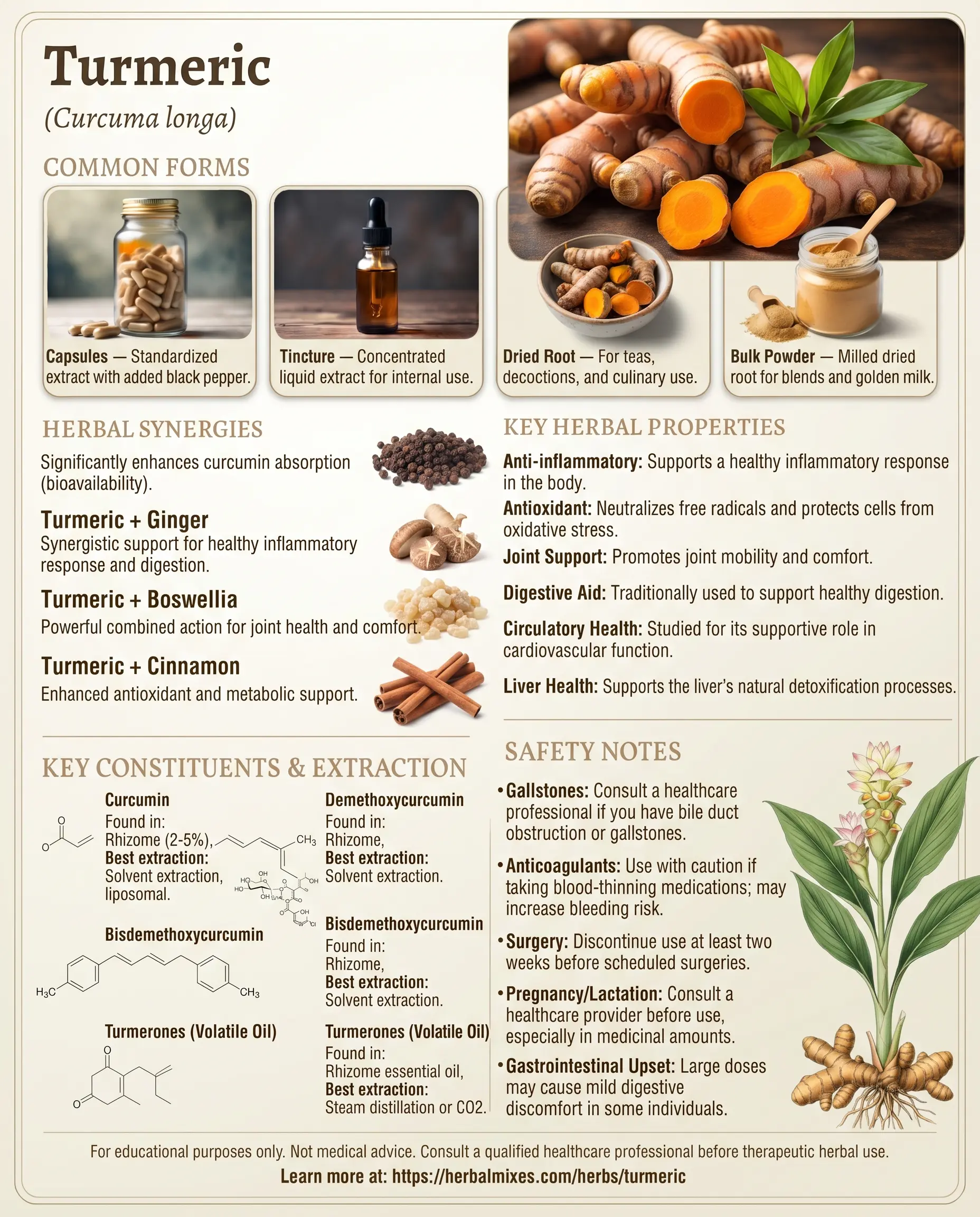
What Turmeric Is Good For
Osteoarthritis pain & stiffness — This is turmeric’s strongest modern clinical use. Multiple randomized trials and meta-analyses suggest curcumin or turmeric extracts can reduce pain and improve function in people with osteoarthritis, especially knee osteoarthritis.
Inflammatory balance — Curcuminoids influence several inflammatory signaling pathways, including NF-κB, COX-related pathways, cytokines, and oxidative stress systems. Human evidence is strongest for musculoskeletal complaints rather than for generalized inflammatory disease.
Digestive support — Turmeric has longstanding traditional use for sluggish digestion and post-meal discomfort. Its bitter-aromatic rhizome may support bile flow and digestive activity, although this also creates an important gallbladder caution.
Antioxidant support — Curcumin, demethoxycurcumin, bisdemethoxycurcumin, turmerones, and related compounds contribute antioxidant activity.
Metabolic wellness — Meta-analyses have reported modest improvements in some markers related to blood sugar, lipids, and inflammatory status, especially in people with metabolic disorders. Effects vary substantially by formulation and study design.
Exercise & recovery support — Curcumin extracts have been investigated for post-exercise soreness and inflammatory recovery, with some trials showing modest benefit.
Available Herbal Products
Buying Guides for Available Turmeric Products
Curcumin Phytosome – Curcumin formulated with phospholipids to improve absorption compared with ordinary curcumin powder. A useful option when a clinically studied enhanced-delivery form is preferred. Seller: Thorne – View Curcumin Phytosome →
Turmeric Supreme Extra Strength – Concentrated turmeric root extract with black pepper-derived piperine and additional whole-root material. Seller: Gaia Herbs – View Turmeric Supreme Extra Strength →
Curcumin 500 mg – Standardized turmeric extract containing curcuminoids, commonly used for antioxidant and joint support. Seller: NOW Foods – View NOW Curcumin →
Organic Turmeric Root Powder – Whole organic Curcuma longa rhizome powder suitable for food, golden milk, smoothies, and custom preparations. Seller: Starwest Botanicals – View Organic Turmeric Root Powder →
Turmeric Curcumin with BioPerine – Curcumin-focused supplement combined with black pepper extract to increase absorption. Seller: Doctor’s Best / iHerb – View Doctor’s Best Curcumin →
For joint or inflammatory goals, a standardized extract with clearly stated curcuminoid content and delivery technology is easier to compare with clinical studies than plain turmeric powder alone.
Herbal Synergies
Turmeric pairs especially well with ginger, boswellia, black pepper, milk thistle, and rosemary depending on whether the goal is joints, digestion, antioxidant support, or inflammatory balance.
Turmeric + Ginger
Best for: Joint discomfort and digestive support
Both rhizomes influence inflammatory signaling, while ginger also adds stronger anti-nausea, warming, and digestive effects.
Best extraction: Turmeric extract or powder combined with ginger tea, powder, or standardized extract.
Turmeric + Boswellia
Best for: Osteoarthritis and inflammatory joint discomfort
Turmeric contributes curcuminoids, while boswellia provides boswellic acids that act through complementary inflammatory pathways.
Best extraction: Standardized extracts.
Turmeric + Black Pepper
Best for: Increasing curcumin absorption
Piperine from black pepper can substantially increase curcumin bioavailability by slowing metabolism.
Best extraction: Standardized curcumin plus measured piperine.
This combination can also increase the risk of drug interactions, so more absorption is not always automatically better.
Turmeric + Milk Thistle
Best for: Antioxidant and traditional liver-support formulas
Turmeric contributes curcuminoids and turmerones, while milk thistle provides silymarin flavonolignans.
Best extraction: Standardized extracts.
People with liver disease should not assume that multiple “liver-support” supplements are automatically safe.
Turmeric + Rosemary
Best for: Antioxidant and inflammatory support
Turmeric contributes curcuminoids, while rosemary adds carnosic acid, carnosol, and rosmarinic acid.
Best extraction: Turmeric extract with rosemary tea or tincture.
Key Herbal Properties
Anti-inflammatory — Curcuminoids influence numerous inflammatory signaling pathways.
Analgesic supportive — Clinical trials suggest reductions in osteoarthritis-related pain.
Antioxidant — Curcumin and related compounds neutralize reactive species and influence endogenous antioxidant systems.
Cholagogue / choleretic — traditional — Turmeric can stimulate bile-related digestive activity.
Digestive supportive — Traditionally used for sluggish digestion and post-meal heaviness.
Metabolic supportive — emerging evidence — Curcumin may improve some glucose, lipid, and inflammatory markers.
Hepatoprotective — experimental — Curcumin shows liver-protective effects in many preclinical models, although concentrated supplements have also been linked to rare cases of liver injury in humans.





Active Compounds
Turmeric contains two especially important fractions: curcuminoids and volatile turmerones.
Curcumin
Found mainly in: Rhizome
Curcumin is turmeric’s best-known polyphenolic pigment and the main compound studied in clinical trials.
It has very poor natural oral bioavailability because of low water solubility, rapid metabolism, and rapid elimination.
Best extraction: Hydroalcoholic or solvent-based standardized extraction. Enhanced formulations use phospholipids, nanoparticles, oils, or piperine to improve absorption.
Demethoxycurcumin
Found mainly in: Rhizome
Demethoxycurcumin is a major curcuminoid structurally related to curcumin.
Best extraction: Alcohol-rich or standardized curcuminoid extraction.
Bisdemethoxycurcumin
Found mainly in: Rhizome
Bisdemethoxycurcumin completes the three major curcuminoids typically measured in turmeric extracts.
Best extraction: Hydroalcoholic extraction.
Ar-Turmerone
Found mainly in: Volatile oil
Ar-turmerone is one of turmeric’s principal sesquiterpenes and has been investigated for anti-inflammatory and neurobiological effects.
Best extraction: Steam distillation, lipid extraction, or broad-spectrum extracts retaining volatile oil.
Alpha-Turmerone
Found mainly in: Essential-oil fraction
Alpha-turmerone contributes to turmeric’s aromatic profile and experimental biological activity.
Best extraction: Steam distillation or lipid-compatible extraction.
Beta-Turmerone
Found mainly in: Essential oil
Beta-turmerone is another important sesquiterpene in the volatile fraction.
Best extraction: Steam distillation.
Zingiberene
Found mainly in: Essential oil
Zingiberene is a sesquiterpene shared with ginger and contributes aromatic and experimental anti-inflammatory properties.
Best extraction: Steam distillation or lipid extraction.
Polysaccharides
Found mainly in: Rhizome
Turmeric contains water-soluble polysaccharides that contribute to the broader whole-root profile.
Best extraction: Hot water.
FAQ
What is turmeric best used for?
Turmeric has its strongest modern evidence for osteoarthritis pain, joint stiffness, and inflammatory support, especially when standardized extracts are used.
Is turmeric powder as effective as curcumin extract?
Not necessarily.
Whole turmeric powder contains curcuminoids plus volatile oils and other constituents, but the curcuminoid dose is much lower than in most clinical extract studies.
Why is curcumin hard to absorb?
Curcumin is poorly water soluble and is rapidly metabolized in the intestine and liver.
This is why products use technologies such as phospholipid complexes, micelles, nanoparticles, oils, or piperine.
Does black pepper really improve turmeric absorption?
Yes.
Piperine can significantly increase curcumin bioavailability, but it can also affect drug metabolism and potentially raise medication levels.
Can turmeric hurt the liver?
Rarely, concentrated turmeric or curcumin supplements have been linked to clinically significant liver injury, especially with some enhanced-absorption products.
Food-level turmeric is very different from concentrated extracts.
Safety & Precautions
Turmeric used normally as a culinary spice is generally safe.
Concentrated extracts require more caution.
Possible adverse effects include:
- nausea;
- reflux;
- diarrhea;
- abdominal discomfort;
- headache.
Gallbladder & Biliary Disease
Because turmeric can stimulate bile-related activity, concentrated preparations may worsen symptoms in people with:
- gallstones;
- bile-duct obstruction;
- acute gallbladder inflammation;
- certain biliary disorders.
People with known gallbladder disease should discuss concentrated turmeric supplements with their healthcare professional.
Bleeding Risk
Curcumin may influence platelet function.
Use caution with:
- warfarin;
- apixaban;
- rivaroxaban;
- clopidogrel;
- high-dose aspirin;
- other anticoagulant or antiplatelet drugs.
This is particularly important before surgery.
Blood Sugar
Turmeric extracts may reduce blood glucose.
People taking insulin or other diabetes medications should monitor for unexpectedly low glucose when adding concentrated curcumin products.
Drug Interactions & Piperine
Black-pepper extract can inhibit drug-metabolizing enzymes and transporters.
Products combining curcumin with piperine may therefore create more interaction potential than plain turmeric powder.
People taking medicines with narrow therapeutic ranges should review these products with a pharmacist.
Liver Injury
Turmeric supplements have been associated with rare cases of drug-induced liver injury.
Risk appears especially relevant to concentrated, high-bioavailability preparations.
Stop use and seek medical evaluation for:
- yellow skin or eyes;
- dark urine;
- severe fatigue;
- persistent nausea;
- unexplained itching;
- right-upper-abdominal pain.
People with existing liver disease should not assume that curcumin supplements are automatically protective.
Pregnancy & Breastfeeding
Culinary turmeric is different from medicinal-dose supplementation.
High-quality safety data for concentrated curcumin extracts during pregnancy are limited.
Use food amounts normally, but avoid high-dose therapeutic supplementation during pregnancy unless specifically recommended by an appropriate healthcare professional.
Iron Absorption
Curcumin can bind iron experimentally.
People with iron deficiency or iron-deficiency anemia should avoid taking large curcumin doses close to iron supplements unless advised otherwise.
Kidney Stones
Turmeric contains oxalates, especially in whole-root preparations.
People prone to calcium oxalate kidney stones should use large amounts cautiously.
Surgery
Because of potential effects on bleeding and glucose, many clinicians recommend stopping concentrated turmeric/curcumin supplements before elective surgery.
Follow the instructions of the surgical team rather than relying on a fixed universal stop date.
Anyone who is pregnant, taking blood thinners, diabetes medications, or drugs affected by piperine, or managing gallbladder, liver, or kidney-stone problems should discuss therapeutic turmeric supplementation with an appropriate healthcare professional.
References
- NCCIH — Turmeric
- PubMed — Curcumin and Knee Osteoarthritis: Systematic Review and Meta-Analysis
- PubMed — Turmeric/Curcumin for Osteoarthritis Pain
- PubMed — Curcumin Bioavailability and Formulation Strategies
- NCBI LiverTox — Turmeric
- PubMed — Turmeric-Associated Liver Injury
- Thorne — Curcumin Phytosome
- Gaia Herbs — Turmeric Supreme Extra Strength
- NOW Foods — Curcumin 500 mg
- Starwest Botanicals — Organic Turmeric Root Powder
- Doctor’s Best / iHerb — Turmeric Curcumin
Disclaimer
Disclaimer: This article is for educational purposes only and is not intended to diagnose, treat, cure, or prevent any disease. Herbal products can cause side effects and interact with medications. Consult a qualified healthcare professional before using herbs therapeutically, especially if you are pregnant, breastfeeding, taking prescription medications, or managing a medical condition.