


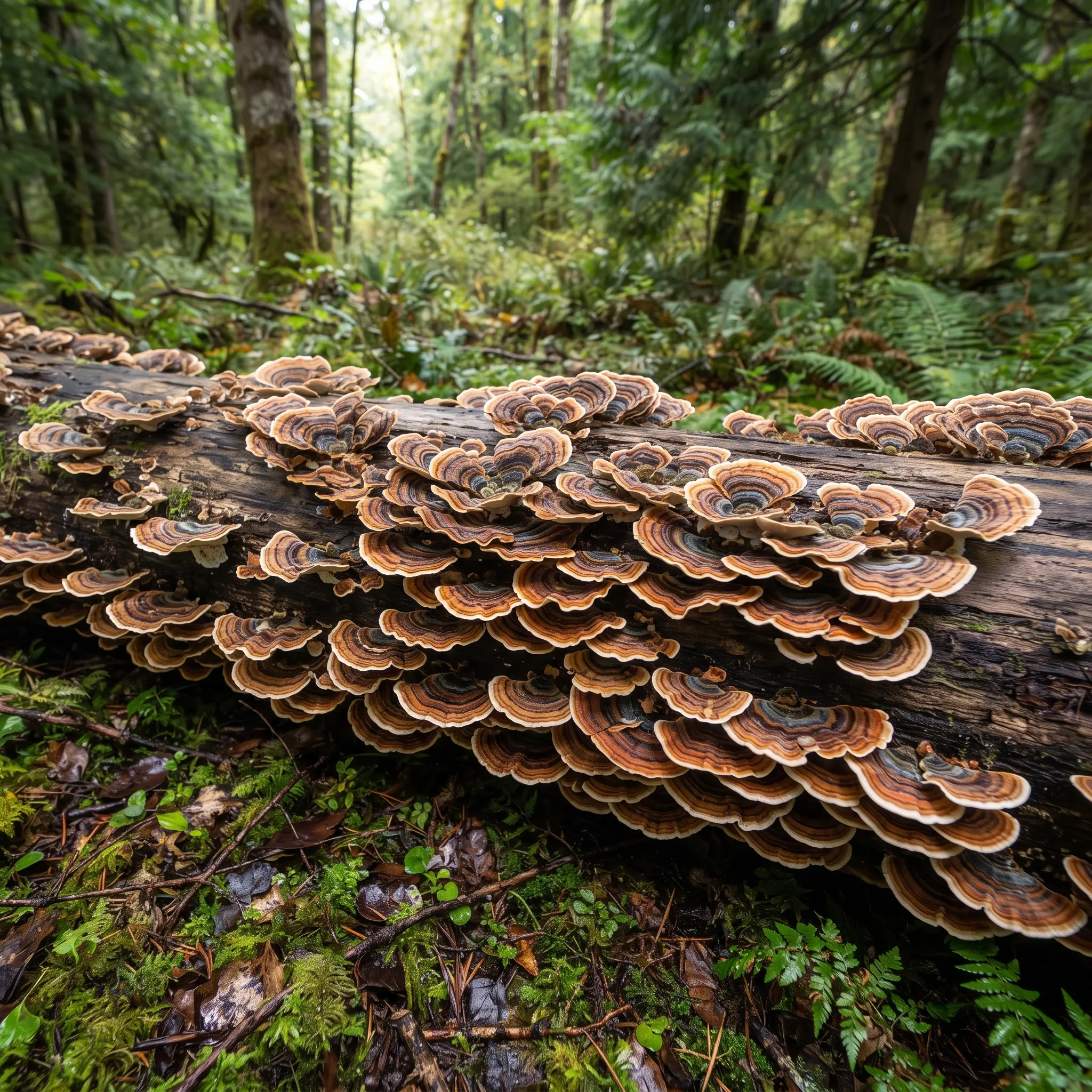
Traditionally, turkey tail has been used primarily for supporting immune health, especially when dealing with general run-down feelings or wanting broader immune system support. It is commonly prepared as a tea, tincture, powdered extract, or capsule.
Common Name: Turkey Tail Latin Name: Trametes versicolor (Latin name itself in italics) Alternate Names: Coriolus versicolor, Cloud Mushroom
- Parts used: fruiting body (mushroom)
- Primary properties: immunomodulator, antioxidant, adaptogen (traditional)
- Common preparations: tea, tincture, powdered extract, capsule
- Best known for: supporting healthy immune system function
What It Helps With
Health conditions this herb is commonly used to support.
Related Buying Guides
Featured Recipes
Explore and try simple ways to prepare and use this herb at home.
Active Compounds
The tiny plant chemistry doing all the heavy lifting.
Key Herbal Properties
What this herb is known for, herbally speaking.



Herbal Synergies
Other herbs that pair especially well with this one — together, their combined properties work better than either herb does alone.
Health Conditions Turkey Tail Helps With
- Immune support — Turkey tail has one of the strongest traditional reputations of any medicinal mushroom for supporting healthy immune system function.
- General fatigue & low vitality — Traditionally used as a tonic to help support overall energy and resilience.
- Digestive & gut health — Traditionally associated with supporting a healthy gut environment, largely tied to its polysaccharide content.
- Recovery support — Historically used as a supportive tonic during recovery from illness or periods of physical depletion.
- Oxidative stress support — Its compound profile gives turkey tail a traditional reputation for supporting the body’s natural antioxidant defenses.
Compounds
- Polysaccharide-K (PSK) & Polysaccharopeptide (PSP) — Compounds turkey tail is particularly well known for, generally understood to contribute significantly to its traditional immune-supportive reputation.
- Beta-glucans — A broader class of polysaccharides thought to underpin much of turkey tail’s traditional immunomodulating effects.
- Phenolic compounds — Contribute to turkey tail’s overall antioxidant profile and traditional anti-inflammatory reputation.
- Ergosterol — A compound that converts to vitamin D with sun or UV exposure, contributing modestly to turkey tail’s nutritive profile.
- Triterpenes — Present in smaller amounts, thought to contribute to turkey tail’s broader traditional tonic reputation.
Properties
- Immunomodulator — Turkey tail’s most defining traditional property, thought to help support balanced immune system function.
- Antioxidant — Its phenolic compound content is thought to contribute to general cellular protective effects.
- Prebiotic (traditional) — Traditionally associated with supporting a healthy gut environment through its polysaccharide content.
- Adaptogen (traditional, food-based) — Loosely associated with general resilience-supportive qualities in traditional use.
Recipes Using Turkey Tail
- Turkey tail immune broth — A simmered decoction of dried turkey tail mushroom, often combined with astragalus or reishi, traditionally used for immune support.
- Turkey tail tea — A simple, longer-simmered infusion made from dried turkey tail pieces, sipped for general vitality support.
- Turkey tail extract capsule blends — Standardized turkey tail extract combined with other immune-supportive mushrooms like reishi or shiitake in capsule form.
Products Featuring Turkey Tail
- Dried whole mushroom — The traditional whole-food form, used in decoctions and broths, though it requires longer simmering to extract its beneficial compounds.
- Standardized extract powder or capsules — Offers a concentrated, consistent dose of key compounds like PSK and beta-glucans for those wanting a supplement form.
- Tincture (dual-extracted) — Since turkey tail’s key compounds are both water- and alcohol-soluble, dual-extracted tinctures are often preferred for more complete extraction.
Synergies
- Turkey tail + reishi mushroom — A classic pairing in traditional and modern formulas for broader immune and vitality support.
- Turkey tail + astragalus root — Combined in traditional immune-supportive broths and formulas.
- Turkey tail + shiitake mushroom — Paired in supplement blends for combined immune and general wellness support.
- Turkey tail + chaga mushroom — Traditionally combined for broader antioxidant and immune-tonic support.
Safety & Precautions
Turkey tail is generally well-tolerated as a food-based mushroom and supplement, though some people may experience mild digestive upset, particularly when first starting or at higher doses. Because of its traditional immune-modulating properties, anyone with an autoimmune condition or who is taking immunosuppressant medications should consult a healthcare provider before using concentrated turkey tail extracts, as its effects on immune activity could be relevant in these situations.
There is limited specific safety data on concentrated turkey tail extracts during pregnancy and breastfeeding, so it’s best to consult a healthcare provider before using concentrated supplement forms during these times. Turkey tail should only be sourced from reputable suppliers, as mushroom identification and sourcing quality matter for safety and potency, particularly since wild-harvested lookalike species exist. Anyone with a known mushroom allergy should avoid turkey tail products.
Turkey tail from a reputable source is generally well-tolerated by most healthy adults. For pets, turkey tail is increasingly used as a supplement for dogs, particularly in veterinary integrative care settings, but appropriate dosing should always be guided by a veterinarian.
Q&A
Can I identify and harvest turkey tail myself in the wild?
Turkey tail is a distinctive, commonly found mushroom, but it does have several lookalike species that can be more difficult to distinguish for those without foraging experience, so misidentification is a real risk. Getting proper training or going with an experienced forager matters if you plan to harvest it yourself.
For most people, purchasing turkey tail products from a reputable supplier that verifies species identity is the safer and more practical approach.
Can turkey tail be used daily?
Turkey tail is commonly used daily as part of an ongoing immune-support routine, and many people take it consistently for weeks to months at a time. It’s generally considered a gentle, food-based supplement rather than a harsh or fast-acting remedy.
That said, checking in with a healthcare provider periodically during long-term use is a reasonable practice, particularly for anyone with an autoimmune condition or taking immune-related medications.
Why do some turkey tail products use both water and alcohol extraction?
Turkey tail’s key beneficial compounds include some that dissolve better in water and others that dissolve better in alcohol, so a “dual-extraction” process is often used to pull out a fuller range of its traditional active compounds compared to a single-method extraction. This is a common quality marker to look for when choosing a turkey tail tincture or extract.
Reputable brands often specify their extraction method on the label, which can be a helpful way to gauge product quality.
Does turkey tail taste like a typical mushroom?
Turkey tail has a tough, woody texture that isn’t really eaten directly the way a culinary mushroom like shiitake would be; it’s instead simmered for extended periods to make tea or broth, or processed into extracts and powders. Its flavor when prepared as tea is mild, earthy, and slightly bitter.
Because of its tough texture, turkey tail is prepared quite differently from most cooking mushrooms and is used specifically for its traditional remedy applications rather than as a food ingredient on its own.
Is turkey tail safe around pets?
Turkey tail is increasingly used as a supplement for dogs, including in some veterinary integrative care settings, and is generally considered one of the better-studied mushrooms for this purpose. That said, proper dosing matters, and it should be introduced under veterinary guidance rather than assumed safe at human doses.
If you’re interested in using turkey tail for a pet’s wellness support, working with a veterinarian familiar with mushroom supplements is the safest way to determine an appropriate approach.
References
- Plants of the World Online: Trametes versicolor
- PubMed: Scientific Literature on Trametes versicolor
- National Library of Medicine: Chemical Constituents from Trametes versicolor
- Wikipedia: Trametes versicolor
- ScienceDirect Topics: Trametes versicolor Research
- Memorial Sloan Kettering Cancer Center: About Herbs — Turkey Tail Mushroom
- PubMed: PSK PSP Polysaccharide Immune Research
This information is for educational purposes only and is not intended as medical advice. Consult a qualified healthcare professional before using any herb, especially if pregnant, breastfeeding, taking medications, or managing a health condition.