

What Thyme Is Good For
Productive cough — This is thyme’s best-established traditional medicinal use. The European Medicines Agency recognizes thyme herb for productive, chesty cough associated with colds, based on longstanding medicinal use.
Cold & respiratory comfort — Thyme’s aromatic compounds, particularly thymol and carvacrol, contribute expectorant, antispasmodic, and antimicrobial activity. Thyme is commonly included in cough syrups and respiratory teas.
Throat support — Warm thyme preparations can soothe an irritated throat while its volatile oils provide aromatic respiratory support.
Bloating & gas — Thyme has longstanding traditional use for digestive complaints. Its aromatic volatile compounds help explain its carminative and antispasmodic reputation.
Digestive sluggishness — Thyme can function as a warming aromatic digestive herb, especially when heaviness, gas, and mild intestinal discomfort occur after meals.
Antimicrobial support — Thymol and carvacrol demonstrate substantial antibacterial and antifungal activity in laboratory research. These effects support thyme’s traditional use but do not mean thyme can replace antibiotics or antifungal medication when those treatments are medically necessary.
Available Herbal Products
Buying Guides for Available Thyme Products
Thyme Liquid Herbal Extract – Certified-organic Thymus vulgaris flowering aerial-parts tincture made at a 1:5 herb-to-menstruum ratio. Currently available directly from the manufacturer. Seller: Herb Pharm – View Herb Pharm Thyme →
Organic Thyme Leaf Cut & Sifted – Loose organic Thymus vulgaris leaf from Egypt. Currently listed in stock and suitable for tea, culinary use, respiratory blends, and homemade infusions. Seller: Starwest Botanicals – View Organic Thyme Leaf →
Organic Thyme Leaf Powder – Finely milled organic Thymus vulgaris leaf. Currently listed in stock and useful for culinary preparations, capsules, or custom herbal formulas. Seller: Starwest Botanicals – View Organic Thyme Leaf Powder →
White Thyme Oil – Pure steam-distilled essential oil from Thymus vulgaris / T. zygis aerial parts. Currently available, with manufacturer quality testing and certificate-of-analysis access. Seller: NOW Foods – View NOW White Thyme Oil →
For cough and digestive support, tea, tincture, syrup, or a properly formulated oral herbal product is generally more appropriate than swallowing essential oil.
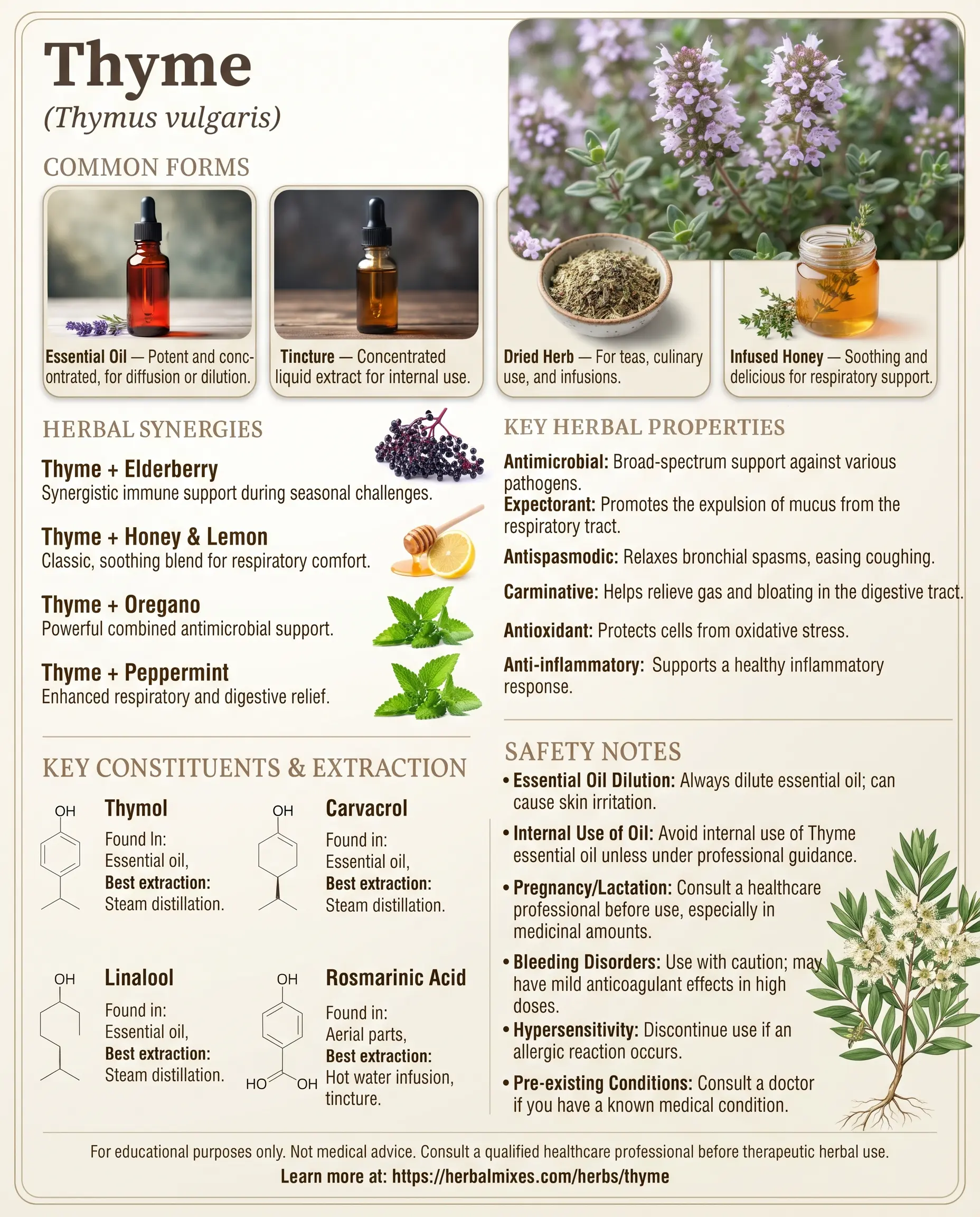
Herbal Synergies
Thyme pairs especially well with mullein, marshmallow root, licorice root, ginger, and peppermint depending on whether the goal is cough, throat soothing, digestion, or respiratory comfort.
Thyme + Mullein
Best for: Productive cough and bronchial irritation
Thyme contributes aromatic expectorant and antimicrobial activity, while mullein adds soothing mucilage and traditional respiratory support.
Best extraction: Covered thyme infusion combined with well-filtered mullein tea.
Thyme + Marshmallow Root
Best for: Cough with a dry, irritated throat
Thyme helps loosen respiratory secretions, while marshmallow root provides soothing mucilage for dry mucous membranes.
Best extraction: Prepare thyme as a covered hot infusion and marshmallow separately as a cold infusion, then combine.
Thyme + Licorice Root
Best for: Irritated throat with productive cough
Thyme contributes aromatic expectorant activity while licorice adds demulcent and inflammatory-modulating effects.
Best extraction: Combined tea, decoction, or professionally formulated syrup.
Whole licorice is not appropriate for everyone because prolonged or high-dose use can raise blood pressure and lower potassium.
Thyme + Ginger
Best for: Cold-related respiratory discomfort with sluggish digestion
Thyme provides respiratory and antimicrobial support, while ginger adds warming digestive, circulatory, and anti-nausea effects.
Best extraction: Covered thyme infusion combined with fresh ginger tea.
Thyme + Peppermint
Best for: Bloating, gas, and digestive tension
Both are aromatic mint-family herbs. Thyme contributes warming stimulation, while peppermint adds stronger carminative and smooth-muscle-relaxing activity.
Best extraction: Covered hot infusion to help preserve volatile compounds.
Key Herbal Properties
Expectorant — Thyme is traditionally used to help loosen and clear respiratory secretions during productive coughs.
Carminative — Aromatic compounds help relieve gas and digestive tension.
Antispasmodic — Thymol, carvacrol, and related constituents demonstrate smooth-muscle-relaxing effects experimentally.
Antimicrobial — Thyme essential oil shows broad antibacterial and antifungal activity in laboratory research.
Antioxidant — Rosmarinic acid, flavonoids, thymol, and carvacrol contribute antioxidant activity.
Anti-inflammatory — experimental — Thyme constituents influence inflammatory signaling pathways in laboratory and animal studies.
Respiratory supportive — EMA recognizes longstanding traditional thyme use for productive cough associated with colds.






Active Compounds
Thyme contains two major phytochemical fractions: volatile essential-oil compounds, especially thymol and carvacrol, and nonvolatile polyphenols, including rosmarinic acid and flavonoids.
Thymol
Found mainly in: Essential oil and aromatic glandular tissues
Thymol is one of thyme’s signature phenolic monoterpenes and can make up a substantial portion of some Thymus vulgaris essential oils.
It has well-characterized antimicrobial, antioxidant, anti-inflammatory, and antispasmodic activity.
Best extraction: Steam distillation strongly concentrates thymol; hydroalcoholic tinctures also recover part of the volatile fraction.
Carvacrol
Found mainly in: Essential oil
Carvacrol is the structural isomer of thymol and another important antimicrobial phenolic monoterpene.
Its amount varies considerably among thyme chemotypes.
Best extraction: Steam distillation or alcohol-rich extraction.
Rosmarinic Acid
Found mainly in: Leaves and flowering aerial parts
Rosmarinic acid is a characteristic mint-family polyphenol with antioxidant and inflammatory-modulating effects.
Best extraction: Hot water or hydroalcoholic extraction.
P-Cymene
Found mainly in: Essential oil
P-cymene is an aromatic monoterpene and biochemical precursor related to thymol and carvacrol formation.
Best extraction: Steam distillation.
Gamma-Terpinene
Found mainly in: Essential oil
Gamma-terpinene is another common volatile constituent and precursor in the biosynthesis of thymol and carvacrol.
Best extraction: Steam distillation.
Linalool
Found mainly in: Essential oil, especially certain thyme chemotypes
Linalool contributes a softer floral aroma and experimental calming and antimicrobial effects.
Best extraction: Steam distillation.
Apigenin
Found mainly in: Leaves and aerial parts
Apigenin and related flavonoids contribute antioxidant and inflammatory-modulating activity.
Best extraction: Hot water or hydroalcoholic extraction.
Luteolin Derivatives
Found mainly in: Leaves
Luteolin-related flavonoids complement thyme’s phenolic antioxidant profile.
Best extraction: Hot water or diluted alcohol.
FAQ
What is thyme best used for?
Thyme is particularly useful for productive coughs associated with colds, respiratory comfort, bloating, gas, and mild digestive complaints.
Its respiratory use is formally recognized by the European Medicines Agency.
Does thyme really help coughs?
There is good traditional-use support and pharmacological rationale.
EMA recognizes thyme herb for productive cough associated with colds, although many modern clinical cough studies involve thyme in combination with other herbs rather than thyme alone.
Is thyme tea the same as thyme essential oil?
No.
Tea contains rosmarinic acid, flavonoids, tannins, and relatively small amounts of volatile compounds.
Essential oil is highly concentrated in thymol, carvacrol, p-cymene, and other terpenes and carries substantially greater irritation and toxicity risk.
Does thyme kill bacteria?
Thymol, carvacrol, and thyme essential oil show strong antibacterial effects in laboratory studies.
That does not mean drinking thyme tea can replace antibiotics for pneumonia, strep throat, urinary infection, or another diagnosed bacterial infection.
Should thyme tea be covered while steeping?
Yes.
Covering the cup helps reduce loss of volatile aromatic compounds during steeping.
Safety & Precautions
Thyme used normally as a culinary herb or herbal tea is generally well tolerated.
Possible adverse effects include stomach irritation, nausea, or allergic reactions, particularly in people sensitive to herbs in the mint family.
People allergic to other Lamiaceae plants, such as oregano, mint, basil, sage, rosemary, or lavender, may have a greater likelihood of reacting.
Essential Oil Safety
Thyme essential oil is much more concentrated than thyme tea or culinary herb.
Do not swallow undiluted thyme essential oil.
Phenolic chemotypes rich in thymol or carvacrol can strongly irritate skin and mucous membranes.
For topical use, thyme essential oil should be properly diluted in a carrier oil or used in a professionally formulated product.
Keep concentrated oil away from:
- eyes;
- mouth;
- nose;
- genital tissues;
- damaged skin.
Pregnancy & Breastfeeding
Culinary thyme is very different from concentrated medicinal preparations.
Herb Pharm advises seeking expert medical advice before taking its thyme extract during pregnancy.
High-quality pregnancy and breastfeeding data for concentrated thyme extracts and essential oil remain limited.
Avoid internal essential-oil use during pregnancy and use concentrated medicinal preparations only with appropriate professional guidance.
Children
EMA notes that most medicinal thyme preparations are intended for adults and adolescents over 12, although certain specific products may be used in children over 4 depending on their approved formulation.
Do not give concentrated essential oil internally to children.
Medication Considerations
Clinically significant medication interactions with normal thyme tea are not well established.
Because thyme preparations can have antispasmodic, antimicrobial, and possibly platelet- or hormone-related effects in experimental research, people taking multiple medications should use concentrated extracts conservatively.
Do not extrapolate laboratory findings with isolated thymol or carvacrol to ordinary culinary thyme.
When to Seek Medical Advice
A productive cough should be medically evaluated if it is accompanied by:
- shortness of breath;
- chest pain;
- coughing blood;
- persistent high fever;
- blue lips;
- wheezing that is severe or new;
- symptoms lasting longer than about a week without improvement.
EMA advises seeking medical care if cough symptoms persist longer than one week or worsen during thyme use.
Thyme should not replace medical treatment for pneumonia, asthma attacks, COPD exacerbations, severe bronchitis, or bacterial throat infections.
Anyone who is pregnant, breastfeeding, treating a child, using concentrated essential oils, or managing significant respiratory disease should discuss therapeutic thyme use with an appropriate healthcare professional.
References
- European Medicines Agency — Thyme Herb
- PubMed — Thymol, Thyme, and Potential Health Uses
- PubMed — Thymol and Thyme Essential Oil: Therapeutic Applications
- PubMed — Thyme Biological, Chemical, and Therapeutic Properties
- PubMed — Thyme Phytochemistry and Bioactivities
- PubMed — Carvacrol and Human Health
- PubMed — Antibacterial Properties of Thymol and Carvacrol
- Herb Pharm — Thyme Liquid Herbal Extract
- Starwest Botanicals — Organic Thyme Leaf
- Starwest Botanicals — Organic Thyme Leaf Powder
- NOW Foods — White Thyme Oil
Disclaimer
Disclaimer: This article is for educational purposes only and is not intended to diagnose, treat, cure, or prevent any disease. Herbal products can cause side effects and interact with medications. Consult a qualified healthcare professional before using herbs therapeutically, especially if you are pregnant, breastfeeding, taking prescription medications, or managing a medical condition.