


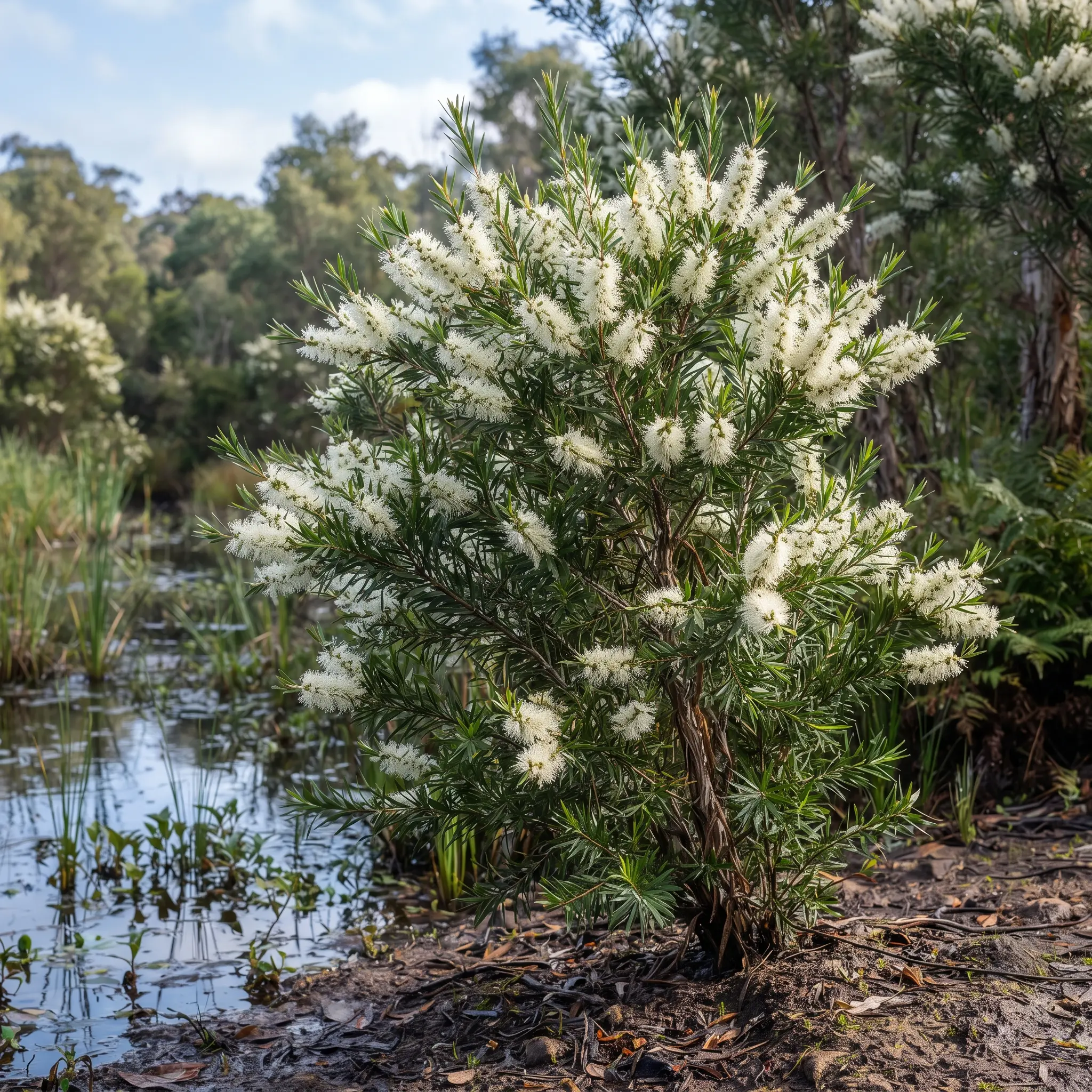
Traditionally, tea tree has been used primarily for supporting skin health and minor wound care, especially when dealing with blemishes, minor cuts, or fungal skin irritation. It is commonly prepared as an essential oil, diluted topical solution, salve, or added into skin and hair products.
Common Name: Tea Tree Latin Name: Melaleuca alternifolia (Latin name itself in italics) Alternate Names: Ti Tree, Narrow-Leaved Paperbark
- Parts used: leaves (distilled into essential oil)
- Primary properties: antimicrobial, antifungal, antiseptic
- Common preparations: essential oil (diluted), salve, topical solution
- Best known for: supporting clear skin and minor wound care
What It Helps With
Health conditions this herb is commonly used to support.
Related Buying Guides
Featured Recipes
Explore and try simple ways to prepare and use this herb at home.
Active Compounds
The tiny plant chemistry doing all the heavy lifting.
Key Herbal Properties
What this herb is known for, herbally speaking.




Herbal Synergies
Other herbs that pair especially well with this one — together, their combined properties work better than either herb does alone.
Health Conditions Tea Tree Helps With
- Acne & blemishes — Tea tree oil has a strong traditional and modern reputation for helping calm blemishes and support clearer skin when applied topically, diluted.
- Minor cuts & scrapes — Traditionally used as a diluted topical antiseptic to help clean and support minor wound care.
- Fungal skin & nail irritation — Long used traditionally, applied topically and diluted, to help address fungal-related skin and nail irritation such as athlete’s foot.
- Dandruff & scalp irritation — Traditionally added to shampoos and scalp treatments to help ease flaking and scalp discomfort.
- Insect bites — Diluted tea tree oil has traditionally been dabbed on insect bites to help ease itching and irritation.
Compounds
- Terpinen-4-ol — The primary active compound in tea tree oil, generally understood to be the main contributor to its traditional antimicrobial and antifungal effects.
- Cineole — Present in smaller amounts, and products are generally preferred with lower cineole content, as high levels are associated with greater skin irritation potential.
- Other monoterpenes — Contribute to tea tree oil’s characteristic aroma and support its overall traditional antiseptic reputation.
Properties
- Antimicrobial — Tea tree oil’s most defining property, traditionally used topically to help address bacteria-related skin concerns.
- Antifungal — Long used traditionally for fungal-related skin and nail irritation when properly diluted.
- Antiseptic — Traditionally applied to minor cuts and scrapes to support basic wound cleanliness.
- Anti-inflammatory — Supports tea tree oil’s traditional use for calming irritated or inflamed skin.
Recipes Using Tea Tree
- Diluted tea tree spot treatment — A few drops of tea tree oil diluted in a carrier oil, dabbed onto individual blemishes as a traditional spot treatment.
- Tea tree scalp rinse — Diluted tea tree oil added to shampoo or a final hair rinse, traditionally used for scalp and dandruff support.
- Tea tree all-purpose salve — Tea tree oil blended into a beeswax-and-carrier-oil salve base for minor cuts, scrapes, and general skin support.
Products Featuring Tea Tree
- Pure essential oil — The most concentrated and versatile form, always intended for dilution before topical use, never internal use.
- Pre-diluted topical solutions or gels — A convenient, ready-to-use option for those who prefer not to measure and dilute the oil themselves.
- Skin and hair care products — Tea tree is commonly incorporated into commercial cleansers, shampoos, and salves at safe, pre-formulated concentrations.
Synergies
- Tea tree + lavender — A classic pairing combining tea tree’s antimicrobial action with lavender’s soothing, skin-calming qualities.
- Tea tree + witch hazel — Combined in traditional topical toners for blemish and general skin support.
- Tea tree + coconut oil — A common carrier oil pairing used to safely dilute tea tree oil for skin application.
- Tea tree + aloe vera — Paired for soothing, hydrating support alongside tea tree’s antimicrobial action.
Safety & Precautions
Tea tree oil is intended for external, diluted use only and should never be taken internally, as ingestion can cause serious toxicity, including symptoms affecting the nervous system; if accidental ingestion occurs, contact poison control or seek medical care immediately. Undiluted (“neat”) tea tree oil applied directly to skin can cause irritation, redness, or allergic contact dermatitis in many people, so it should always be diluted in a carrier oil before topical use, and a patch test is a reasonable precaution before broader application.
Tea tree oil is not recommended for use on or around young children, particularly prepubertal boys, as some research has raised questions about hormonal effects with repeated topical exposure in this group; it should also be kept well out of reach of children generally, given the risk of serious toxicity if ingested. Pregnant and breastfeeding individuals should use tea tree oil cautiously and only in properly diluted topical form, given limited safety data on more concentrated or frequent use. Anyone with broken or significantly irritated skin should use extra caution, as absorption and irritation potential are higher on compromised skin.
Tea tree oil is generally well-tolerated in appropriately diluted topical use by most healthy adults, but it is not a gentle, risk-free oil and calls for careful handling. For pets, tea tree oil is considered toxic to both cats and dogs, especially in concentrated or undiluted form, and should never be applied directly to pets or used in diffusers around them without veterinary guidance; accidental exposure warrants a prompt call to a veterinarian.
Q&A
Can tea tree oil be taken internally for infections?
No — tea tree oil should never be taken internally under any circumstances, as ingestion can cause serious toxicity affecting the nervous system, even in relatively small amounts. This is one of the most important safety points about this particular oil.
If tea tree oil is accidentally swallowed, contacting poison control or seeking medical care right away is the appropriate response rather than waiting to see if symptoms develop.
Can tea tree oil be applied directly to skin?
Undiluted tea tree oil applied directly to skin can cause irritation, redness, or an allergic reaction in many people, so it’s generally recommended to dilute it in a carrier oil, such as jojoba or coconut oil, before applying it topically. A common approach is a small number of drops per tablespoon of carrier oil.
Doing a patch test on a small area of skin before wider use is a reasonable way to check for sensitivity, since reactions vary from person to person.
Is tea tree oil safe to use daily?
Diluted tea tree oil is commonly used daily for ongoing skin concerns like blemishes, and many people incorporate it into a regular skincare routine without issue. That said, some people find that daily use can be drying or irritating over time, so adjusting frequency based on how your skin responds is reasonable.
If irritation develops, reducing frequency or diluting further is usually the first step before discontinuing use altogether.
How is tea tree oil different from other antiseptic essential oils?
Tea tree oil is particularly well known and widely studied for its traditional antimicrobial and antifungal properties compared to many other essential oils, which is part of why it’s become one of the most commonly used oils for topical skin support. Its primary active compound, terpinen-4-ol, is often highlighted as the main contributor to this reputation.
Quality and freshness matter with tea tree oil, as oxidized or old oil may be more likely to cause skin irritation, so choosing a reasonably fresh, well-stored product is worthwhile.
Is tea tree oil safe around pets?
No — tea tree oil is considered toxic to both cats and dogs, particularly in concentrated or undiluted form, and should never be applied directly to a pet’s skin or used in diffusers in spaces where pets spend significant time without veterinary guidance. Cats in particular tend to be more sensitive to essential oils generally.
If a pet is accidentally exposed to tea tree oil, whether through skin contact or ingestion, contacting a veterinarian promptly is important, as symptoms can be serious.
References
- Plants of the World Online: Melaleuca alternifolia
- PubMed: Scientific Literature on Melaleuca alternifolia
- National Library of Medicine: Chemical Constituents from Melaleuca alternifolia
- Wikipedia: Melaleuca alternifolia
- ScienceDirect Topics: Melaleuca alternifolia Research
- Memorial Sloan Kettering Cancer Center: About Herbs — Tea Tree Oil
- PubMed: Terpinen-4-ol Antimicrobial Research
- ASPCA: Toxic and Non-Toxic Plants — Tea Tree Oil
This information is for educational purposes only and is not intended as medical advice. Consult a qualified healthcare professional before using any herb, especially if pregnant, breastfeeding, taking medications, or managing a health condition.