

What Schisandra Is Good For
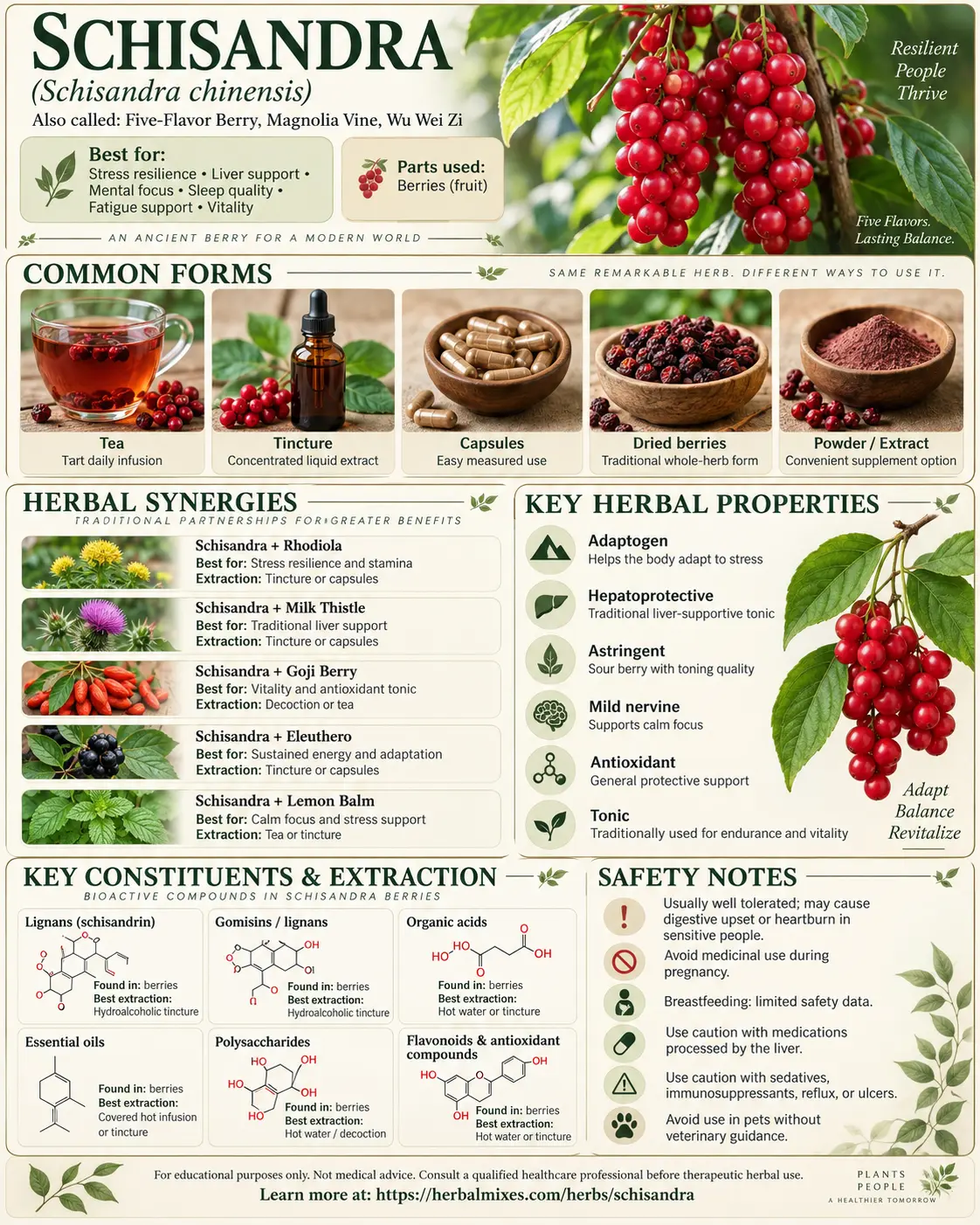
Stress resilience — Schisandra is traditionally used as a restorative or adaptogenic herb for maintaining physical and mental performance during prolonged stress. Modern reviews describe anti-fatigue and neuroprotective activity, but much of the evidence remains preclinical rather than based on large controlled human trials.
Mental fatigue & focus — Schisandra is frequently used when stress is accompanied by reduced concentration, mental tiredness, or declining endurance. Lignans such as schisandrin and schisandrol have demonstrated neuroprotective and central-nervous-system effects experimentally.
Liver support — This is one of schisandra’s most extensively researched areas. Its dibenzocyclooctadiene lignans influence antioxidant defenses and liver-enzyme pathways and demonstrate hepatoprotective effects in experimental studies. Human evidence exists for some preparations, but schisandra should not replace treatment for liver disease.
Physical endurance — Traditional use includes fatigue, stamina, and resistance to physical stress. Modern pharmacological reviews support anti-fatigue activity, although strong contemporary clinical evidence remains limited.
Antioxidant protection — Schisandrin, gomisin compounds, schisandrols, and related lignans influence glutathione and other antioxidant systems and help protect cells against oxidative stress experimentally.
General vitality — In traditional Chinese herbalism, the berry is known as Wu Wei Zi, or “five-flavor fruit,” because it combines sour, sweet, salty, bitter, and pungent qualities and is used as a broad restorative tonic.
Available Herbal Products
Buying Guides for Available Schisandra Products
Schisandra Liquid Herbal Extract – Certified-organic ripe-berry tincture. Made from Schisandra chinensis berries at a 1:3 herb-to-menstruum ratio and currently available directly from the manufacturer. Seller: Herb Pharm – View Herb Pharm Schisandra →
Organic Schisandra Berry Powder – Whole dried berry powder. A single-ingredient Schisandra chinensis product currently listed in stock and suitable for smoothies, teas, powders, and custom formulations. Seller: Starwest Botanicals – View Organic Schisandra Berry Powder →
Schisandra Fruit Capsules – Whole-fruit capsules. Provides a blend of Schisandra chinensis and southern schisandra fruit totaling 1.16 g per two-capsule serving and is currently listed in stock. Seller: Nature’s Way / iHerb – View Nature’s Way Schisandra Fruit →
Schisandra Extract, Alcohol-Free – Concentrated liquid extract. A glycerin-based schisandra preparation currently listed for purchase through iHerb. Seller: Nature’s Answer / iHerb – View Nature’s Answer Schisandra Extract →
When comparing products, check whether the label specifies Schisandra chinensis, Schisandra sphenanthera, or a blend. Both contain related lignans, but their concentrations can differ substantially.
Herbal Synergies
Schisandra pairs especially well with rhodiola, reishi, astragalus, milk thistle, and holy basil depending on whether the goal is stress resilience, fatigue, immunity, or liver support.
Schisandra + Rhodiola
Best for: Mental fatigue and performance under stress
Schisandra provides lignan-rich restorative support, while rhodiola tends to be more activating and is commonly used for stress-related fatigue and mental performance.
Best extraction: Hydroalcoholic tinctures or standardized extracts, because many of the key lignans in schisandra are better extracted with alcohol than with water alone.
Schisandra + Reishi
Best for: Long-term stress and immune resilience
Schisandra emphasizes stress adaptation and liver-associated antioxidant pathways, while reishi contributes beta-glucans and triterpenes associated with immune modulation.
Best extraction: Schisandra tincture or dual extract combined with reishi hot-water or dual extract.
Schisandra + Astragalus
Best for: Everyday resilience and immune support
Schisandra contributes adaptogenic lignans, while astragalus adds polysaccharides and saponins traditionally used for long-term immune and vitality support.
Best extraction: Schisandra tincture plus astragalus decoction or standardized extract.
Schisandra + Milk Thistle
Best for: Liver antioxidant support
Schisandra contributes dibenzocyclooctadiene lignans, while milk thistle supplies silymarin flavonolignans.
These herbs affect complementary antioxidant and liver-cell-protective pathways.
Best extraction: Standardized or hydroalcoholic extracts.
Schisandra + Holy Basil
Best for: Stress with nervous tension
Schisandra provides endurance-oriented adaptogenic support, while holy basil contributes gentler calming and aromatic effects.
Best extraction: Schisandra tincture or powder combined with holy-basil tea or tincture.
Key Herbal Properties
Adaptogenic / restorative — Traditionally used to support resilience during prolonged physical or psychological stress.
Anti-fatigue — Experimental and traditional evidence supports use for fatigue and endurance.
Hepatoprotective — mainly experimental — Schisandra lignans influence oxidative stress, glutathione pathways, and liver-enzyme systems.
Neuroprotective — experimental — Schisandrin-type lignans demonstrate protective effects in neuronal models.
Antioxidant — Lignans and phenolic compounds contribute strong antioxidant activity.
Anti-inflammatory — experimental — Schisandrin, schisandrol, gomisin, and related compounds influence inflammatory signaling.
Immunomodulatory — experimental — Reviews describe immune-modulating effects from S. chinensis constituents.
Astringent / fluid-conserving — traditional — The intensely sour berry is traditionally used in formulas for excessive sweating and other conditions characterized by fluid loss.





Active Compounds
Schisandra is particularly rich in dibenzocyclooctadiene lignans, along with triterpenoids, volatile oils, phenolic acids, flavonoids, polysaccharides, phytosterols, and organic acids.
Schisandrin
Found mainly in: Berry and seed
Schisandrin, also called schizandrin, is one of schisandra’s signature lignans and is widely used as a quality marker.
It has demonstrated antioxidant, neuroprotective, liver-protective, and metabolic effects experimentally.
Best extraction: Hydroalcoholic extraction. Lignans are considerably less water soluble than polysaccharides.
Schisandrin A
Found mainly in: Berry and seed
Schisandrin A is a dibenzocyclooctadiene lignan extensively investigated for anti-inflammatory and neuroprotective effects.
Best extraction: Alcohol-rich or hydroalcoholic tincture.
Schisandrin B
Found mainly in: Berry and seed
Schisandrin B is particularly well studied for antioxidant and hepatoprotective activity.
It can influence glutathione-related cellular defenses.
Best extraction: Hydroalcoholic or lipid-compatible extraction.
Schisandrin C
Found mainly in: Fruit and seed
Schisandrin C belongs to the same lignan family and contributes to schisandra’s broader pharmacological profile.
Best extraction: Alcohol-containing extraction.
Schisandrol A
Found mainly in: Fruit
Schisandrol A, also called schizandrol A, is another major marker lignan found in S. chinensis.
Best extraction: Hydroalcoholic tincture or standardized extract.
Schisandrol B
Found mainly in: Fruit
Schisandrol B complements the other dibenzocyclooctadiene lignans and contributes to schisandra’s experimental neuroprotective and hepatic effects.
Best extraction: Hydroalcoholic extraction.
Gomisin A
Found mainly in: Fruit and seed
Gomisin A is a biologically active lignan particularly important from a drug-interaction perspective because it can inhibit CYP2C8, CYP2C19, and CYP3A4 in experimental systems.
Best extraction: Alcohol-rich preparations.
Schisantherin A
Found mainly in: Fruit
Schisantherin A is another major lignan present in both S. chinensis and S. sphenanthera, although concentrations differ between species.
Best extraction: Hydroalcoholic extraction.
-
FAQ
What is schisandra best used for?
Schisandra is best suited to stress resilience, mental and physical fatigue, antioxidant support, and traditional liver support.
Many mechanistic claims are supported strongly by laboratory research, while modern human trials are more limited.
Why is schisandra called five-flavor fruit?
Its berry is traditionally described as containing sour, sweet, salty, bitter, and pungent flavors, which gave rise to the Chinese name Wu Wei Zi.
Is schisandra tea or tincture better?
They emphasize different chemistry.
Hot water extracts organic acids, polysaccharides, and other polar compounds, while alcohol-containing tinctures extract the signature lignans much more efficiently.
For a broad-spectrum preparation, tincture or combined water-alcohol extraction is usually preferable.
Is Schisandra chinensis the same as Schisandra sphenanthera?
No.
They are closely related medicinal species with overlapping chemistry, but their lignan profiles and concentrations differ. S. chinensis is generally referred to as northern Wu Wei Zi, while S. sphenanthera is southern Wu Wei Zi.
Can schisandra be taken every day?
It is often used as a daily tonic, but medication interactions make long-term concentrated use more complicated than the traditional reputation suggests.
People taking prescription drugs should review schisandra with a healthcare professional before regular use.
Safety & Precautions
Schisandra is generally well tolerated in ordinary herbal amounts, but possible adverse effects include heartburn, stomach discomfort, reduced appetite, nausea, or skin reactions.
The most important modern safety issue is drug interaction potential.
Both Schisandra chinensis and Schisandra sphenanthera can inhibit CYP3A enzymes and P-glycoprotein, which may alter absorption and blood levels of many medications.
Individual lignans have also demonstrated inhibition of CYP2B6, CYP2C8, CYP2C9, CYP2C19, CYP2E1, and CYP3A in human liver microsomes.
This is especially important for medications with a narrow therapeutic range, where modest changes in blood concentration can matter clinically.
Use particular caution with medicines such as tacrolimus, cyclosporine, certain statins, calcium-channel blockers, some antidepressants, anticonvulsants, anticoagulants, chemotherapy drugs, and other CYP3A4 or P-glycoprotein substrates.
The exact interaction depends on the medication, dose, extract, and individual metabolism, so schisandra should not simply be “spaced apart” from medication and assumed safe.
Modern reviews specifically warn that schisandra-induced changes in CYP and P-glycoprotein activity can lead to clinically important drug-drug interactions.
Pregnancy safety has not been adequately established. Concentrated medicinal schisandra preparations are generally avoided during pregnancy unless specifically directed by a qualified practitioner.
Gaia Herbs products containing schisandra currently advise against use during pregnancy and lactation.
Safety during breastfeeding is likewise insufficiently established for concentrated extracts.
People with significant liver disease should not assume that an herb described as “liver supportive” is automatically appropriate. Existing liver disease can change medication metabolism and may increase the importance of interactions.
Do not use schisandra as a replacement for treatment of hepatitis, fatty liver disease, cirrhosis, depression, chronic fatigue syndrome, or other diagnosed conditions.
Persistent fatigue should be evaluated when accompanied by unexplained weight loss, fever, severe weakness, shortness of breath, jaundice, neurological symptoms, or major changes in mood or sleep.
Anyone who is pregnant, breastfeeding, taking prescription medications, undergoing transplantation or cancer treatment, or managing significant liver disease should discuss therapeutic schisandra use with an appropriate healthcare professional.
References
- PubMed — Comprehensive Review of Schisandra chinensis and Schisandra sphenanthera
- PubMed — Schisandra Lignans and CYP/P-Glycoprotein Drug Interactions
- PubMed — Schisandra Lignans: Pharmacokinetics and Pharmacological Mechanisms
- PubMed — Pharmacodynamic Effects of Schisandra chinensis Lignans
- PubMed — Schisandra Lignans and Cytochrome P450 Inhibition
- PubMed — Schisandra chinensis as a Medicinal Plant
- Herb Pharm — Schisandra Liquid Herbal Extract
- Starwest Botanicals — Organic Schisandra Berry Powder
- Nature’s Way / iHerb — Schisandra Fruit Capsules
- iHerb — Schisandra Products
Disclaimer
Disclaimer: This article is for educational purposes only and is not intended to diagnose, treat, cure, or prevent any disease. Herbal products can cause side effects and interact with medications. Consult a qualified healthcare professional before using herbs therapeutically, especially if you are pregnant, breastfeeding, taking prescription medications, or managing a medical condition.