

What Saffron Is Good For
Mood support — Saffron has one of the more substantial clinical research bases among culinary herbs for mood. A 2026 meta-analysis of 34 randomized controlled trials involving 1,769 adults found improvements in some self-reported depression and anxiety measures, although clinician-rated outcomes were less consistent. (PubMed)
Mild depressive symptoms — Multiple earlier systematic reviews found saffron extracts performed better than placebo in several trials and produced results comparable with antidepressants in some small studies. These findings are promising, but saffron should not replace professional treatment for major depression. (PubMed)
PMS support — Clinical research suggests saffron may reduce some premenstrual emotional and physical symptoms, including mood changes and irritability. The evidence base is smaller than for mood support but is encouraging.
Sleep quality — A systematic review of five randomized trials involving 379 participants found saffron preparations may improve sleep duration and quality. Standardized extracts rather than ordinary culinary amounts were generally used. (PubMed)
Menopausal well-being — Saffron extracts have been studied for mood, sleep, and psychological symptoms during menopause. Emerging evidence suggests potential benefit, although larger trials are still needed.
Eye and retinal support — Crocin and crocetin have attracted considerable interest for retinal antioxidant and neuroprotective effects. Small human studies suggest saffron may support visual function in some people with age-related macular degeneration, but it is not a replacement for ophthalmologic treatment.
Available Herbal Products
Buying Guides for Available Saffron Products
Saffron 50 mg – Whole saffron stigma capsules standardized to at least 10% total crocins. A currently available product using the whole stigma rather than a proprietary extract. Seller: NOW Foods – View NOW Saffron 50 mg →
Affron Saffron Extract 30 mg – Standardized stigma extract. Provides clinically studied Affron saffron standardized to 3.5% Lepticrosalides and is currently available directly from the manufacturer. Seller: Solaray – View Solaray Affron Saffron Extract →
Safr’Inside Saffron Extract 30 mg – Organic standardized stigma extract providing at least 2% safranal and currently available. Seller: Swanson – View Swanson Safr’Inside Saffron Extract →
Full Spectrum Saffron 15 mg – Whole ground Spanish saffron stigmas rather than a concentrated extract. Currently available. Seller: Swanson – View Swanson Full Spectrum Saffron →
For mood or sleep support, a standardized extract with clearly stated crocin, safranal, or proprietary marker levels is easier to compare with clinical research than an unspecified saffron powder.
Herbal Synergies
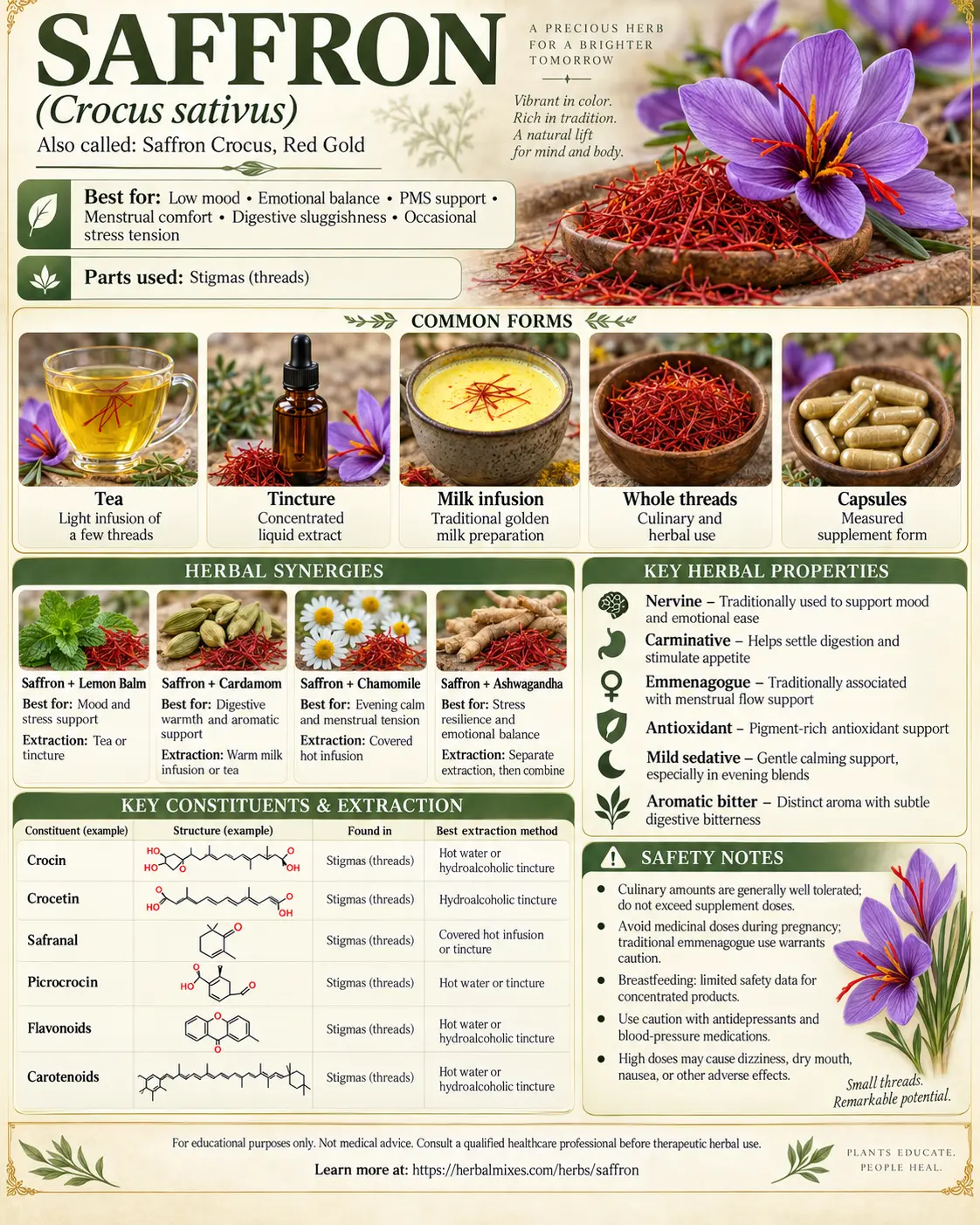
Saffron pairs especially well with lemon balm, ashwagandha, passionflower, ginger, and rose depending on whether the goal is mood, stress resilience, sleep, PMS, or emotional support.
Saffron + Lemon Balm
Best for: Mild anxiety, stress, and nervous tension
Saffron contributes mood-supportive carotenoids and aromatic constituents, while lemon balm provides gentle calming and digestive effects.
Best extraction: Standardized saffron extract combined with lemon-balm tea or tincture.
Saffron + Ashwagandha
Best for: Stress with low mood and fatigue
Saffron emphasizes mood and emotional well-being, while ashwagandha provides more restorative adaptogenic support.
Best extraction: Standardized extracts.
Saffron + Passionflower
Best for: Stress-related sleep difficulty
Saffron has emerging evidence for improved sleep quality, while passionflower provides more direct traditional calming and sleep support.
Best extraction: Standardized saffron extract combined with passionflower tea or tincture.
Saffron + Ginger
Best for: PMS-related discomfort with nausea or digestive symptoms
Saffron contributes mood and menstrual support, while ginger adds warming antispasmodic and digestive activity.
Best extraction: Saffron infusion or standardized extract combined with ginger tea.
Saffron + Rose
Best for: Emotional tension and menstrual mood changes
Both herbs have traditional associations with emotional and reproductive support.
Best extraction: Saffron and rose as a gently covered infusion or saffron extract combined with rose tea.
Key Herbal Properties
Mood supportive — Clinical trials suggest saffron can improve some depressive and anxiety symptoms.
Anxiolytic supportive — Saffron has reduced anxiety scores in several randomized trials, although results are not uniform across all assessment methods.
Antioxidant — Crocin, crocetin, safranal, and related compounds provide significant antioxidant activity.
Neuroprotective — experimental — Saffron constituents show neuronal protective effects in laboratory and animal studies.
Sleep supportive — Standardized saffron extracts have improved subjective sleep measures in several clinical trials.
Anti-inflammatory — experimental — Crocin and crocetin modulate inflammatory signaling pathways.
Retinal supportive — Saffron carotenoids have been investigated for antioxidant and neuroprotective effects in the retina.




Active Compounds
Saffron’s most characteristic compounds are crocin, crocetin, picrocrocin, and safranal, supported by flavonoids and other carotenoids.
Crocin
Found mainly in: Stigmas
Crocin is a water-soluble carotenoid glycoside responsible for saffron’s intense golden color.
It is extensively studied for antioxidant, neuroprotective, retinal, and mood-related effects.
Best extraction: Hot water. Crocin is unusually water soluble for a carotenoid because of its sugar groups.
Crocetin
Found mainly in: Formed from crocin during digestion and processing
Crocetin is the carotenoid aglycone of crocin.
It is more lipid soluble than crocin and has been investigated for cardiovascular, neurological, and retinal effects.
Best extraction: Hydroalcoholic or lipid-compatible extraction.
Safranal
Found mainly in: Dried stigma volatile fraction
Safranal is a major aromatic compound responsible for much of saffron’s distinctive fragrance.
It is formed largely during drying from precursors related to picrocrocin.
Best extraction: Alcohol-containing extraction or volatile-oil-compatible techniques. Prolonged uncovered heating can cause loss through evaporation.
Picrocrocin
Found mainly in: Stigmas
Picrocrocin is responsible for saffron’s characteristic bitter taste.
During drying and storage, it contributes to the formation of safranal.
Best extraction: Hot water or hydroalcoholic extraction.
Kaempferol Glycosides
Found mainly in: Stigmas and floral tissues
Saffron contains kaempferol-related flavonoids that complement its carotenoid antioxidant profile.
Best extraction: Water or diluted alcohol.
Flavonoids
Found mainly in: Stigmas and tepals
Various flavonoids contribute additional antioxidant and inflammatory-modulating activity.
Best extraction: Hot water or hydroalcoholic tincture.
FAQ
What is saffron best used for?
Saffron has its strongest modern evidence for mood support, mild depressive and anxiety symptoms, sleep quality, and some PMS-related symptoms.
Its evidence base is stronger than that of many herbs, but it still should not replace treatment for diagnosed psychiatric or medical conditions.
How much saffron is used in clinical studies?
Many modern studies use standardized extracts in the range of roughly 14–30 mg daily, while some trials use different preparations or higher amounts.
Product strength varies considerably, so extract-specific directions matter.
Is culinary saffron the same as saffron extract?
They come from the same Crocus sativus stigma but are not equivalent.
A standardized extract can provide a defined concentration of crocin, safranal, or proprietary marker compounds, while culinary saffron varies naturally in potency.
Can saffron help sleep?
Possibly.
A systematic review of randomized trials found encouraging improvements in sleep quality and duration, particularly with standardized extracts.
Is saffron an antidepressant?
Saffron has demonstrated antidepressant-like clinical effects, but it should not be considered a direct substitute for prescribed antidepressants.
Depression can become severe or life-threatening and deserves appropriate professional care.
Safety & Precautions
Saffron used in normal culinary quantities is generally well tolerated.
Concentrated supplements require more caution.
Possible adverse effects include nausea, headache, dizziness, dry mouth, appetite changes, or gastrointestinal discomfort.
Pregnancy is the most important precaution.
Saffron has a longstanding traditional association with uterine stimulation, and a 2026 review concluded that pregnancy safety evidence remains limited and inconclusive. Manufacturers of standardized saffron supplements commonly advise against use during pregnancy.
Normal amounts used to flavor food are different from concentrated medicinal supplementation.
Avoid high-dose or standardized saffron extracts during pregnancy unless specifically recommended by an obstetric healthcare professional.
Safety during breastfeeding has not been adequately established for concentrated supplements.
Saffron may have antiplatelet effects, so use caution with anticoagulant or antiplatelet drugs such as warfarin, apixaban, rivaroxaban, clopidogrel, or high-dose aspirin.
Source Naturals specifically advises people taking antiplatelet medications to consult a healthcare professional before using its standardized saffron extract.
Experimental and clinical studies also suggest saffron can influence blood pressure and blood glucose, so caution is appropriate with antihypertensive or diabetes medications.
People with bipolar disorder should discuss mood-active supplements with their mental-health clinician because any substance that influences mood may complicate management in susceptible individuals.
Do not use saffron to self-treat major depression, suicidal thoughts, severe anxiety, bipolar disorder, or other serious psychiatric conditions.
Seek urgent professional help for suicidal thoughts, severe mood deterioration, psychosis, mania, or inability to function normally.
Anyone who is pregnant, breastfeeding, taking anticoagulants or psychiatric medications, or managing bipolar disorder, diabetes, or low blood pressure should discuss therapeutic saffron supplementation with an appropriate healthcare professional.
References
- Kew Plants of the World Online — Crocus sativus L.
- PubMed — Saffron and Depression, Anxiety and Mood: 2026 Meta-Analysis of 34 RCTs
- PubMed — Saffron for Mild-to-Moderate Depression: Systematic Review and Meta-Analysis
- PubMed — Saffron Supplementation for Depression and Anxiety: Meta-Analysis
- PubMed — Saffron and Sleep Quality: Systematic Review
- PubMed — Saffron in Neurological and Psychiatric Disorders: 2024 Systematic Review
- PubMed — Saffron and Pregnancy: 2026 Safety Review
- NOW Foods — Saffron 50 mg
- Solaray — Affron Saffron Extract
- Swanson — Safr’Inside Saffron Extract
Disclaimer
Disclaimer: This article is for educational purposes only and is not intended to diagnose, treat, cure, or prevent any disease. Herbal products can cause side effects and interact with medications. Consult a qualified healthcare professional before using herbs therapeutically, especially if you are pregnant, breastfeeding, taking prescription medications, or managing a medical condition.