


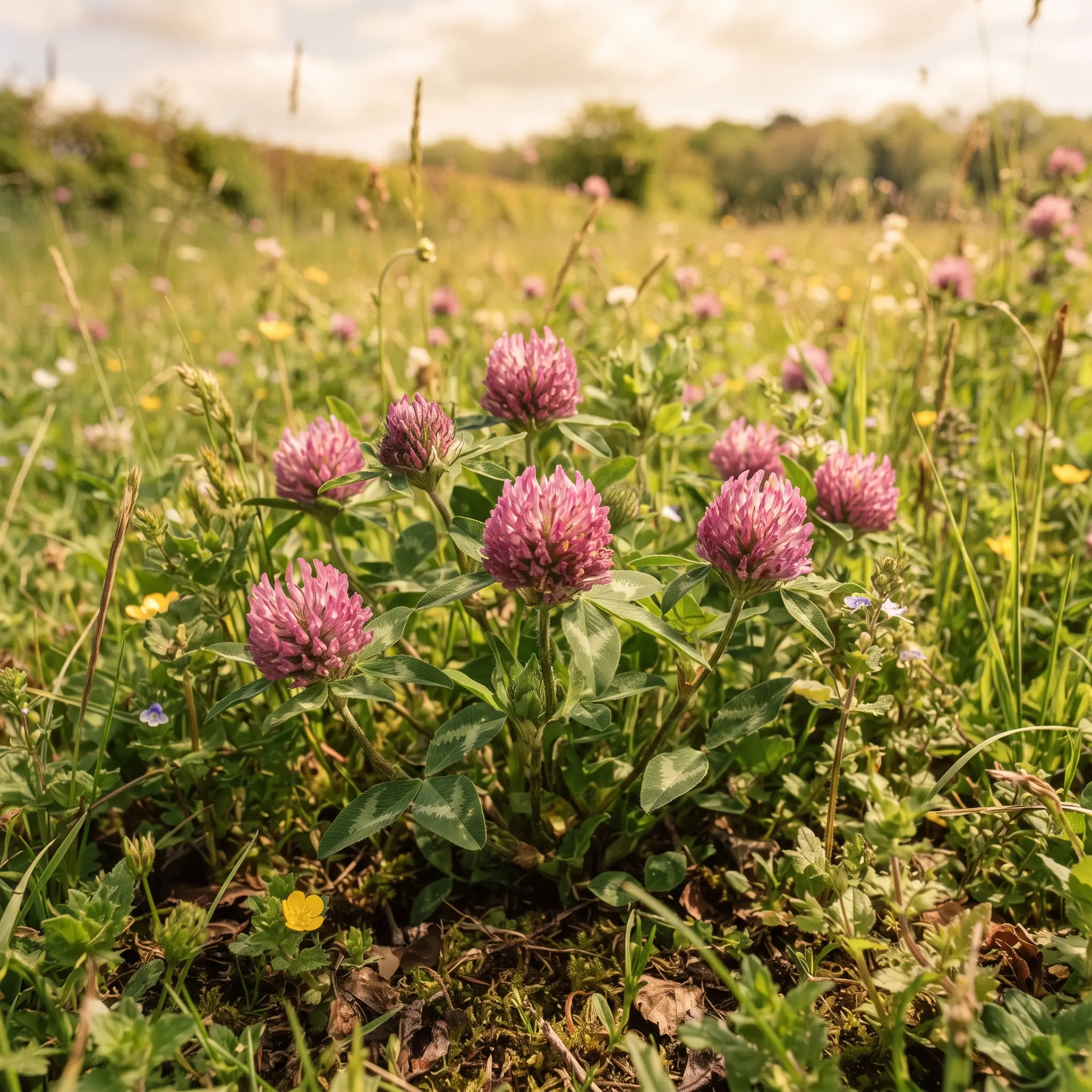
Traditionally, red clover has been used primarily for menopausal support and as a gentle herb for respiratory and skin concerns. It is commonly prepared as an infusion, tincture, dried-herb blend, or concentrated extract.
Common Name: Red Clover
Latin Name: Trifolium pratense L.
Alternate Names: Cow Clover, Meadow Clover
- Parts used: Flowering tops, flowers, leaves
- Primary properties: Alterative, expectorant, phytoestrogenic
- Common preparations: Tea, tincture, capsules, extracts
- Best known for: Traditional menopausal support
What It Helps With
Health conditions this herb is commonly used to support.
Related Buying Guides
Featured Recipes
Explore and try simple ways to prepare and use this herb at home.
Active Compounds
The tiny plant chemistry doing all the heavy lifting.
Key Herbal Properties
What this herb is known for, herbally speaking.




Herbal Synergies
Other herbs that pair especially well with this one — together, their combined properties work better than either herb does alone.
Health Conditions Red Clover Helps With
- Menopausal symptoms: Red clover has become particularly associated with traditional support during menopause, especially for occasional hot flashes and other symptoms associated with hormonal transition. Its isoflavones have mild estrogen-like activity, although clinical research on effectiveness has produced mixed results.
- Respiratory discomfort: Traditionally, red clover flowering tops have been used as an expectorant and soothing herb for coughs and irritated respiratory passages. Historical herbal sources have also associated it with whooping cough and asthma, although these traditional uses should not be confused with established medical treatments.
- Skin concerns: Red clover has a long history of traditional use in herbal formulas for chronic skin complaints, including eczema and psoriasis. It has traditionally been viewed as an alterative herb, meaning it was used in formulas intended to support overall skin and elimination function.
- Premenstrual and breast discomfort: Traditional herbal use has included red clover for premenstrual symptoms and occasional breast tenderness. These uses are based on traditional practice rather than a reliable guarantee of benefit.
- General nutritive support: Red clover has traditionally been included in nourishing herbal preparations, particularly when flowering tops are used as an infusion alongside other nutritive herbs. Its traditional role here is supportive rather than a treatment for a specific deficiency or disease.
Compounds
- Isoflavones: Red clover is particularly rich in isoflavones, a class of plant compounds with phytoestrogenic activity. The major red clover isoflavones include formononetin and biochanin A, along with daidzein and genistein.
- Formononetin: This is one of red clover’s principal isoflavones. It can be metabolized into daidzein, contributing to the herb’s overall phytoestrogenic profile.
- Biochanin A: Another major red clover isoflavone, biochanin A can be metabolized into genistein. Its presence helps distinguish red clover from many other commonly used herbal preparations.
- Daidzein and genistein: These isoflavones are also found in red clover and have been studied for their interactions with estrogen receptors and other biological pathways. Their activity does not mean that red clover functions identically to estrogen therapy.
- Flavonoids and other phenolic compounds: Red clover contains additional phenolic constituents that contribute to its broader phytochemical profile. Their individual contribution to traditional herbal effects is less clearly established than that of the isoflavones.
Properties
- Alterative: Red clover has traditionally been regarded as an alterative herb and used in formulas intended to support skin health and general elimination.
- Expectorant: Traditionally used to help loosen and clear respiratory mucus, particularly when included in soothing cough formulas.
- Antispasmodic: Historical herbal use describes red clover as an antispasmodic, which helps explain its inclusion in some traditional respiratory and menstrual formulas.
- Nutritive: The flowering tops can be used as part of a nourishing herbal infusion, particularly when combined with other mineral-rich or nutritive herbs.
- Phytoestrogenic: Red clover contains isoflavones capable of interacting with estrogen receptors. This property is central to its modern use for menopausal support and also explains several of its safety precautions.
Recipes Using Red Clover
- Red Clover Herbal Infusion: Dried flowering tops can be prepared as a simple tea and combined with other herbs when a gentle, nourishing or menopause-focused herbal infusion is desired. Traditional preparations include infusions and decoctions.
- Red Clover Tincture: A tincture provides a concentrated liquid preparation and is a traditional way to incorporate red clover into formulas. Different extraction methods can produce different phytochemical profiles.
- Menopause Herbal Blend: Red clover is often combined with other traditionally used women’s wellness herbs such as sage or black cohosh to create a broader formula rather than relying on a single herb.
Products Featuring Red Clover
- Dried Red Clover Flowering Tops: A practical choice for making tea, infusions, and custom herbal blends at home.
- Red Clover Tincture: Convenient when a liquid extract is preferred over preparing tea.
- Red Clover Extract Capsules: Concentrated extracts are often standardized for isoflavones, making them different from ordinary dried herb and more appropriate for people specifically seeking a measured extract.
Synergies
- Black Cohosh: Traditionally paired with red clover in menopause-focused herbal formulas, giving the formula complementary traditional approaches to menopausal discomfort.
- Sage: Often combined with red clover in women’s wellness teas and blends, particularly when the goal is a balanced formula rather than a single-herb preparation.
- Nettle: Red clover and nettle can be combined in nourishing herbal infusions when a mineral-rich, nutritive blend is desired.
- Burdock: Both herbs have a history of inclusion in traditional alterative formulas, particularly those aimed at supporting skin health.
Safety & Precautions
Red clover is generally considered reasonably well tolerated as an herb, but concentrated extracts deserve more caution than an occasional cup of tea. Its isoflavones have phytoestrogenic activity, and the long-term safety of supplementation is not fully established.
- Pregnancy and breastfeeding: Avoid medicinal doses and concentrated red clover preparations during pregnancy and breastfeeding because safety has not been established.
- Hormone-sensitive conditions: People with hormone-sensitive cancers or other conditions where estrogenic activity is a concern should not use concentrated red clover without discussing it with an appropriate healthcare professional.
- Blood thinners and antiplatelet medicines: Red clover may increase bleeding risk or potentially enhance the effects of anticoagulant or antiplatelet medicines. Extra caution is appropriate with medicines such as warfarin.
- Methotrexate: A reported interaction with methotrexate makes combining the two inappropriate without medical supervision.
- Surgery: Because of the potential bleeding concern, concentrated red clover supplements should be discussed with a healthcare professional before surgery.
- Pet safety: Red clover should not be given to dogs or cats as a concentrated medicinal supplement without veterinary guidance. Reliable safety information for therapeutic dosing in companion animals is limited, while the herb’s phytoestrogenic and possible bleeding-related effects warrant caution.
Q&A
Does Red Clover taste bitter?
Red clover tea is usually mild, slightly sweet, and grassy rather than strongly bitter. The flavor is generally easy to combine with other herbs.
If the tea tastes too mild or earthy, try combining it with peppermint, lemon balm, or another pleasant-tasting herb. The flavor of a tincture is considerably more concentrated.
Can Red Clover be used daily?
Red clover has traditionally been used as an ongoing herbal infusion, but daily use of concentrated extracts is a different matter. Supplements can provide substantially more isoflavones than an ordinary cup of tea.
For regular long-term use, especially of capsules or standardized extracts, it is sensible to review the choice with a healthcare professional. Long-term safety is not well established, and medication and hormone-related precautions matter.
Is Red Clover better as tea or a tincture?
Tea is the gentler, traditional option and works well when you want a simple everyday herbal infusion. Research on traditional preparations shows that infusions, decoctions, and tinctures can extract different groups and amounts of red clover constituents.
A tincture is more concentrated and convenient when preparing tea is impractical. It should not automatically be considered stronger or better simply because it is concentrated.
Can I combine Red Clover with other herbs?
Yes. Red clover is traditionally used in formulas rather than only as a single herb. Sage, black cohosh, nettle, and burdock are examples of herbs that may be selected for complementary traditional purposes.
When combining several concentrated extracts or supplements, however, the safety considerations of every ingredient need to be considered rather than assuming that natural products are automatically compatible.
Should I use fresh or dried Red Clover?
Dried flowering tops are generally the more practical choice for home herbal preparations because they are easier to store and use consistently. Red clover has traditionally been prepared as dried-herb infusions, decoctions, and tinctures.
For a home tea or custom herbal blend, properly dried flowering tops are usually the simplest format. Store dried herb in a sealed container away from heat, light, and moisture.
References
- Plants of the World Online: Trifolium pratense
- PubMed: Scientific Literature on Trifolium pratense
- National Library of Medicine: Chemical Constituents from Trifolium pratense
- Wikipedia: Trifolium pratense
- ScienceDirect: Trifolium pratense Research
- Memorial Sloan Kettering Cancer Center: About Herbs — Red Clover
- American Herbal Pharmacopoeia: Red Clover Flowering Tops
- Dynamics of the Isoflavone Metabolome of Traditional Preparations of Trifolium pratense
- Botanical Modulation of Menopausal Symptoms: Mechanisms of Action
- Health Canada: Red Clover Isoflavone Extract Monograph
This information is for educational purposes only and is not intended as medical advice. Consult a qualified healthcare professional before using any herb, especially if pregnant, breastfeeding, taking medications, or managing a health condition.