

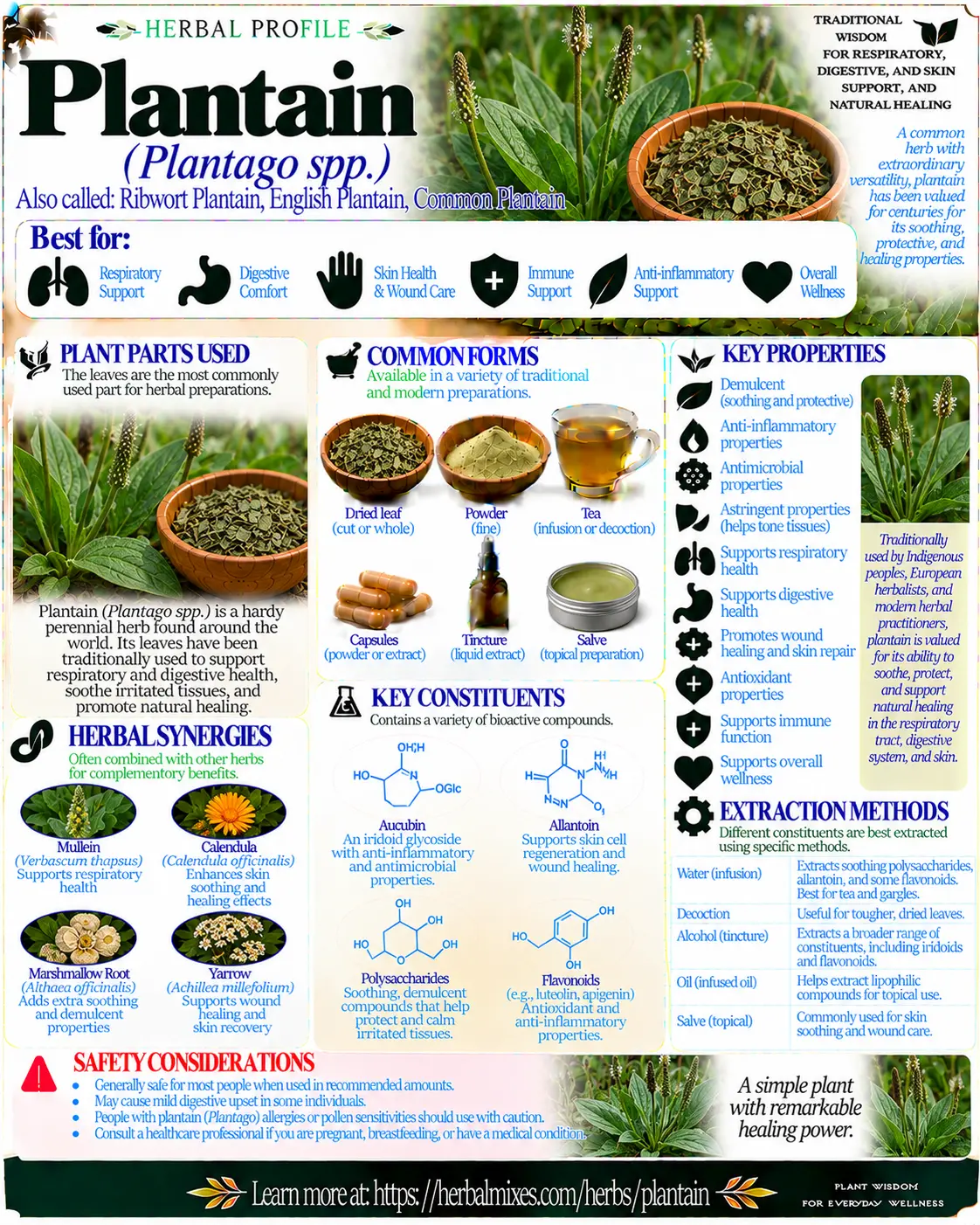
What Plantain Is Good For
Throat soothing — Plantain leaf is traditionally used to calm irritation of the mouth, throat, and upper respiratory tract. The European Medicines Agency recognizes Plantago lanceolata leaf for traditional use in cough-and-cold preparations.
Cough support — Its combination of mucilage, iridoid glycosides, and phenolic compounds makes plantain especially useful when cough is accompanied by a dry or irritated throat.
Minor skin irritation — Plantain has a strong traditional reputation for external use on minor cuts, scrapes, insect bites, and irritated skin. This use is supported mainly by traditional practice and preclinical wound-healing research rather than large clinical trials.
Digestive irritation — Plantain leaf contains mucilage and tannin-like constituents that can provide a combination of soothing and mild astringent activity in the digestive tract.
Mild astringent support — Plantain is unusual because it combines mucilage-rich soothing action with mild astringency, making it useful when tissues are both irritated and slightly weepy.
General respiratory comfort — Ribwort plantain is commonly used in European cough syrups and herbal teas for mild respiratory irritation.
Available Herbal Products
Buying Guides for Available Plantain Products
Plantain Liquid Herbal Extract – Fresh-leaf tincture. Made from certified-organic fresh Plantago major leaf at a 1:1 fresh-herb extraction ratio and currently available directly from the manufacturer. Seller: Herb Pharm – View Herb Pharm Plantain →
Plantain Extract – Low Alcohol Liquid – Low-alcohol leaf extract. Provides 2,000 mg of Plantago major leaf per serving and is currently listed in stock. Seller: Nature’s Answer – View Nature’s Answer Plantain Extract →
Plantain Leaf Tincture – Dried-leaf hydroalcoholic extract. A Plantago major tincture currently listed in stock in multiple bottle sizes. Seller: HawaiiPharm – View HawaiiPharm Plantain Tincture →
Plantain Leaf Alcohol-Free Extract – Glycerite. Made from dried Plantago major leaf using vegetable glycerin and purified water; a useful option for people who prefer to avoid alcohol. Seller: HawaiiPharm – View HawaiiPharm Plantain Alcohol-Free Extract →
Mountain Rose Herbs and Starwest Botanicals also carry dried plantain leaf and powder, but those products were listed out of stock when checked, so they are not included above as current buying options.
Herbal Synergies
Plantain pairs especially well with marshmallow root, mullein, calendula, yarrow, and chamomile depending on whether the goal is throat soothing, skin comfort, respiratory support, or tissue healing.
Plantain + Marshmallow Root
Best for: Dry throat, irritated cough, and digestive irritation
Plantain contributes mucilage, iridoids, and mild astringency, while marshmallow root provides a stronger demulcent mucilage layer.
Best extraction: Plantain as a hot infusion combined with marshmallow cold infusion. This preserves marshmallow mucilage while extracting plantain’s water-soluble constituents.
Plantain + Mullein
Best for: Dry irritated cough and respiratory comfort
Plantain adds soothing and mildly astringent action, while mullein contributes demulcent and traditional expectorant effects.
Best extraction: Hot infusion, carefully filtered.
Plantain + Calendula
Best for: Minor skin irritation and superficial wound care
Plantain provides soothing and tissue-tightening properties, while calendula adds stronger traditional vulnerary and inflammatory-supportive activity.
Best extraction: Infused oil, salve, poultice, or external wash.
Plantain + Yarrow
Best for: Minor cuts, scrapes, and weeping skin
Plantain contributes soothing and astringent properties, while yarrow adds stronger traditional styptic and vulnerary activity.
Best extraction: External infusion, wash, compress, or properly prepared topical product.
Plantain + Chamomile
Best for: Irritated skin and digestive tension
Plantain provides mucilage and iridoid support, while chamomile contributes gentler antispasmodic and anti-inflammatory activity.
Best extraction: Covered hot infusion or external wash.
Key Herbal Properties
Demulcent — Plantain leaf contains mucilage polysaccharides that help soothe irritated mucous membranes.
Astringent — Tannins and related phenolic compounds provide mild tissue-tightening activity.
Vulnerary — Plantain has longstanding traditional use in wound-care preparations for minor superficial skin injuries.
Anti-inflammatory — Iridoid glycosides such as aucubin and phenylethanoid compounds influence inflammatory pathways experimentally.
Antioxidant — Flavonoids and phenolic compounds contribute antioxidant activity.
Antimicrobial — Plantain extracts show antibacterial and antiviral effects in laboratory studies, but this does not establish it as a treatment for infection.
Expectorant / respiratory supportive — Plantago lanceolata leaf has formal European traditional-use recognition in cough-and-cold preparations.





Active Compounds
Plantain leaves contain iridoid glycosides, phenylethanoid glycosides, flavonoids, mucilage polysaccharides, tannins, phenolic acids, and small amounts of other secondary metabolites.
Aucubin
Found mainly in: Leaves and aerial parts
Aucubin is one of the characteristic iridoid glycosides of Plantago species.
It has been extensively studied for anti-inflammatory, antioxidant, hepatoprotective, and tissue-protective activity, although much of this research is preclinical.
Best extraction: Water or hydroalcoholic extraction. Aucubin is a polar glycoside and extracts well in aqueous solvents.
Catalpol
Found mainly in: Leaves
Catalpol is another iridoid glycoside found in Plantago species and contributes to the herb’s broader anti-inflammatory and antioxidant profile.
Best extraction: Hot water or diluted alcohol.
Acteoside
Found mainly in: Leaves
Acteoside, also called verbascoside, is a phenylethanoid glycoside with antioxidant and inflammatory-modulating activity.
Best extraction: Water or hydroalcoholic tincture.
Mucilage Polysaccharides
Found mainly in: Leaves
Plantain contains mucilage, which absorbs water and helps explain its traditional soothing effect on irritated throat and digestive tissues.
Best extraction: Water. Long or moderately warm infusions are especially appropriate when mucilage is a priority.
Allantoin
Found mainly in: Leaves and aerial tissues
Allantoin is commonly associated with plantain’s traditional wound-healing reputation and is used in many commercial skin-care products for soothing and tissue support.
Best extraction: Water-based or hydroalcoholic preparations.
Flavonoids
Found mainly in: Leaves
Plantain contains flavonoids including apigenin- and luteolin-related compounds, which contribute antioxidant and inflammatory-modulating effects.
Best extraction: Hot water or diluted alcohol.
Tannins
Found mainly in: Leaves
Tannins provide plantain’s mild astringency and complement its soothing mucilage.
Best extraction: Hot-water infusion or hydroalcoholic tincture.
Phenolic Acids
Found mainly in: Leaves and aerial parts
Plantain contains several phenolic acids that contribute antioxidant activity.
Best extraction: Water or hydroalcoholic extraction.
-
FAQ
What is plantain best used for?
Plantain leaf is best suited to soothing irritated throat and respiratory tissues, supporting minor skin irritation, and providing gentle digestive demulcent and astringent effects.
Is Plantago plantain the same as banana plantain?
No.
Herbal plantain refers to Plantago major or Plantago lanceolata. Banana-like cooking plantains belong to the genus Musa and are completely unrelated.
Is plantain the same as psyllium?
No.
Psyllium comes primarily from Plantago ovata seed husks and is used mainly as a bulk-forming fiber.
This profile concerns Plantago leaf, not psyllium husk.
Is Plantago major the same as Plantago lanceolata?
They are different but closely related species.
Plantago major has broader oval leaves, while Plantago lanceolata has narrower lance-shaped leaves. They share many traditional uses, although EMA’s current formal monograph specifically covers P. lanceolata leaf for cough-and-cold use.
Is plantain tea or tincture better?
For throat soothing and mucilage extraction, tea is often the better choice.
Tincture is more concentrated and convenient and captures a broader range of iridoids, phenolics, and less-water-soluble compounds.
Safety & Precautions
Plantain leaf is generally considered a gentle herb, and serious adverse reactions appear uncommon.
Allergic reactions are possible, particularly in people sensitive to Plantago pollen.
Stop use if you develop rash, swelling, wheezing, throat tightness, or worsening respiratory symptoms.
Safety during pregnancy and breastfeeding has not been thoroughly established for concentrated medicinal preparations. Culinary or incidental exposure is different from concentrated tinctures and extracts.
There are no well-established major drug interactions with plantain leaf, but this reflects limited interaction data rather than proof that interactions are impossible.
Because plantain contains mucilage, very large or concentrated oral preparations could theoretically slow absorption of medications, particularly if taken at the same time. Separating mucilage-rich preparations from prescription medicines by a couple of hours is a reasonable precaution.
Fresh plantain gathered from roadsides, lawns, or parks should only be used if the plant is positively identified and free from pesticides, herbicides, pet contamination, or roadside pollution.
Do not apply fresh plant material directly to deep puncture wounds, serious burns, infected wounds, animal bites, or heavily contaminated injuries without appropriate medical care.
Plantain should not replace medical treatment for pneumonia, severe asthma, serious infection, persistent coughing, or significant gastrointestinal disease.
Seek medical care for cough accompanied by difficulty breathing, chest pain, coughing blood, persistent high fever, or symptoms that are severe or worsening.
Anyone pregnant, breastfeeding, taking prescription medications, or managing a significant chronic condition should discuss concentrated therapeutic plantain use with an appropriate healthcare professional.
References
- European Medicines Agency — Plantaginis lanceolatae folium
- PubMed — Chemical Constituents and Medical Benefits of Plantago major
- PubMed — Characteristics, Isolation Methods, and Biological Properties of Aucubin
- PubMed — Pharmacology and Toxicology of Aucubin
- Herb Pharm — Plantain Liquid Herbal Extract
- Nature’s Answer — Plantain Extract
- HawaiiPharm — Plantain Leaf Tincture
- HawaiiPharm — Plantain Leaf Alcohol-Free Extract
- Mountain Rose Herbs — Plantain Leaf
- Starwest Botanicals — Organic Plantain Leaf
Disclaimer
Disclaimer: This article is for educational purposes only and is not intended to diagnose, treat, cure, or prevent any disease. Herbal products can cause side effects and interact with medications. Consult a qualified healthcare professional before using herbs therapeutically, especially if you are pregnant, breastfeeding, taking prescription medications, or managing a medical condition.