

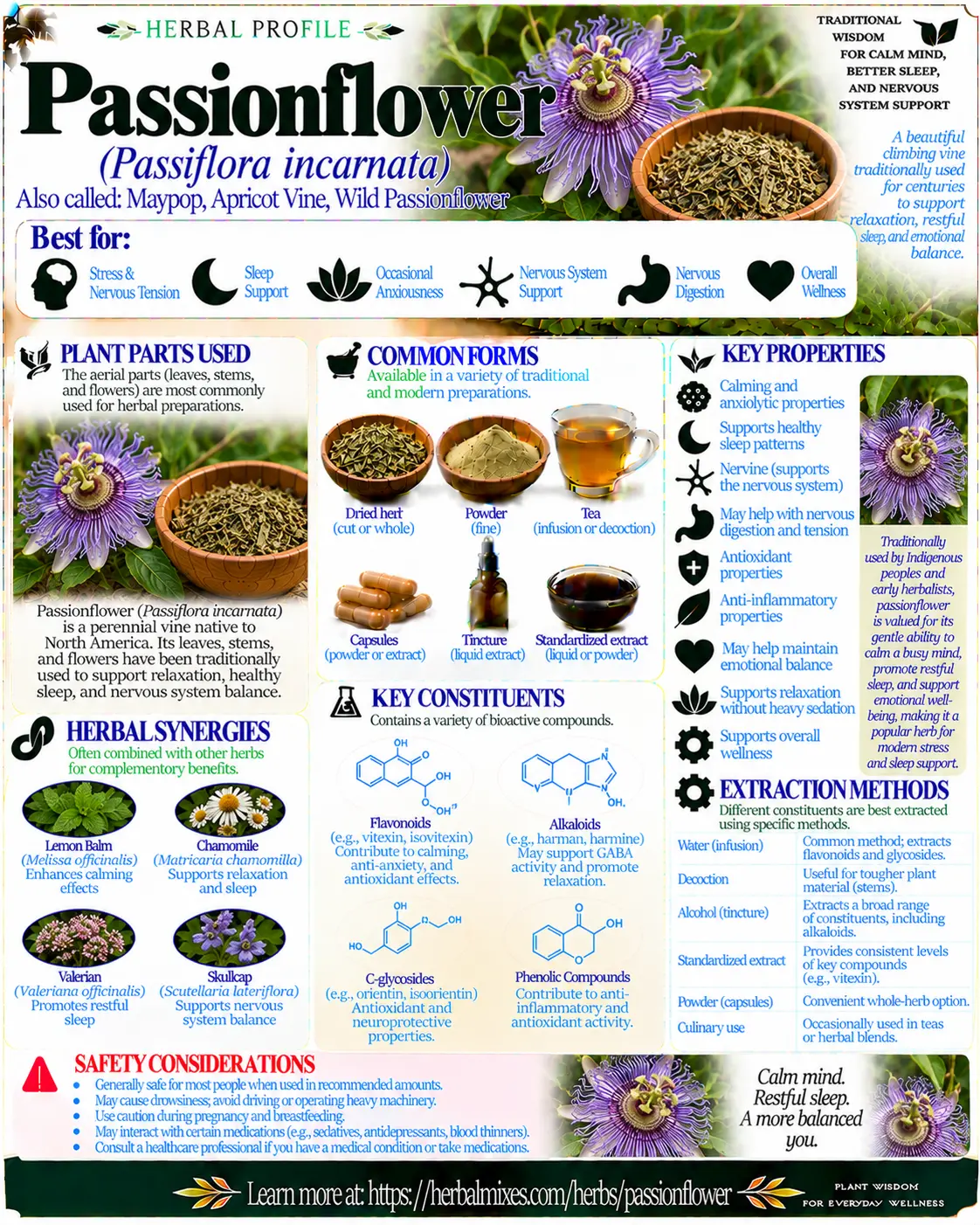
What Passionflower Is Good For
Stress & nervous tension — Passionflower is a gentle calming nervine traditionally used when stress produces restlessness, mental overactivity, or difficulty relaxing. The European Medicines Agency recognizes Passiflora incarnata for traditional relief of mild mental stress.
Occasional anxiousness — Small human trials suggest passionflower may reduce anxiety symptoms. One randomized trial comparing passionflower extract with oxazepam in generalized anxiety disorder found improvement with both treatments, although the study involved only 36 participants and larger trials are needed.
Sleep support — Passionflower is particularly useful when difficulty sleeping is connected to mental tension or an inability to wind down. EMA recognizes traditional use to aid sleep, and a placebo-controlled tea study found improved subjective sleep quality.
Restlessness — Its calming activity can be useful when nervous energy produces physical agitation without requiring a strongly sedating herb.
Stress-related sleep problems — A randomized 30-day trial involving 65 adults with stress and insomnia found improvements in perceived stress and total sleep time with a standardized Passiflora incarnata extract compared with placebo.
Available Herbal Products
Buying Guides for Available Passionflower Products
Passionflower Liquid Herbal Extract – Certified-organic aerial-parts tincture. Made from Passiflora incarnata leaf, flower, and succulent stem at a 1:5 herb-to-menstruum ratio and currently available directly from the manufacturer. Seller: Herb Pharm – View Herb Pharm Passionflower →
Passion Flower 350 mg – Standardized capsules. Provides Passiflora incarnata extract standardized to 3.5% total flavonoids calculated as vitexin and isovitexin and is currently available. Seller: NOW Foods – View NOW Passion Flower →
Organic Passion Flower Herb Powder – Whole aerial-herb powder. A single-ingredient organic Passiflora incarnata preparation currently listed in stock and suitable for capsules or herbal formulations. Seller: Starwest Botanicals – View Starwest Organic Passion Flower Powder →
Passion Flower 250 mg – Standardized extract capsules. Provides Passiflora incarnata aerial-parts extract standardized to 3.5% flavonoids calculated as isovitexin and is currently available through iHerb. Seller: NaturesPlus / iHerb – View NaturesPlus Passion Flower →
Organic Passionflower 400 mg – Whole-herb capsules. Provides organic Passiflora incarnata in a measured vegan capsule format and is currently available through iHerb. Seller: Oregon’s Wild Harvest / iHerb – View Oregon’s Wild Harvest Passionflower →
Mountain Rose Herbs and Starwest Botanicals also carry loose cut-and-sifted passionflower, but those products were listed out of stock when checked, so they are not included above as current buying options.
Herbal Synergies
Passionflower pairs especially well with lemon balm, valerian, skullcap, chamomile, and hops depending on whether the goal is daytime calm, racing thoughts, muscular tension, or stronger nighttime sleep support.
Passionflower + Lemon Balm
Best for: Stress, anxiousness, and difficulty winding down
Passionflower contributes calming and sleep-supportive activity, while lemon balm adds gentle nervine and digestive support.
This is one of the better combinations when emotional tension is accompanied by nervous digestion.
Best extraction: Covered hot infusion or hydroalcoholic tincture. Covering the tea helps preserve lemon balm’s volatile oils while extracting passionflower flavonoids.
Passionflower + Valerian
Best for: Difficulty falling asleep and nighttime restlessness
Passionflower provides calming support for mental overactivity, while valerian contributes stronger sedative and sleep-promoting activity.
This combination is usually better suited to evening use because it may increase drowsiness.
Best extraction: Hydroalcoholic tincture or standardized extracts.
Passionflower + Skullcap
Best for: Nervous tension with physical restlessness
Passionflower helps quiet mental overactivity, while skullcap contributes a relaxing nervine effect traditionally used for muscular and nervous tension.
Best extraction: Tincture or hot infusion.
Passionflower + Chamomile
Best for: Mild stress with digestive tension
Passionflower contributes nervous-system calming, while chamomile adds gentle antispasmodic and digestive support.
Best extraction: Covered hot infusion or tincture.
Passionflower + Hops
Best for: Stronger nighttime relaxation
Passionflower helps reduce mental restlessness, while hops contributes a more sedating bitter-nervine effect.
Best extraction: Tincture or standardized extract.
This combination may increase drowsiness and is generally best reserved for evening use.
Key Herbal Properties
Nervine — Passionflower is traditionally used to calm nervous tension and restlessness without the intensity of stronger sedatives.
Anxiolytic — Small controlled human trials suggest anxiety-reducing effects, although the overall clinical evidence remains limited.
Sedative — Passionflower may produce mild sedation and is widely used in nighttime herbal formulas.
Sleep supportive — EMA recognizes traditional use to aid sleep, particularly when mild mental stress contributes to sleep difficulty.
Antispasmodic — Traditional and experimental research supports smooth-muscle-relaxing activity that may contribute to its calming profile.
Antioxidant — Flavonoids including vitexin, isovitexin, orientin, and related compounds contribute antioxidant activity.
Neuroactive — Laboratory and animal studies suggest interaction with GABA-related signaling, although the exact compounds and mechanisms responsible for passionflower’s clinical effects remain incompletely understood.





Active Compounds
Passionflower contains a characteristic mixture of C-glycosyl flavonoids, other flavonoids, phenolic compounds, small quantities of alkaloids, sugars, and other secondary metabolites. The flavonoid profile can vary between plant chemotypes.
Vitexin
Found mainly in: Leaves and flowering aerial parts
Vitexin is an apigenin C-glycoside frequently used as a marker compound in passionflower extracts.
It has demonstrated antioxidant, inflammatory-modulating, and neuroactive effects experimentally.
Best extraction: Hot water or hydroalcoholic extraction. Its glycoside structure makes it relatively polar.
Isovitexin
Found mainly in: Aerial parts
Isovitexin is an isomer of vitexin and one of the major flavonoids associated with Passiflora incarnata.
Some standardized passionflower supplements quantify total flavonoids as vitexin and isovitexin.
Best extraction: Water or hydroalcoholic tincture.
Schaftoside
Found mainly in: Leaves and flowering vine
Schaftoside is another characteristic C-glycosyl flavonoid found in common Passiflora incarnata chemotypes.
Pharmacognosy research has identified chemotypes rich in isovitexin and schaftoside-related compounds.
Best extraction: Hot water or diluted alcohol.
Isoschaftoside
Found mainly in: Aerial parts
Isoschaftoside commonly occurs alongside schaftoside and contributes to passionflower’s flavonoid fingerprint.
Best extraction: Water or hydroalcoholic extraction.
Orientin
Found mainly in: Leaves and flowering aerial parts
Orientin is a luteolin C-glycoside widely identified in Passiflora species and contributes antioxidant and neuroprotective effects experimentally.
Best extraction: Hot-water infusion or diluted alcohol.
Isoorientin
Found mainly in: Aerial parts
Isoorientin is closely related to orientin and is another characteristic passionflower flavonoid.
Best extraction: Hot water or hydroalcoholic tincture.
Apigenin
Found mainly in: Aerial parts
Apigenin is a flavonoid with known interactions with several neurochemical pathways in experimental research.
It may contribute to passionflower’s calming profile, although the whole herb’s effects cannot be attributed to apigenin alone.
Best extraction: Hydroalcoholic extraction; glycosylated forms are more readily extracted into water.
Harman-Type Alkaloids
Found mainly in: Reported in very small or variable amounts in aerial tissues
Older literature describes trace beta-carboline alkaloids such as harman, harmine, harmol, and related compounds.
Modern analyses suggest their levels may be very low or inconsistent, so they should not be considered the primary explanation for passionflower’s effects.
Best extraction: Alcohol-containing preparations would generally extract these alkaloids more effectively than plain water.
FAQ
What is passionflower best used for?
Passionflower is best suited to mild stress, nervous tension, occasional anxiousness, restlessness, and sleep difficulty associated with an overactive mind.
EMA recognizes its traditional use for mild mental stress and as an aid to sleep.
Does passionflower really help anxiety?
Possibly.
A small randomized study involving 36 adults with generalized anxiety disorder found passionflower extract and oxazepam both improved symptoms over four weeks.
Because the trial was small, passionflower should not be considered a replacement for established anxiety treatment.
Does passionflower make you sleepy?
It can.
Some people experience noticeable relaxation or drowsiness, especially with concentrated extracts or when combined with valerian, hops, alcohol, or sedative medications.
Is passionflower tea or tincture better?
Both can work.
Tea effectively extracts many flavonoids and is well suited to mild evening relaxation. Tincture or standardized extract provides a more concentrated and convenient preparation when stronger or more consistent dosing is desired.
How quickly does passionflower work for sleep?
Some people use it shortly before bedtime for immediate relaxation, while clinical studies have also examined repeated use over several days or weeks.
It is better suited to mild, stress-related sleep difficulty than severe chronic insomnia.
Safety & Precautions
Passionflower is generally considered a relatively gentle calming herb when used appropriately, but it can cause drowsiness, dizziness, confusion, or impaired coordination in some people.
Avoid driving, operating machinery, or performing activities requiring full alertness if passionflower makes you sleepy.
Use caution when combining passionflower with benzodiazepines, sleep medicines, sedating antihistamines, opioids, anticonvulsants, alcohol, valerian, hops, kava, or other CNS depressants, because sedative effects may be additive.
Pregnancy is an important precaution. Passionflower has historically been associated with uterine activity, and commercial manufacturers including Gaia Herbs advise against use during pregnancy.
Safety during breastfeeding has not been adequately established for concentrated medicinal preparations.
EMA recommends passionflower medicinal products for adults and adolescents over 12 years, based on traditional-use preparations.
Passionflower should not be used as a substitute for professional treatment of severe anxiety, panic disorder, major depression, persistent insomnia, or other psychiatric conditions.
Seek professional evaluation if sleep or anxiety symptoms are severe, worsening, associated with significant daytime impairment, or persist despite self-care.
Stop use and seek care for an unusual allergic reaction, severe dizziness, fainting, confusion, or abnormal heart symptoms.
Anyone who is pregnant, breastfeeding, taking sedative or psychiatric medication, or managing a significant neurological or psychiatric condition should discuss therapeutic passionflower use with an appropriate healthcare professional.
References
- European Medicines Agency — Passiflorae Herba
- PubMed — Passionflower vs. Oxazepam for Generalized Anxiety Disorder
- PubMed — Passionflower Tea and Subjective Sleep Quality
- PubMed — Passionflower Extract for Stress and Sleep Problems
- PubMed — Pharmacognosy and Chemotypes of Passiflora incarnata
- PubMed — Phenolic Compounds in Passiflora Species
- PubMed — Vitexin and Isovitexin Pharmacology Review
- Herb Pharm — Passionflower Liquid Herbal Extract
- NOW Foods — Passion Flower 350 mg
- Starwest Botanicals — Organic Passion Flower Powder
- Gaia Herbs — Passionflower Reference Guide
- NaturesPlus / iHerb — Passion Flower 250 mg
Disclaimer
Disclaimer: This article is for educational purposes only and is not intended to diagnose, treat, cure, or prevent any disease. Herbal products can cause side effects and interact with medications. Consult a qualified healthcare professional before using herbs therapeutically, especially if you are pregnant, breastfeeding, taking prescription medications, or managing a medical condition.