

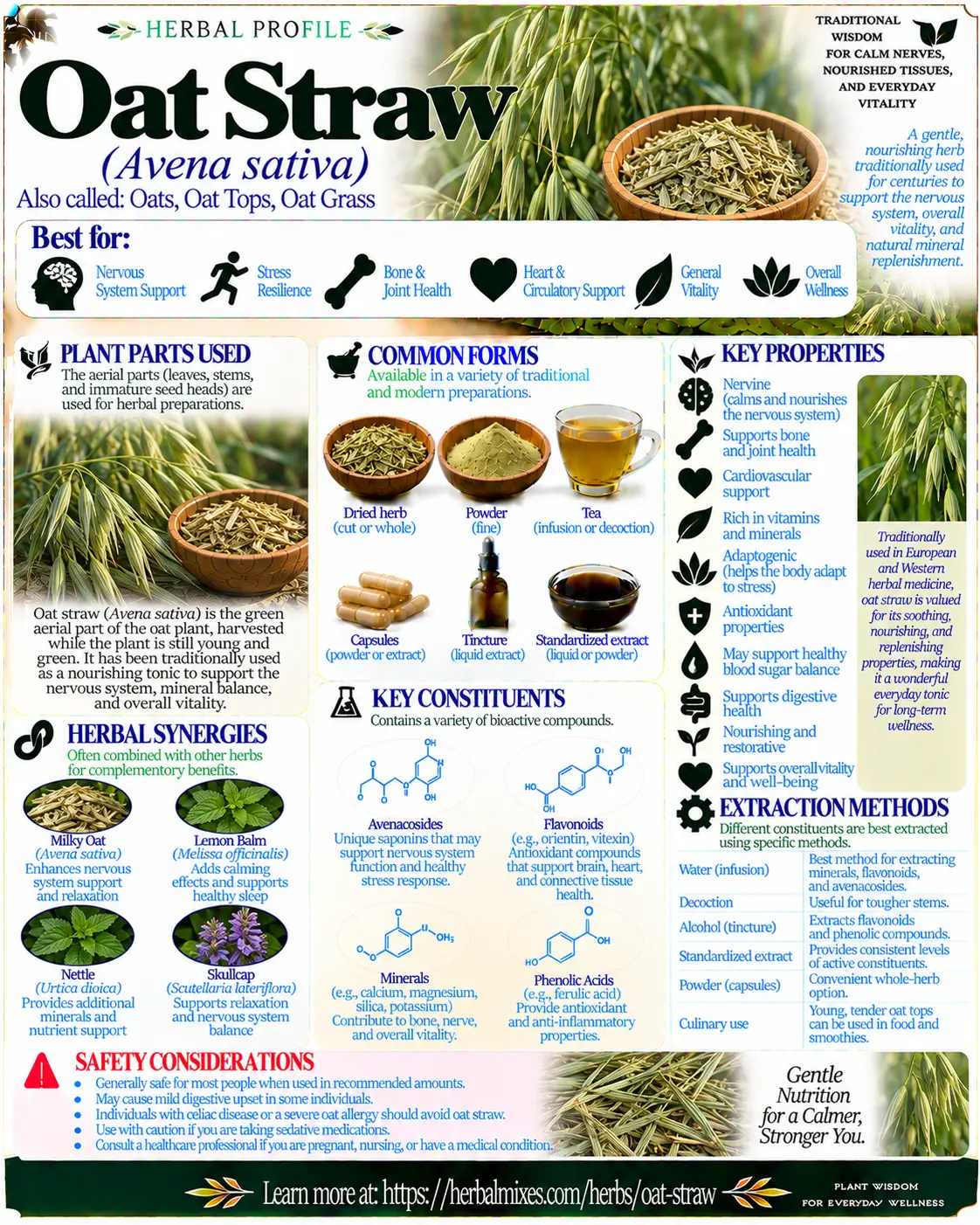
What Oat Straw Is Good For
Nervous-system nourishment — Oat straw is traditionally regarded as a gentle nutritive nervine, particularly suited to people who feel depleted or mentally worn down rather than needing strong sedation.
Stress & nervous tension — The European Medicines Agency recognizes Avena sativa herb—its aerial parts harvested before flowering—for traditional use in mild mental stress and as an aid to sleep.
Restorative support — Herbalists commonly use oat straw over time as a rebuilding tonic during periods of prolonged stress, overwork, or exhaustion. It is generally gentler and less immediately sedating than valerian, hops, or kava.
Mental fatigue & focus — Standardized green oat extracts have been studied for cognition. A randomized trial in healthy adults found improvements in several working-memory and multitasking measures after acute and four-week supplementation, although these specialized extracts are not equivalent to ordinary oat-straw tea.
Mild sleep difficulty — Oat herb is most appropriate when sleep problems accompany mild stress and nervous depletion rather than severe insomnia.
Everyday nutritional support — Oat straw provides minerals and a broad range of plant constituents and is traditionally prepared as a long water infusion when the goal is gentle daily nourishment.
Available Herbal Products
Buying Guides for Available Oat Straw Products
True Herbs Avena Sativa – Oat-straw stem capsules. Provides 350 mg of Avena sativa oat straw per capsule and offers a convenient whole-herb option without requiring tea preparation. Seller: Solaray / iHerb – View Solaray Avena Sativa →
Avena Sativa 10:1 Extract – Concentrated whole-plant capsules. Provides a concentrated oat-straw extract for people who prefer an extract rather than loose herb; note that the current formula contains wheat/gluten. Seller: Swanson / iHerb – View Swanson Avena Sativa →
Oat Seed Liquid Herbal Extract – Fresh milky-oat tincture. This is not oat straw, but it is closely related and useful when the goal is traditional nervous-system support; Herb Pharm prepares it from fresh immature “milky” Avena sativa seed. Seller: Herb Pharm – View Herb Pharm Oat Seed →
Oat Seed Alcohol-Free – Fresh milky-oat glycerite. An alcohol-free alternative prepared from fresh immature oat seed and currently available directly from the manufacturer. Seller: Herb Pharm – View Herb Pharm Oat Seed Alcohol-Free →
Organic Oatstraw – Dried loose aerial herb. Well suited to long nourishing infusions and homemade preparations, although Mountain Rose Herbs currently lists it as out of stock. Seller: Mountain Rose Herbs – View Mountain Rose Herbs Oatstraw →
When shopping, distinguish oat straw, milky oats, and oat grain. They all come from Avena sativa, but they are harvested at different stages and used differently.
Herbal Synergies
Oat straw pairs especially well with lemon balm, skullcap, passionflower, nettle, and ashwagandha depending on whether the goal is nervous-system nourishment, relaxation, sleep, or recovery from prolonged stress.
Oat Straw + Lemon Balm
Best for: Stress, tension, and gentle daytime relaxation
Oat straw provides slow restorative nervous-system support, while lemon balm contributes more immediate aromatic calming and digestive effects.
Best extraction: Long oat-straw infusion combined with a shorter covered lemon-balm infusion. This extracts oat straw’s water-soluble constituents while preserving lemon balm’s volatile oils.
Oat Straw + Skullcap
Best for: Nervous exhaustion with muscular tension
Oat straw provides nourishing, rebuilding support, while skullcap adds a more direct relaxing nervine effect.
Best extraction: Oat-straw infusion combined with skullcap tincture or tea.
Oat Straw + Passionflower
Best for: Evening restlessness and difficulty winding down
Oat straw provides a gentle restorative base, while passionflower is better suited to racing thoughts and nighttime mental restlessness.
Best extraction: Hot infusion or separate tinctures.
Oat Straw + Nettle
Best for: Mineral-rich restorative support
Both herbs are commonly used as nutritive green infusions. Nettle contributes particularly strong mineral and polyphenol nutrition, while oat straw adds traditional nervine support.
Best extraction: Long hot-water infusion. This is one of the most logical combinations when nutritional extraction is the priority.
Oat Straw + Ashwagandha
Best for: Prolonged stress and fatigue
Oat straw contributes gentle nervous-system nourishment, while ashwagandha adds stronger adaptogenic support for stress resilience and recovery.
Best extraction: Oat-straw infusion combined with ashwagandha decoction, powder, or standardized extract.
Key Herbal Properties
Nutritive nervine — Oat straw is traditionally used as a gentle restorative for the nervous system rather than as a strongly sedating herb.
Mild anxiolytic / calming — European traditional-use evaluation supports oat herb for mild mental stress.
Mild sleep supportive — Oat herb has traditional use as an aid to sleep when nervous tension is involved.
Nootropic / cognitive supportive — Specialized green-oat extracts have improved selected cognitive measures in human trials, although results are not completely consistent.
Antioxidant — Oat aerial tissues contain polyphenols, flavonoids, and avenanthramide-related compounds with antioxidant activity.
Restorative tonic — Traditional herbal practice uses oat straw as a gradual rebuilding herb during nervous exhaustion or prolonged stress.
Nutritive — Oat straw supplies minerals and other water-soluble constituents that make it particularly suited to long infusions.




Active Compounds
Oat straw and green oat herb contain flavonoids, triterpenoid saponins, avenanthramides, phenolic acids, minerals, polysaccharides, and other polyphenols. Specialized green-oat extracts used in cognition research can have a substantially different chemical profile from ordinary dried oat straw.
Avenanthramides
Found mainly in: Oat grain and aerial tissues
Avenanthramides are distinctive phenolic alkaloid-like compounds characteristic of oats.
They are best known for antioxidant and inflammatory-modulating activity and contribute to the broader protective chemistry of Avena sativa.
Best extraction: Water or hydroalcoholic extraction. Avenanthramides are sufficiently polar to occur in aqueous preparations.
Flavonoids
Found mainly in: Green aerial parts
Oat herb contains several flavonoids that contribute antioxidant activity and form part of the phytochemical profile of standardized green-oat extracts.
Best extraction: Hot water or hydroalcoholic tincture.
Triterpenoid Saponins
Found mainly in: Green aerial tissues
Oat herb contains triterpene saponins, including avenacoside-related compounds, that have been discussed as potentially relevant to its neurological and stress-related effects. Green-oat cognition research specifically notes triterpene saponins among potentially psychoactive constituents.
Best extraction: Water or hydroalcoholic extraction.
Avenacosides
Found mainly in: Green aerial portions
Avenacosides are steroidal saponin glycosides characteristic of oats.
They contribute to the plant’s broader secondary-metabolite profile, although their exact contribution to human nervous-system effects is uncertain.
Best extraction: Water or hydroalcoholic tincture because glycosides have useful polarity.
Phenolic Acids
Found mainly in: Aerial parts
Oat straw contains phenolic acids that complement its flavonoid and avenanthramide antioxidant profile.
Best extraction: Hot-water infusion or diluted alcohol.
Polysaccharides
Found mainly in: Stems and aerial tissues
Water-soluble polysaccharides contribute to the gentle nutritive character of oat-straw infusions.
Best extraction: Long hot-water infusion.
Minerals
Found mainly in: Aerial tissues
Oat straw is traditionally valued as a mineral-rich herb and supplies minerals including calcium, magnesium, iron, manganese, and silica-related compounds, though actual amounts vary with soil and harvesting conditions.
Best extraction: Long hot-water infusion. Minerals are not efficiently captured by high-proof alcohol alone.
FAQ
What is oat straw best used for?
Oat straw is best suited to gentle nervous-system nourishment, mild stress, nervous depletion, and restorative support.
EMA recognizes oat herb for mild mental stress and sleep support based on long-standing traditional use.
Is oat straw the same as milky oats?
No.
Oat straw refers to the green aerial portions of Avena sativa, while milky oats are the immature seeds harvested during the brief stage when they contain a white milky fluid.
Herb Pharm’s Oat Seed extract, for example, is specifically prepared from fresh milky seed rather than straw.
Which is better: oat straw or milky oats?
Neither is universally better.
Oat straw is traditionally favored for long-term nutritive and restorative support, especially as tea. Milky oats are commonly used as fresh tinctures or glycerites for more focused nervous-system formulas.
Does oat straw improve memory?
Ordinary oat-straw tea has not been proven to improve memory.
However, several studies of specialized standardized green-oat extracts have reported improvements in selected attention, working-memory, and cognitive-performance measures. One older 12-week study found no sustained cognitive benefit, showing that the evidence is mixed.
Is oat straw tea or tincture better?
For nutritive and mineral-focused use, tea or a long infusion is generally the better choice.
Tinctures are more convenient and capture a broader range of phytochemicals, while fresh milky-oat tincture is a distinct preparation used specifically for nervous-system support.
Safety & Precautions
Oat straw is generally considered a gentle herb, and serious adverse reactions to ordinary preparations are uncommon.
The most important practical issue is gluten contamination.
Oats themselves do not naturally contain wheat gluten, but conventional oats are frequently contaminated with wheat, barley, or rye during growing, harvesting, processing, or packaging. People with celiac disease or medically diagnosed gluten intolerance should select products specifically labeled and tested as gluten-free.
Herb Pharm, for example, labels its current Oat Seed products gluten-free, while Swanson’s concentrated Avena Sativa product sold through iHerb specifically states that it contains wheat (gluten).
People with an oat allergy should avoid oat-straw preparations.
Rarely, individuals with celiac disease may also react to the oat protein avenin even when uncontaminated gluten-free oats are used.
Safety during pregnancy and breastfeeding has not been extensively studied for concentrated medicinal green-oat extracts. Ordinary oat foods are clearly different from medicinal extracts, so professional guidance is appropriate for concentrated supplementation.
EMA’s traditional monograph does not identify major known drug interactions for oat herb, but evidence is limited rather than proof that interactions are impossible.
Because oat straw is gently calming, use additional caution if combining concentrated preparations with multiple sedative medicines or strongly sedating herbs, particularly if drowsiness occurs.
Do not use oat straw as a substitute for medical treatment of severe anxiety, major depression, persistent insomnia, cognitive decline, or neurological disease.
Anyone with celiac disease, oat allergy, pregnancy, breastfeeding, or prescription medication use should choose appropriately tested products and discuss concentrated therapeutic use with an appropriate healthcare professional.
References
- European Medicines Agency — Avenae Herba
- PubMed — Acute and Chronic Green Oat Extract Effects on Cognition and Stress
- PubMed — Acute Effects of Wild Green Oat Extract on Cognitive Function
- PubMed — Chronic Green Oat Extract and Cognition in Older Adults
- PubMed — Green Oat Extract During Smoking Reduction
- Herb Pharm — Oat Seed Liquid Herbal Extract
- Herb Pharm — Oat Seed Alcohol-Free
- Solaray / iHerb — True Herbs Avena Sativa
- Swanson / iHerb — Avena Sativa Extract
- Mountain Rose Herbs — Organic Oatstraw
Disclaimer
Disclaimer: This article is for educational purposes only and is not intended to diagnose, treat, cure, or prevent any disease. Herbal products can cause side effects and interact with medications. Consult a qualified healthcare professional before using herbs therapeutically, especially if you are pregnant, breastfeeding, taking prescription medications, or managing a medical condition.