

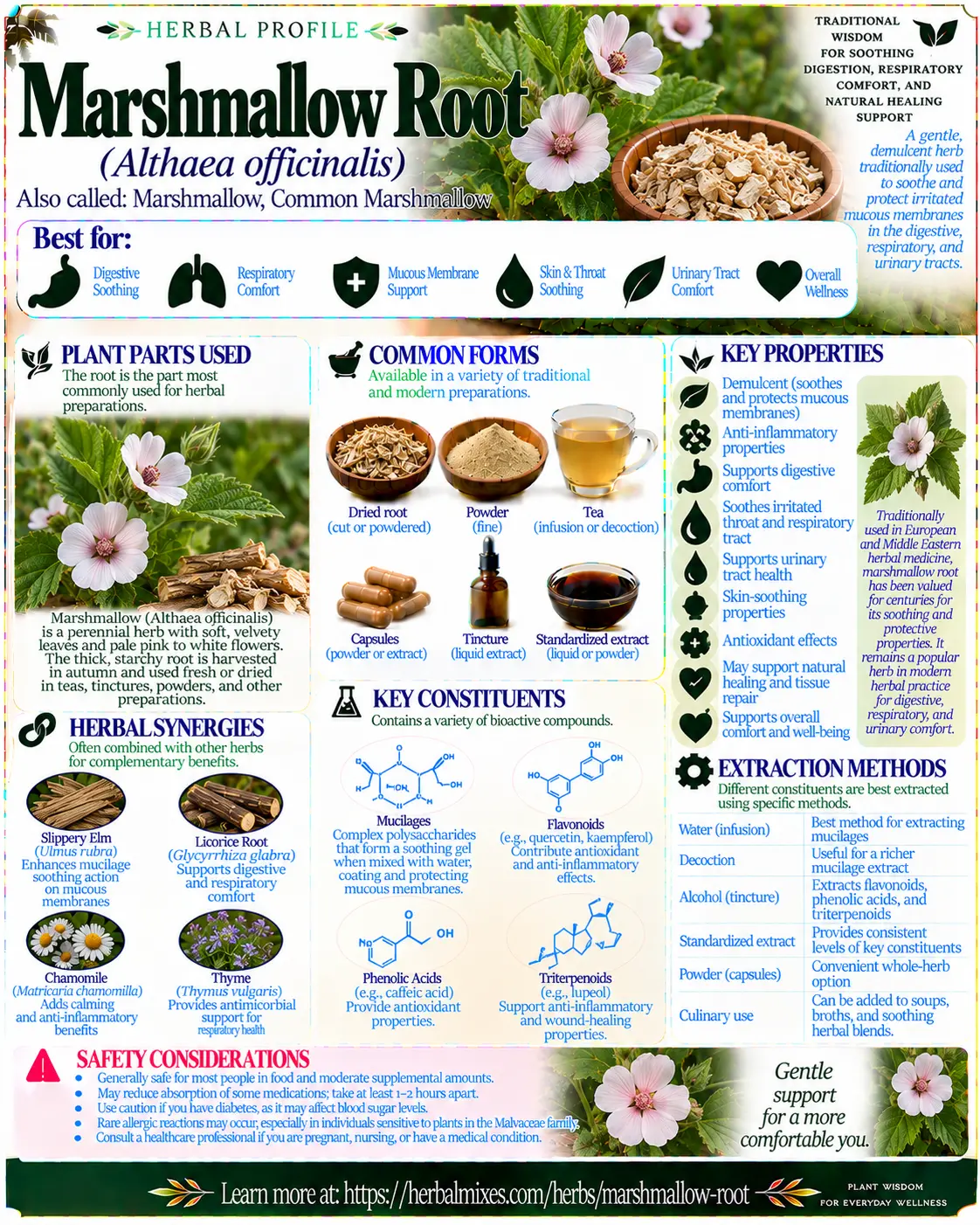
What Marshmallow Root Is Good For
Dry irritated throat — Marshmallow root is one of the classic demulcent herbs, forming a slippery mucilage-rich preparation that coats and soothes irritated tissues of the mouth and throat. The European Medicines Agency recognizes traditional use for irritation of the mouth or throat.
Dry cough — EMA also recognizes marshmallow root for dry cough associated with throat irritation. It is better suited to dry, scratchy coughs than to thick, heavily congested coughs that primarily need stronger expectorant herbs.
Digestive irritation — Marshmallow’s mucilaginous polysaccharides absorb water and create a soothing gel-like texture that can help comfort irritated digestive mucous membranes. Traditional Medicinals specifically describes water-soaked marshmallow root as soothing to the digestive tract.
Mild stomach and intestinal discomfort — EMA recognizes marshmallow root for relief of mild gastrointestinal discomfort based on long-standing traditional use.
Sensitive mucous membranes — Its soothing action makes marshmallow useful in formulas where tissues feel dry, irritated, or raw, including respiratory and digestive preparations.
Urinary tract soothing — Marshmallow is commonly included in traditional urinary formulas for its demulcent qualities, especially when irritation accompanies urinary discomfort. It should not be relied on to treat a urinary tract infection.
Available Herbal Products
Buying Guides for Available Marshmallow Root Products
Organic Marshmallow Root Cut & Sifted – Dried loose root. An excellent choice for making cold infusions, teas, syrups, or custom demulcent blends; it is currently listed in stock. Seller: Starwest Botanicals – View Starwest Botanicals Organic Marshmallow Root →
Marshmallow Liquid Herbal Extract – Fresh-root tincture. A 1:2.5 fresh-root hydroalcoholic extract made from certified-organic Althaea officinalis and currently available directly from the manufacturer. Seller: Herb Pharm – View Herb Pharm Marshmallow →
Marshmallow Root Fluid Extract Alcohol-Free – Alcohol-free liquid extract. A convenient concentrated liquid option for people who prefer drops rather than tea or capsules. Seller: iHerb / Nature’s Answer – View Nature’s Answer Marshmallow Root Extract →
Marshmallow Root – Whole-root capsules. Provides powdered Althaea officinalis root in a measured capsule format and is currently available through iHerb even though the manufacturer’s own site lists it as backordered. Seller: iHerb / Nature’s Way – View Nature’s Way Marshmallow Root →
Organic Marshmallow – Whole-root capsules. Provides 850 mg of organic marshmallow root per two-capsule serving and is currently available through iHerb. Seller: iHerb / Oregon’s Wild Harvest – View Oregon’s Wild Harvest Marshmallow →
For marshmallow root, form matters. If your main goal is soothing mucous membranes, a cold infusion or other water-rich preparation generally makes more sense than a dry capsule because mucilage needs water to fully swell.
Herbal Synergies
Marshmallow root pairs especially well with licorice, slippery elm, mullein, chamomile, and plantain leaf depending on whether the goal is throat, respiratory, digestive, or urinary soothing.
Marshmallow Root + Licorice Root
Best for: Dry throat, cough irritation, and upper digestive discomfort
Marshmallow supplies abundant soothing mucilage, while licorice contributes additional demulcent, expectorant, and anti-inflammatory activity.
This is one of the strongest traditional combinations for irritated mucous membranes.
Best extraction: Marshmallow cold infusion combined with licorice decoction. Cool water preserves marshmallow mucilage especially well, while licorice root tolerates longer heating.
Marshmallow Root + Slippery Elm
Best for: Dry throat and digestive irritation
Both herbs are strongly mucilaginous demulcents. Slippery elm adds additional soluble fiber and forms a thick soothing preparation.
Traditional Medicinals currently combines marshmallow and slippery elm in its Throat Coat formula.
Best extraction: Water. Marshmallow works especially well as a cold infusion, while slippery elm can be stirred into warm water or incorporated into tea.
Marshmallow Root + Mullein
Best for: Cough with throat or airway irritation
Marshmallow contributes soothing mucilage, while mullein adds gentle respiratory and expectorant support.
This combination is useful when a cough needs both tissue soothing and mild mucus support.
Best extraction: Marshmallow cold infusion combined with carefully strained mullein hot infusion.
Marshmallow Root + Chamomile
Best for: Digestive irritation with cramping or nervous tension
Marshmallow soothes irritated digestive tissues, while chamomile contributes carminative, antispasmodic, and calming properties.
Best extraction: Prepare marshmallow in cool water and chamomile as a covered hot infusion, then combine.
Marshmallow Root + Plantain Leaf
Best for: Irritated throat, respiratory tissues, or urinary mucous membranes
Both herbs have a traditional affinity for irritated mucous membranes. Plantain adds mild astringent and vulnerary qualities while marshmallow provides stronger demulcent action.
Best extraction: Cool or warm water infusion. Both release useful polysaccharides and other polar constituents into water.
Key Herbal Properties
Demulcent — Marshmallow root’s defining property comes from its mucilage polysaccharides, which form a slippery hydrated layer over irritated mucous membranes.
Antitussive / cough soothing — EMA recognizes traditional use for dry cough associated with irritation of the mouth and throat.
Gastroprotective / digestive soothing — Its hydrated mucilage helps soothe sensitive upper gastrointestinal tissues and supports traditional use for mild stomach and intestinal discomfort.
Emollient — Marshmallow preparations soften and moisturize irritated tissues, particularly when used in water-rich forms.
Mild anti-inflammatory — Polysaccharides, flavonoids, and phenolic compounds demonstrate anti-inflammatory activity experimentally, although this should not be confused with treatment of inflammatory disease.
Vulnerary — Marshmallow has a longstanding traditional reputation for supporting irritated and damaged mucous membranes.
Mild urinary demulcent — It is often used to soothe irritated urinary tissues as part of broader herbal formulas, though evidence is mostly traditional.




Active Compounds
Marshmallow root is dominated by mucilage polysaccharides, accompanied by starch, pectins, flavonoids, phenolic acids, and smaller amounts of other constituents. Its medicinal identity is primarily defined by these water-loving polysaccharides rather than volatile oils or strongly active alkaloids.
Mucilage Polysaccharides
Found mainly in: Root
Marshmallow root contains abundant mucilage, a complex mixture of polysaccharides that absorb water and swell into a slippery gel.
This hydrated layer helps explain its soothing effect on the mouth, throat, and gastrointestinal mucosa. Traditional Medicinals specifically notes that soaking marshmallow root in water creates a viscous preparation because of these mucilaginous polysaccharides.
Best extraction: Cold or room-temperature water infusion. This is usually the preferred preparation when the goal is maximum mucilage extraction.
Arabinogalactans and Related Polysaccharides
Found mainly in: Root
Marshmallow mucilage includes complex sugar polymers containing arabinose, galactose, rhamnose, and uronic-acid-containing structures.
These polysaccharides are responsible for much of the swelling, viscosity, and tissue-coating effect.
Best extraction: Cool or warm water. High-proof alcohol is a poor solvent for mucilage.
Pectins
Found mainly in: Root
Pectins are soluble plant polysaccharides that contribute additional gel-forming and soothing properties.
Best extraction: Water infusion or gentle decoction.
Starch
Found mainly in: Root
Marshmallow root naturally contains substantial starch, contributing to its nutritive and thickening properties.
Best extraction: Hot water gelatinizes starch efficiently, although prolonged heating is not necessary when the therapeutic goal is primarily mucilage.
Flavonoids
Found mainly in: Root and aerial portions
Marshmallow contains flavonoid compounds that contribute antioxidant and anti-inflammatory activity.
Best extraction: Hot water or hydroalcoholic tincture.
Phenolic Acids
Found mainly in: Root and aerial tissues
Phenolic acids complement the polysaccharide fraction by contributing antioxidant activity.
Best extraction: Water or hydroalcoholic extract.
Mineral Salts
Found mainly in: Root
Marshmallow contains naturally occurring mineral salts as part of its whole-root nutritional matrix.
Best extraction: Water-based preparations or consumption of whole powdered root.
FAQ
What is marshmallow root best used for?
Marshmallow root is best suited to dry irritated throat, dry cough, and mild digestive irritation.
EMA recognizes traditional use for mouth and throat irritation with associated dry cough and for mild stomach and intestinal discomfort.
Is marshmallow root better for dry or productive coughs?
It is especially well suited to a dry, scratchy, irritated cough because its main action is soothing rather than strongly expectorant.
For thick mucus, it can be combined with herbs such as mullein, thyme, or horehound.
Why is cold infusion recommended for marshmallow root?
The main therapeutic constituents are mucilage polysaccharides, which readily absorb water and form a thick soothing liquid.
A long cool-water soak extracts this slippery fraction very effectively without emphasizing starch or other constituents as strongly.
Is marshmallow root tea or tincture better?
For mucilage and tissue soothing, water is generally the better solvent.
Tinctures are convenient and capture other constituents, but alcohol is not ideal for extracting large polysaccharides. A cold infusion is therefore often the most logical preparation when the main goal is coating and soothing irritated tissues.
Can marshmallow root be taken every day?
Short-term traditional use is generally considered low risk.
EMA advises seeking medical advice if throat irritation or dry cough lasts more than one week, or if mild gastrointestinal discomfort persists longer than two weeks.
Safety & Precautions
Marshmallow root is generally considered a gentle, well-tolerated herb, and EMA reports that significant adverse effects have not been established for traditional preparations.
The most important practical concern is that the thick mucilage may delay or reduce absorption of oral medications if taken at the same time.
For this reason, it is prudent to separate marshmallow root from prescription medicines and other oral supplements. Commercial marshmallow products likewise warn about possible interference with medication absorption.
Take powdered marshmallow root or capsules with adequate liquid, because the mucilage absorbs water and swells. Starwest Botanicals specifically advises taking its dried root with at least 8 ounces of liquid.
EMA permits certain traditional marshmallow preparations for mouth/throat irritation and dry cough in children over 3 years, depending on the exact preparation, while gastrointestinal use is generally intended for adults and adolescents over 12. Alcohol-containing extracts have more restrictive age recommendations.
Safety during pregnancy and breastfeeding has not been adequately established for concentrated medicinal products. Commercial manufacturers commonly recommend professional consultation before use during pregnancy or nursing.
Marshmallow root may theoretically influence blood glucose absorption, but clinically important effects have not been well established. People taking diabetes medications should still be cautious with concentrated regular supplementation.
Seek medical evaluation for a cough accompanied by shortness of breath, high fever, chest pain, coughing blood, wheezing, or persistent worsening symptoms.
For digestive symptoms, seek evaluation for persistent vomiting, black or bloody stool, unexplained weight loss, severe abdominal pain, difficulty swallowing, or symptoms that persist despite self-care.
Anyone who takes prescription medication, is pregnant or breastfeeding, or manages a chronic medical condition should discuss regular therapeutic marshmallow root use with an appropriate healthcare professional.
References
- European Medicines Agency — Althaeae Radix
- Kew Plants of the World Online — Althaea officinalis L.
- Traditional Medicinals — Marshmallow Herb Profile
- Herb Pharm — Marshmallow Liquid Herbal Extract
- Starwest Botanicals — Organic Marshmallow Root
- Nature’s Way — Marshmallow Root
- iHerb — Marshmallow Root Products
- Traditional Medicinals — Throat Coat Tea
Disclaimer
Disclaimer: This article is for educational purposes only and is not intended to diagnose, treat, cure, or prevent any disease. Herbal products can cause side effects and interact with medications. Consult a qualified healthcare professional before using herbs therapeutically, especially if you are pregnant, breastfeeding, taking prescription medications, or managing a medical condition.