

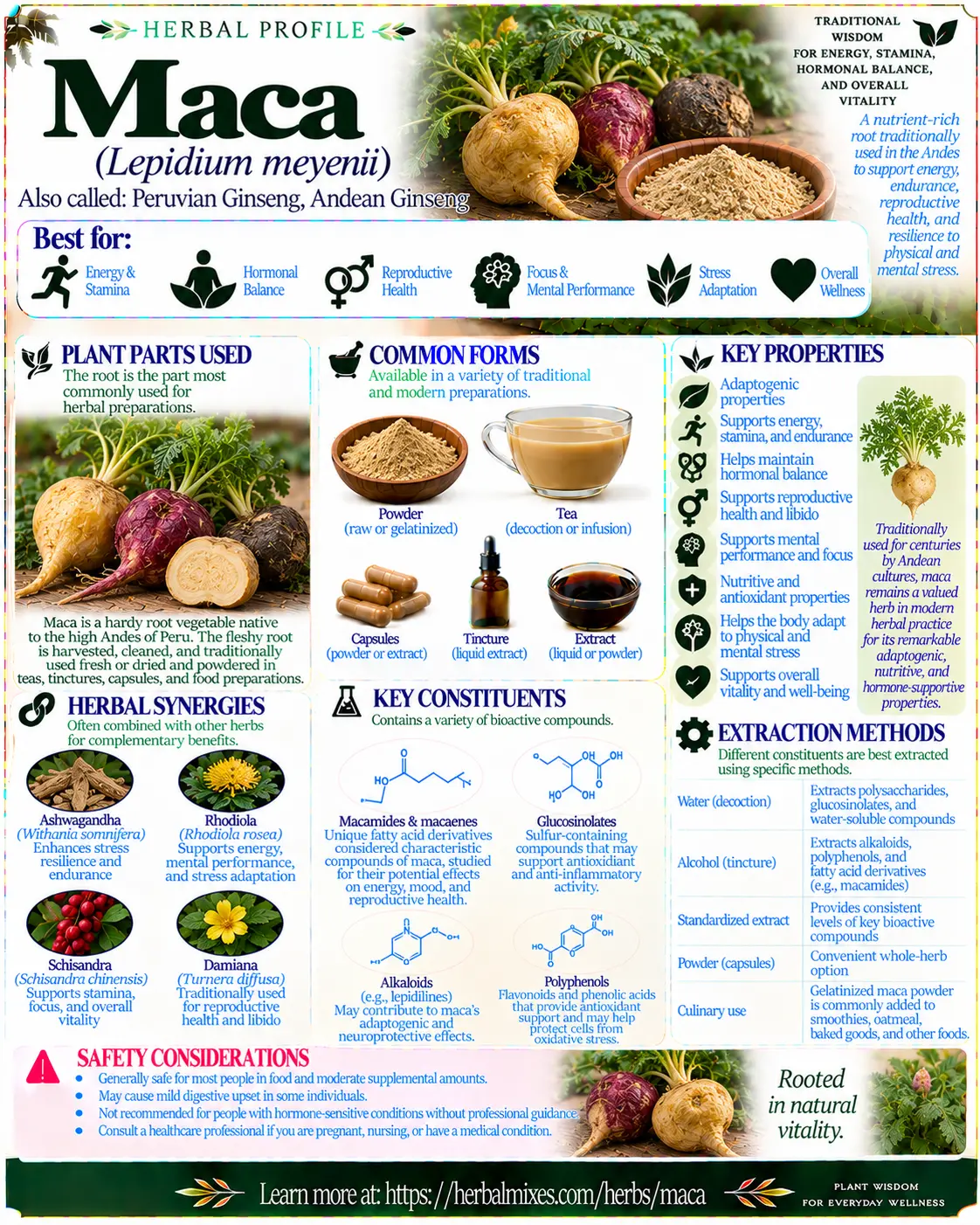
What Maca Is Good For
Energy & stamina — Maca is traditionally used as a caffeine-free food and tonic for physical energy and endurance. Experimental and limited human research suggests possible antifatigue effects, but the clinical evidence remains much smaller than its popularity as an energy supplement would suggest.
Libido support — Sexual desire is one of maca’s better-studied uses. A placebo-controlled study in healthy men found improved sexual desire after eight weeks without corresponding increases in testosterone or estradiol.
Sexual wellness — Small trials have reported modest improvements in sexual function in people with mild erectile dysfunction and in some people experiencing SSRI-associated sexual dysfunction. A systematic review concluded that the evidence is promising but still too limited for firm conclusions.
Mood & stress resilience — Preliminary research suggests maca may help with psychological symptoms including anxiety, low mood, and perceived well-being in some populations. A small study in postmenopausal women reported improvements without corresponding changes in reproductive hormones.
Menopausal wellness — Maca has been investigated for psychological and sexual symptoms associated with menopause. Evidence remains preliminary, and it should not be treated as a replacement for medical evaluation or hormone therapy when those are indicated.
Reproductive health — Maca has a strong traditional association with fertility, but modern evidence is inconsistent. A randomized study in men with fertility problems did not demonstrate statistically significant improvement in semen quality compared with placebo.
Available Herbal Products
Buying Guides for Available Maca Products
Gaia Herbs Maca Root – Gelatinized whole-root capsules. Uses organic gelatinized Lepidium meyenii rather than a concentrated extract, making it a good option for people seeking convenient daily maca with easier digestion. Seller: Gaia Herbs – View Gaia Herbs Maca Root →
Gaia Herbs Maca Powder – Gelatinized organic maca powder. A flexible choice for smoothies, oatmeal, yogurt, or drinks; gelatinization removes much of the starch and generally improves digestibility. Seller: Gaia Herbs – View Gaia Herbs Maca Powder →
NOW Foods Maca 500 mg – Whole-root capsules. Provides 500 mg of Lepidium meyenii root per capsule without claiming direct hormonal activity; a straightforward option for people who prefer measured capsules. Seller: NOW Foods – View NOW Foods Maca 500 mg →
When buying maca, check whether the product is raw, gelatinized, or extracted. These forms are chemically different and should not automatically be considered equivalent.
Herbal Synergies
Maca pairs especially well with ashwagandha, rhodiola, schisandra, cacao, and damiana depending on whether the goal is stamina, stress resilience, libido, or mood support.
Maca + Ashwagandha
Best for: Stress-related fatigue and sexual wellness
Maca contributes nutritional and traditional energy/libido support, while ashwagandha adds adaptogenic activity associated with stress resilience and physical recovery.
This combination may be especially appropriate when low energy appears alongside prolonged stress.
Best extraction: Maca powder or gelatinized root combined with ashwagandha extract or powder. Maca is well suited to whole-food use, while standardized extraction is useful for ashwagandha’s withanolides.
Maca + Rhodiola
Best for: Mental and physical fatigue
Maca provides sustained, caffeine-free nutritional support, while rhodiola is generally more stimulating and specifically associated with fatigue and performance under stress.
Best extraction: Maca powder or capsules combined with standardized rhodiola extract.
Maca + Schisandra
Best for: Stamina and stress resilience
Maca contributes energy and nutritional support, while schisandra provides lignans traditionally associated with endurance and adaptation to stress.
Best extraction: Maca powder or gelatinized capsules alongside a schisandra tincture or standardized extract.
Maca + Cacao
Best for: Energy, mood, and libido
Maca provides macamides and other root constituents, while cacao contributes methylxanthines, flavanols, magnesium, and a naturally stimulating food profile.
This combination works particularly well in smoothies and functional-food preparations.
Best extraction: Whole powders. Both are well suited to direct food consumption rather than requiring tincture extraction.
Maca + Damiana
Best for: Libido and sexual wellness
Maca is traditionally associated with sexual desire and vitality, while damiana adds aromatic nervine and traditional aphrodisiac activity.
Best extraction: Maca powder or capsules combined with damiana tincture or tea.
Key Herbal Properties
Adaptogenic / restorative — Maca is widely used as a resilience and vitality tonic, although its classification as a classic adaptogen is less firmly established than that of ashwagandha or rhodiola.
Aphrodisiac — Human studies provide limited support for increased sexual desire without corresponding increases in testosterone.
Antifatigue — Animal and limited human research suggests potential support for endurance and fatigue resistance.
Nutrient-rich — Dried maca contains substantial carbohydrate along with protein, fiber, minerals, and secondary metabolites, making it as much a traditional food as an herbal supplement.
Antioxidant — Polyphenols, macamides, glucosinolates, and other constituents contribute antioxidant activity.
Neuroprotective — Macamides and other compounds demonstrate neuroprotective actions in experimental research, but these findings have not yet translated into established neurological treatments.
Reproductive supportive — Maca has long-standing traditional use for fertility and sexual function, but modern clinical evidence is mixed and should not be overstated.





Active Compounds
Maca contains a distinctive mixture of macamides, macaenes, glucosinolates, alkaloids, thiohydantoins, phytosterols, polyphenols, and nutritional carbohydrates and proteins. More than 100 secondary metabolites have been identified in maca hypocotyls.
Macamides
Found mainly in: Dried hypocotyl/root
Macamides are unusual fatty-acid benzylamides considered characteristic chemical markers of maca. They have been investigated experimentally for neuroprotective, antifatigue, reproductive, and metabolic actions.
Their concentration can increase during traditional drying because drying promotes reactions between fatty acids and benzylamine precursors.
Best extraction: Alcohol or other lipophilic extraction, or consumption of whole dried maca. Macamides are relatively nonpolar and are poorly extracted into plain water.
Macaenes
Found mainly in: Dried hypocotyl/root
Macaenes are unsaturated fatty-acid derivatives structurally related to macamides and may act as precursors in macamide formation.
They remain much less studied than macamides.
Best extraction: Lipid-compatible or hydroalcoholic extraction. Whole powdered maca also retains these compounds.
Glucotropaeolin
Found mainly in: Hypocotyl/root, especially fresh material
Glucotropaeolin is the dominant aromatic glucosinolate in many maca samples and may represent roughly 80% of total glucosinolates in some analyses.
When plant tissue is damaged, glucosinolates can be converted by myrosinase into biologically active isothiocyanates and related products.
Best extraction: Water extracts intact glucosinolates effectively. Fresh or minimally heated preparations better preserve the myrosinase system, while extensive processing alters the final profile.
Glucolimnanthin
Found mainly in: Hypocotyl/root
Glucolimnanthin is another major aromatic glucosinolate in maca and usually occurs below glucotropaeolin in abundance.
Best extraction: Water or hydroalcoholic preparations because glucosinolates are polar, water-soluble compounds.
Lepidilines
Found mainly in: Hypocotyl/root
Maca contains unique imidazole alkaloids known as lepidilines, which contribute to its distinctive phytochemical fingerprint.
Their contribution to maca’s effects in humans remains uncertain.
Best extraction: Hydroalcoholic extraction provides broader alkaloid recovery than water alone.
Thiohydantoins
Found mainly in: Hypocotyl/root
Maca contains several unusual thiohydantoin derivatives, some of which may arise through glucosinolate-related biosynthetic pathways.
These compounds are chemically interesting but remain largely preclinical research targets.
Best extraction: Hydroalcoholic extraction.
Polyphenols
Found mainly in: Hypocotyl and aerial tissues
Maca contains phenolic compounds that contribute antioxidant activity alongside its more distinctive macamides and glucosinolates.
Best extraction: Water or hydroalcoholic extraction.
FAQ
What is maca best used for?
Maca is most commonly used for energy, stamina, libido, sexual wellness, and general vitality.
Sexual desire has some human evidence, but fertility, testosterone enhancement, athletic performance, and many other popular claims remain insufficiently established.
Does maca increase testosterone?
Available human evidence does not support that claim.
A 12-week randomized study using 1.5 or 3 grams daily found no significant effect on testosterone, estradiol, LH, FSH, or prolactin despite improved sexual desire.
What is gelatinized maca?
Gelatinized maca is not gelatin-coated and does not necessarily contain animal gelatin.
The maca is treated with heat and water to remove much of its starch, producing a concentrated powder that many people find easier to digest. Gaia Herbs currently uses this process for both its maca capsules and powder.
Is raw or gelatinized maca better?
Neither is automatically better.
Raw powder undergoes less processing and may preserve more heat-sensitive compounds and active myrosinase. Gelatinized maca is easier to digest and provides less starch per gram, but heating changes glucosinolate and enzyme chemistry.
For people with sensitive digestion, gelatinized maca is often the more practical option.
How long does maca take to work?
Maca is not generally an immediate stimulant.
In one controlled study, increased sexual desire became apparent after approximately eight weeks, suggesting that some effects may develop gradually rather than after a single serving.
Safety & Precautions
Maca has generally shown good short-term tolerability in available human trials, but high-quality long-term safety data remain limited.
Possible adverse effects include digestive discomfort, bloating, headache, or sleep disturbance, particularly with larger servings or when taken late in the day.
Maca is not a proven testosterone booster. Human research has repeatedly shown that sexual or well-being effects can occur without increasing reproductive hormone concentrations.
Because maca belongs to the Brassicaceae/mustard family and contains substantial glucosinolates, people with significant thyroid disease or iodine deficiency may wish to be conservative with very large quantities of raw maca. Cooking or gelatinization reduces some glucosinolate-related enzyme activity. Ordinary food-level use is different from excessive concentrated supplementation.
People with hormone-sensitive conditions often receive warnings about maca because of its reputation as a reproductive herb. However, available human studies have not demonstrated straightforward estrogenic, androgenic, or testosterone-raising activity. Individual medical circumstances still warrant professional guidance.
Safety during pregnancy and breastfeeding has not been adequately established for concentrated supplementation. Gaia Herbs advises against its maca products during pregnancy and lactation.
People taking prescription medication or managing fertility, thyroid, endocrine, or hormone-sensitive conditions should discuss concentrated maca supplementation with an appropriate healthcare professional.
References
- Maca (Lepidium meyenii) — Review of Biological Properties PubMed →
- Maca for Improving Sexual Function — Systematic Review PubMed →
- Maca and Sexual Desire Without Changes in Testosterone PubMed →
- Maca and Reproductive Hormone Levels in Healthy Men PubMed →
- Maca and Male Fertility — Randomized Clinical Trial PubMed →
- Maca Chemical and Pharmacological Variability — Comprehensive Review PubMed Central →
- Maca as a Functional Food and Dietary Supplement PubMed Central →
- Maca Glucosinolates and Related Constituents PubMed Central →
- Gaia Herbs Maca Root Product page →
- NOW Foods Maca 500 mg Product page →
Disclaimer
Disclaimer: This article is for educational purposes only and is not intended to diagnose, treat, cure, or prevent any disease. Herbal products can cause side effects and interact with medications. Consult a qualified healthcare professional before using herbs therapeutically, especially if you are pregnant, breastfeeding, taking prescription medications, or managing a medical condition.