

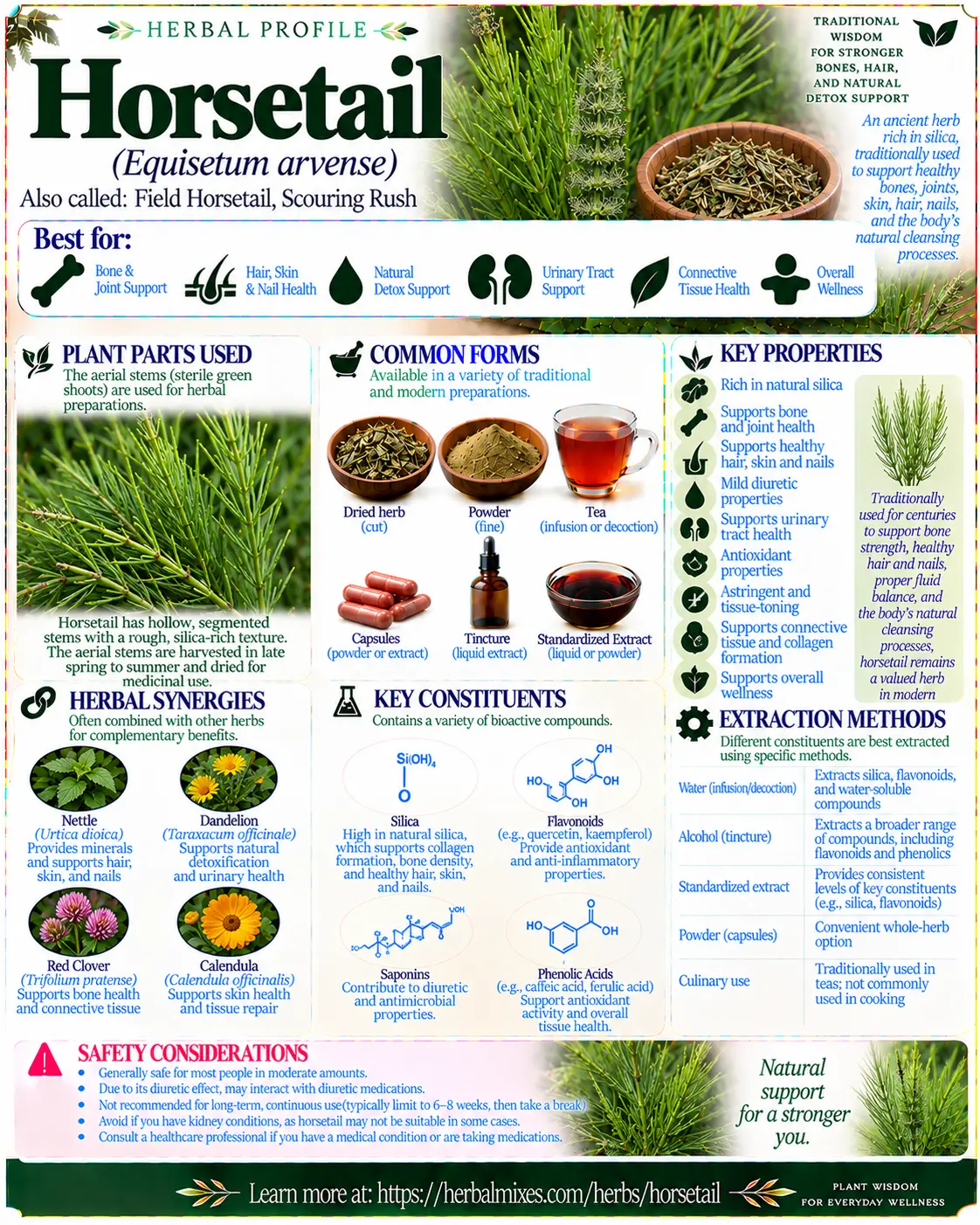
What Horsetail Is Good For
Urinary tract flushing — Horsetail is traditionally used as a mild diuretic to increase urine production and help flush the urinary tract during minor urinary complaints. This is the principal oral use recognized by the European Medicines Agency. (ema.europa.eu)
Mild fluid retention — Its traditional diuretic activity makes horsetail useful when gentle support for normal fluid elimination is desired. It should not be used to self-treat edema caused by heart or kidney disease.
Connective tissue support — Horsetail is unusually rich in silicon-containing compounds, including amorphous silica and soluble silicon species. Silicon has been investigated for roles in collagen, connective tissue, and bone biology, although strong evidence that horsetail supplements directly improve these tissues in humans is lacking. (pubmed.ncbi.nlm.nih.gov)
Hair & nail support — Horsetail is widely included in beauty supplements because of its silicon content. Silicon has potential roles in hair and nail structure, but the bioavailability of silicon varies greatly by chemical form, and evidence specifically demonstrating benefits from horsetail itself remains limited. (pubmed.ncbi.nlm.nih.gov)
Superficial wound support — EMA recognizes traditional topical use of horsetail preparations for the supportive treatment of superficial wounds. This indication is based on long-standing use rather than strong modern clinical trials. (ema.europa.eu)
Available Herbal Products
Buying Guides for Available Horsetail Products
Horsetail Grass – Whole-herb capsules. Provides 440 mg of horsetail stem and leaf per capsule and is marketed for traditional hair and nail support. A straightforward option for people who prefer whole powdered herb rather than a liquid extract. Seller: Nature’s Way – View Nature’s Way Horsetail Grass →
Organic Horsetail – Dried aerial herb. A useful form for preparing your own horsetail tea, decoction, infused vinegar, or custom herbal blend. The product is Equisetum arvense, although it was listed as out of stock when this profile was prepared. Seller: Mountain Rose Herbs – View Mountain Rose Herbs Horsetail →
Organic Horsetail Powder – Powdered aerial herb. Useful for capsules, homemade extracts, body-care preparations, or formulas where the entire powdered herb is consumed. It was listed as out of stock when this profile was prepared. Seller: Mountain Rose Herbs – View Mountain Rose Herbs Horsetail Powder →
Horsetail Liquid Herbal Extract – Fresh aerial-parts tincture. A concentrated liquid preparation for traditional urinary-system support. Note that Herb Pharm currently uses Equisetum telmateia rather than Equisetum arvense, so it is not botanically identical to the species covered in this profile. Seller: Herb Pharm – View Herb Pharm Horsetail →
When buying horsetail, always check the Latin name. For the traditional medicinal uses discussed in this article, look specifically for Equisetum arvense unless another horsetail species is intentionally being used by an experienced practitioner.
Herbal Synergies
Horsetail pairs especially well with nettle, goldenrod, marshmallow root, oat straw, and calendula depending on whether the goal is urinary support, connective-tissue nutrition, or topical tissue repair.
Horsetail + Nettle
Best for: Mineral-rich urinary and connective-tissue support
Horsetail contributes silicon-rich mineral chemistry and traditional diuretic activity, while nettle provides additional minerals, flavonoids, and gentle urinary support.
The combination is frequently used as a nourishing tea when the goal is broader mineral and urinary support rather than aggressive fluid elimination.
Best extraction: Decoction or long hot infusion. Both herbs contain water-soluble minerals and flavonoids, while prolonged hot-water extraction helps release more soluble silicon from horsetail.
Horsetail + Goldenrod
Best for: Minor urinary complaints and urinary tract flushing
Both herbs are traditionally used to encourage urine production. Goldenrod adds flavonoids and traditional urinary-tract support, while horsetail contributes its characteristic diuretic and mineral-rich profile.
Best extraction: Hot infusion or tincture. Tea is especially appropriate because urinary-flushing therapy requires adequate fluid intake.
Horsetail + Marshmallow Root
Best for: Urinary support when tissues feel irritated
Horsetail contributes gentle diuretic action, while marshmallow root adds soothing mucilage.
This pairing can be useful when the goal is to encourage urinary flushing without relying only on strongly stimulating herbs.
Best extraction: Separate water preparations. Horsetail benefits from hot infusion or decoction, while marshmallow root mucilage is best extracted in cool or room-temperature water.
Horsetail + Oat Straw
Best for: Mineral and connective-tissue support
Horsetail contributes silicon-rich material, while oat straw adds minerals and traditional nutritive properties.
The combination is most appropriate as a long infusion or decoction rather than a small-dose tincture when the goal is mineral extraction.
Best extraction: Long hot infusion or decoction. Water is the preferred solvent for minerals and soluble silicon species.
Horsetail + Calendula
Best for: Traditional topical support for superficial skin damage
Horsetail has traditional use for superficial wounds, while calendula contributes vulnerary, soothing, and anti-inflammatory properties.
Best extraction: Decoction or topical wash for horsetail combined with calendula infusion, tincture, or professionally formulated topical preparation.
Do not use homemade herbal preparations on deep, heavily contaminated, infected, or serious wounds.
Key Herbal Properties
Diuretic — Horsetail is traditionally used to increase urine production and flush the urinary tract during minor urinary complaints. This is its principal EMA-recognized internal use. (ema.europa.eu)
Mineral-rich — Equisetum arvense is an exceptional accumulator of silicon, storing substantial amorphous silica in its tissues. (pubmed.ncbi.nlm.nih.gov)
Connective-tissue supportive — Its silicon content explains horsetail’s widespread traditional association with skin, hair, nails, bone, and connective tissue. Evidence for these specific therapeutic outcomes from horsetail supplementation remains limited.
Astringent — Horsetail contains tannins and has traditionally been used where mild tissue tightening or drying is desirable.
Vulnerary — Traditional topical use includes supportive care of superficial wounds, an indication recognized by EMA. (ema.europa.eu)
Antioxidant — Flavonoids and phenolic compounds contribute antioxidant activity alongside horsetail’s distinctive mineral fraction.
Remineralizing / nutritive — Herbalists often describe horsetail as a remineralizing herb because of its high mineral and silica content. This is a traditional herbal description rather than evidence that horsetail corrects a diagnosed mineral deficiency.





Active Compounds
Horsetail differs from many medicinal herbs because its most distinctive characteristic is not a single alkaloid or volatile oil but its extraordinary silicon and silica content. It also contains flavonoids, phenolic acids, sterols, saponins, and mineral salts. (pubmed.ncbi.nlm.nih.gov)
Silica
Found mainly in: Outer tissues of stems and leaves
Horsetail accumulates large amounts of amorphous silica (silicon dioxide), particularly in epidermal cell walls. Modern botanical research confirms that Equisetum arvense is an unusually efficient silicon accumulator. (pubmed.ncbi.nlm.nih.gov)
Best extraction: Decoction or whole powdered herb. Much of horsetail’s silica is structurally bound and does not simply dissolve into a quick cup of tea.
Research on plant extraction suggests that prolonged boiling can increase the availability of silicon from dried horsetail compared with untreated plant material. (pubmed.ncbi.nlm.nih.gov)
Soluble Silicic Acid Species
Found mainly in: Aerial stems and leaves
A portion of horsetail’s silicon occurs as more soluble silicic acid and related silicon species.
These forms are particularly relevant because silicon bioavailability varies greatly depending on chemical form. Orthosilicic acid is generally considered more bioavailable than highly polymerized silica. (pubmed.ncbi.nlm.nih.gov)
Best extraction: Hot-water decoction. Water can extract soluble silicon species, and prolonged heating generally releases more than a brief infusion. (pubmed.ncbi.nlm.nih.gov)
Quercetin Glycosides
Found mainly in: Sterile aerial stems
Horsetail contains quercetin-related flavonoids that contribute antioxidant and vascular activity.
Best extraction: Hot-water infusion or hydroalcoholic tincture. Flavonoid glycosides have useful polarity and extract well into both water and diluted alcohol.
Kaempferol Glycosides
Found mainly in: Aerial herb
Kaempferol derivatives form another part of horsetail’s flavonoid profile and contribute antioxidant activity.
Best extraction: Hot infusion or hydroalcoholic tincture.
Phenolic Acids
Found mainly in: Aerial herb
Horsetail contains several phenolic acids, which contribute antioxidant activity alongside its flavonoids.
Best extraction: Hot water or hydroalcoholic tincture. These relatively polar compounds extract effectively in either preparation.
Tannins
Found mainly in: Aerial stems
Tannins contribute to horsetail’s astringent character and help explain its traditional topical use.
Best extraction: Hot-water decoction or hydroalcoholic tincture. Tannins are readily water soluble.
Mineral Salts
Found mainly in: Aerial stems
In addition to silicon, horsetail contains mineral elements such as potassium and other inorganic salts. These may contribute to its traditional diuretic and nutritive reputation.
Best extraction: Decoction or whole powdered herb. Water is generally preferable to high-alcohol preparations when mineral extraction is the goal.
FAQ
What is horsetail best used for?
The best-supported traditional use is increasing urine production to help flush the urinary tract during minor urinary complaints.
EMA also recognizes traditional topical use for superficial wounds. Hair, nail, bone, and connective-tissue uses are popular because horsetail is silica-rich, but they have considerably less direct clinical evidence. (ema.europa.eu)
Is horsetail really high in silica?
Yes.
Modern plant research confirms that Equisetum arvense is an unusually strong silicon accumulator and stores large quantities of amorphous silica throughout its tissues. (pubmed.ncbi.nlm.nih.gov)
That does not mean all of the silica in the dried plant is readily absorbed by the human body.
Is horsetail tea or powder better for silica?
A long hot infusion or decoction can extract soluble silicon species, while powder provides the entire plant material—including more structurally bound silica.
Because silicon bioavailability depends heavily on chemical form, neither preparation can be assumed to deliver the same amount of absorbable silicon as a standardized orthosilicic-acid supplement. (pubmed.ncbi.nlm.nih.gov)
Does horsetail really strengthen hair and nails?
Horsetail is widely marketed for this purpose because of its silicon content.
Silicon has been investigated for potential roles in collagen, skin, hair, and nail structure, but the evidence specifically showing that ordinary horsetail tea or capsules improve hair or nails is limited. (pubmed.ncbi.nlm.nih.gov)
Can horsetail be taken every day?
Horsetail is generally better suited to targeted or limited-duration medicinal use rather than indefinite self-supplementation.
For urinary complaints, EMA advises medical evaluation if symptoms persist longer than about one week. (ema.europa.eu)
Safety & Precautions
Correct botanical identification is particularly important with horsetail. The medicinal species discussed here is Equisetum arvense.
Other Equisetum species are not automatically interchangeable. The European Pharmacopoeia specifically requires testing to exclude potentially toxic species such as Equisetum palustre. (ema.europa.eu)
EMA does not recommend medicinal horsetail preparations for children under 12 years of age. (ema.europa.eu)
Safety during pregnancy and breastfeeding has not been adequately established, so medicinal use is not recommended. (ema.europa.eu)
Because horsetail increases urine production, it should not be used when a healthcare professional has advised fluid restriction, including some cases of serious heart or kidney disease.
Mountain Rose Herbs specifically advises against its horsetail product in people with kidney disease. (mountainroseherbs.com)
People taking prescription diuretics should use caution because combining them with additional diuretic herbs may increase fluid or electrolyte loss.
Mild gastrointestinal complaints and allergic reactions have been reported with horsetail preparations, although their frequency is unknown. (ema.europa.eu)
If urinary symptoms are accompanied by fever, painful urination, blood in the urine, flank or back pain, inability to urinate, or worsening symptoms, seek medical evaluation rather than relying on urinary-flushing herbs.
Do not use diuretic herbs to self-treat unexplained swelling of the legs, rapid weight gain, shortness of breath, or generalized edema, as these can indicate heart, kidney, liver, or vascular disease.
Anyone with kidney disease, heart disease, electrolyte problems, or prescription medications—particularly diuretics—should discuss regular therapeutic horsetail use with an appropriate healthcare professional.
References
- European Medicines Agency — Equiseti Herba
- EMA — European Union Herbal Monograph on Equisetum arvense
- EMA — Assessment Report on Equisetum arvense
- EMA — Horsetail Herb: Summary for the Public
- PubMed — Equisetum arvense as a Silica Accumulator
- PubMed — New Insight into Silica Deposition in Horsetail
- PubMed — Silicon: The Health Benefits of a Metalloid
- PubMed — Use of Silicon for Skin and Hair Care
- Nature’s Way — Horsetail Grass
- Mountain Rose Herbs — Horsetail
Disclaimer
Disclaimer: This article is for educational purposes only and is not intended to diagnose, treat, cure, or prevent any disease. Herbal products can cause side effects and interact with medications. Consult a qualified healthcare professional before using herbs therapeutically, especially if you are pregnant, breastfeeding, taking prescription medications, or managing a medical condition.