

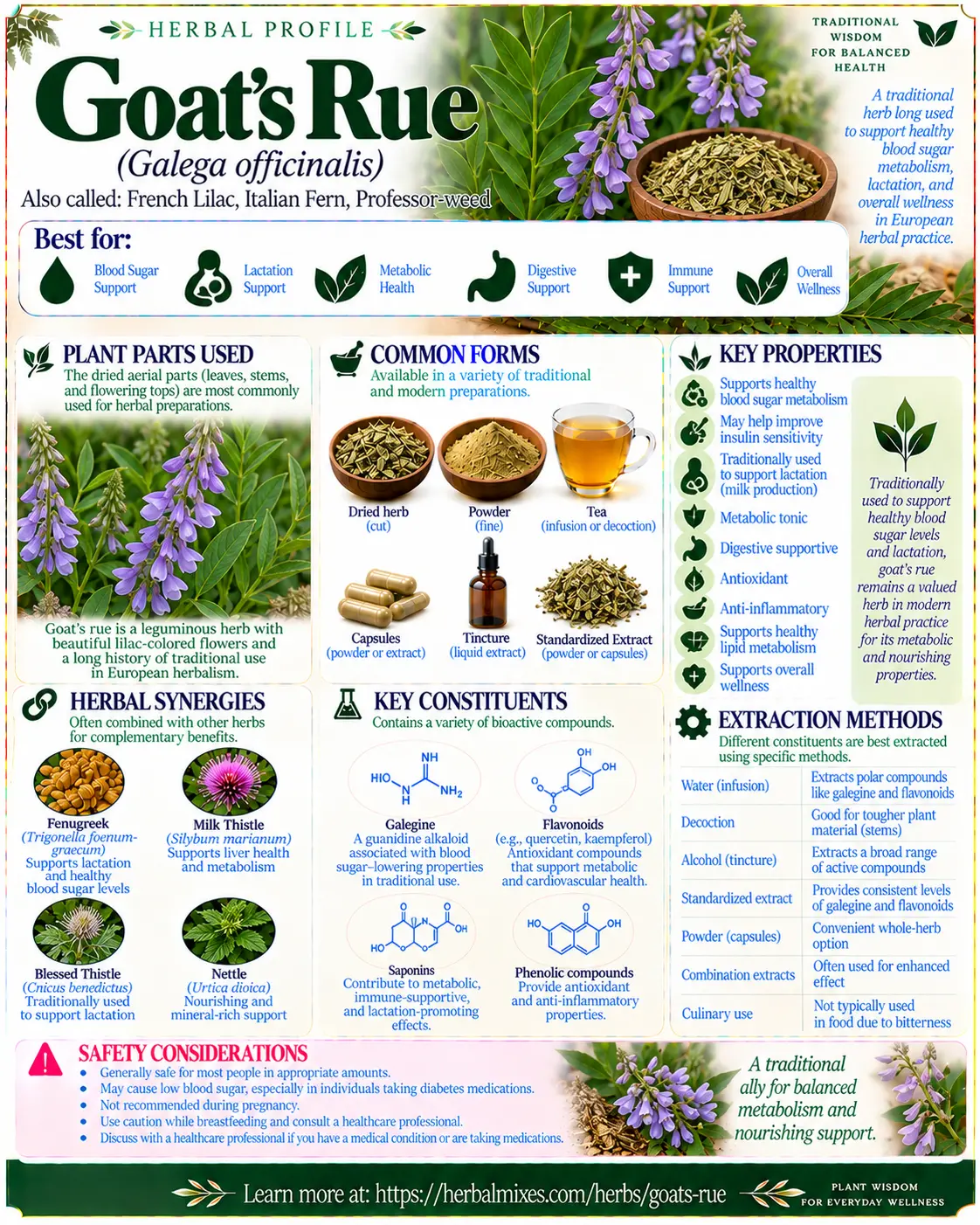
What Goat’s Rue Is Good For
Traditional lactation support — Goat’s rue is widely used as a galactagogue, particularly in postpartum herbal formulas intended to support milk production. However, LactMed notes that there are no scientifically valid clinical trials confirming this benefit, and existing studies are old, small, or poorly controlled.
Blood sugar support — Goat’s rue contains galegine, a guanidine compound capable of lowering blood glucose. The plant’s historical use in diabetes contributed to research that ultimately helped lead to development of the biguanide drug metformin, but goat’s rue itself should not be considered a substitute for diabetes medication.
Metabolic wellness — Modern laboratory research has identified guanidines, flavonoids, and phenolic acids that may influence oxidative stress and compounds associated with hyperglycemia. These findings are preliminary and do not establish clinical metabolic benefits.
Antioxidant support — Goat’s rue contains flavonoids and hydroxycinnamic acids with measurable antioxidant activity in laboratory studies.
Postpartum herbal formulas — Goat’s rue is frequently combined with herbs such as fenugreek, blessed thistle, fennel, and moringa in lactation products. Because low milk supply can have many causes, herbal galactagogues should not replace breastfeeding assessment and support from an appropriately qualified professional.
Available Herbal Products
Buying Guides for Available Goat’s Rue Products
Organic Goat’s Rue Tincture – Single-herb liquid extract. Made with organic goat’s rue herb, alcohol, and water and marketed specifically for postpartum lactation support. A convenient choice for people who prefer drops rather than capsules. Seller: Motherlove – View Motherlove Goat’s Rue →
Goat’s Rue Lactation Tincture – Liquid extract. A single-herb tincture designed for nursing mothers and made with organic alcohol extraction. Seller: WishGarden Herbs – View WishGarden Goat’s Rue →
Goat’s Rue Capsules – Whole-herb capsules. Contains organic Galega officinalis aerial herb in vegetarian capsules and is useful for people who prefer a measured whole-herb preparation without alcohol. Seller: Wild & Organic – View Wild & Organic Goat’s Rue Capsules →
Goat’s Rue Tincture – Concentrated aerial-herb extract. A 1:1.3 alcohol-water extract prepared from Galega officinalis aerial parts and intended for practitioner-guided herbal use. Seller: Sonoran University Medicinary – View Sonoran University Goat’s Rue Tincture →
Fresh Goat’s Rue Aerial Parts Tincture – Fresh flowering-herb tincture. A sustainably sourced practitioner-oriented extract prepared from fresh Galega officinalis aerial parts in flower. Purchasing is restricted to qualified practitioners and clinical herbalists. Seller: Heron Botanicals – View Heron Botanicals Goat’s Rue Tincture →
Herbal Synergies
Goat’s rue pairs especially well with fenugreek, fennel, moringa, and blessed thistle in traditional lactation formulas, while metabolic combinations require considerably more caution because of its glucose-lowering potential.
Goat’s Rue + Fenugreek
Best for: Traditional lactation support
Both herbs have long-standing use as galactagogues. Goat’s rue is traditionally associated with mammary and milk-production support, while fenugreek is one of the most commonly used herbs in commercial lactation blends.
Evidence for goat’s rue remains weak, and both herbs may influence blood glucose, so the combination deserves extra caution in people using diabetes medication.
Best extraction: Tincture or combination preparation. Goat’s rue works well as a hydroalcoholic extract, while fenugreek can be used as tea, tincture, powder, or capsules.
Goat’s Rue + Fennel
Best for: Lactation formulas with digestive support
Goat’s rue contributes the traditional galactagogue role, while fennel adds aromatic, carminative properties that may help with digestive discomfort.
Best extraction: Goat’s rue tincture plus covered fennel infusion, or a combined liquid formula. Fennel’s aromatic oils benefit from covered hot-water extraction, while alcohol provides broader extraction of goat’s rue constituents.
Goat’s Rue + Moringa
Best for: Postpartum nutritional and lactation support
Goat’s rue is traditionally used for milk-supply support, while moringa contributes a nutrient-dense leaf profile and is also widely used in postpartum supplements.
Best extraction: Goat’s rue tincture with moringa powder or capsules. Moringa’s nutritive constituents are best obtained by consuming the leaf itself rather than relying only on an extract.
Goat’s Rue + Blessed Thistle
Best for: Traditional postpartum lactation formulas
Goat’s rue provides the primary galactagogue role, while blessed thistle contributes bitter digestive properties and has also been historically incorporated into lactation formulas.
Best extraction: Tincture. Hydroalcoholic extraction works well for both herbs and keeps the serving volume relatively small.
Goat’s Rue + Cinnamon
Best for: Metabolic formulas — practitioner-guided only
Goat’s rue contains glucose-lowering galegine, while cinnamon is commonly used in metabolic-support formulas. Because their effects may be additive, this pairing is not ideal for casual self-experimentation, particularly in people taking insulin, metformin, sulfonylureas, or other glucose-lowering medications.
Best extraction: Hydroalcoholic tincture or separate standardized preparations under professional supervision.
Key Herbal Properties
Galactagogue — Goat’s rue is traditionally used to support breast milk production. Despite its widespread reputation, LactMed concludes that scientifically valid clinical evidence supporting this use is lacking.
Hypoglycemic — Galegine and related guanidines can lower blood glucose. This is one of the most pharmacologically important properties of the plant and also one of its main safety concerns.
Metabolic supportive — Goat’s rue has a long history of traditional use around glucose metabolism, but clinical evidence for safely managing diabetes with the herb itself is inadequate.
Antioxidant — Flavonols and hydroxycinnamic acids in goat’s rue demonstrated substantial antioxidant activity in laboratory analysis.
Methylglyoxal-trapping — Experimental research found that some goat’s rue constituents, including galegine, hydroxygalegine, and rutin, can interact with methylglyoxal in vitro. The clinical importance of this finding is unknown.
Mild diuretic — Goat’s rue has traditionally been described as having diuretic activity, although good human clinical evidence is lacking.
Antiplatelet-related — Some references describe inhibition of platelet aggregation, making caution appropriate when goat’s rue is combined with anticoagulant or antiplatelet medication.




Active Compounds
Goat’s rue contains several chemically important groups, particularly guanidine derivatives, quinazoline alkaloids, flavonoids, and hydroxycinnamic acids. Galegine is the best-known constituent because of its glucose-lowering activity and historical connection to development of metformin.
Galegine
Found mainly in: Leaves and flowering aerial parts
Galegine is a guanidine derivative and the best-known constituent of goat’s rue. It can lower blood glucose and is largely responsible for the herb’s historical association with diabetes.
Best extraction: Water or hydroalcoholic tincture. Galegine is sufficiently polar to occur in water infusions, and laboratory analysis has detected galegine-derived products in aqueous preparations.
Because galegine can lower blood glucose, stronger extraction is not automatically desirable.
Hydroxygalegine
Found mainly in: Flowering aerial parts
Hydroxygalegine is another guanidine derivative identified in Galega officinalis. Laboratory research found that it, like galegine, could form adducts with methylglyoxal.
Best extraction: Water or hydroalcoholic preparation. Its polar guanidine chemistry makes aqueous and mixed-solvent extraction practical.
Guanidine Derivatives
Found mainly in: Leaves and flowering tops
Goat’s rue contains multiple guanidine compounds, with galegine receiving the most attention. LactMed specifically identifies guanidine derivatives as characteristic constituents of the leaves and flowering tops.
Best extraction: Water or diluted alcohol. Guanidines are polar compounds and do not require oil extraction.
Rutin
Found mainly in: Aerial herb
Rutin is a flavonoid glycoside contributing antioxidant activity. It was among the compounds identified in modern phytochemical analysis of goat’s rue and demonstrated methylglyoxal-trapping activity experimentally.
Best extraction: Hot water or hydroalcoholic tincture. Its glycosidic structure gives rutin useful polarity.
Flavonol Glycosides
Found mainly in: Leaves and flowering aerial portions
Goat’s rue contains numerous mono-, di-, and triglycosylated flavonols. These compounds make up an important portion of the herb’s antioxidant fraction.
Best extraction: Hot-water infusion or hydroalcoholic tincture. Both methods effectively recover many glycosylated flavonoids.
Hydroxycinnamic Acids
Found mainly in: Aerial herb
Modern analysis identified several hydroxycinnamic acid derivatives, including caffeic-acid-related compounds. These appear to contribute strongly to antioxidant activity.
Best extraction: Hot water or diluted alcohol. These relatively polar phenolic compounds extract readily with both.
Quinazoline Alkaloids
Found mainly in: Aerial herb
Goat’s rue also contains tricyclic quinazoline alkaloids. Their individual contribution to the herb’s traditional effects is much less established than the role of galegine.
Best extraction: Hydroalcoholic tincture. Mixed solvents are useful when the goal is a broad-spectrum preparation covering alkaloid and polyphenol fractions.
Phenolic Compounds
Found mainly in: Leaves and flowering tops
A broad range of phenolics contributes antioxidant activity and complements the herb’s better-known guanidine chemistry.
Best extraction: Hot infusion or hydroalcoholic tincture. Water-alcohol preparations generally capture a broader phenolic spectrum.
FAQ
What is goat’s rue mainly used for?
Today, goat’s rue is most commonly sold for traditional lactation support, although evidence that it reliably increases milk production is weak.
It is also historically associated with blood sugar control because it contains galegine, but the herb itself should not be used as a substitute for diabetes medication.
Does goat’s rue really increase breast milk?
It is widely used for this purpose, but strong evidence is lacking.
LactMed’s August 2026 review states that no scientifically valid clinical trials support goat’s rue as a galactagogue. One very small study found no change in milk volume or milk fat, while older uncontrolled studies are not reliable enough to establish effectiveness.
Is goat’s rue related to metformin?
Historically, yes.
The glucose-lowering compound galegine found in goat’s rue helped inspire research into guanidine and biguanide compounds that eventually led to metformin. This does not mean goat’s rue and metformin are equivalent or interchangeable.
Is tincture or tea better for goat’s rue?
Both can extract important polar constituents.
A tincture is more concentrated and convenient, while tea extracts water-soluble constituents including some guanidines and flavonoids. Because glucose-lowering activity is a safety consideration, a more concentrated preparation is not necessarily preferable.
Can goat’s rue be taken every day?
Daily use appears in commercial lactation products, but long-term safety data are limited. Anyone using goat’s rue regularly—especially during breastfeeding or while taking glucose-lowering medication—should discuss it with an appropriate healthcare professional.
Safety & Precautions
The most important safety issue with goat’s rue is hypoglycemia. Galegine can lower blood glucose, and LactMed specifically advises caution in people using antidiabetic drugs.
People taking insulin, metformin, sulfonylureas, GLP-1-related diabetes medications, or other glucose-lowering medicines should not add concentrated goat’s rue without professional guidance because additive glucose-lowering effects are possible.
Symptoms such as shakiness, sweating, dizziness, weakness, confusion, unusual hunger, or palpitations can indicate low blood sugar and warrant prompt attention, particularly in someone using diabetes medication.
Although goat’s rue is widely used during breastfeeding, LactMed emphasizes that reliable safety and efficacy information for nursing mothers and infants is very limited. Galactagogues should not replace evaluation of latch, feeding frequency, milk transfer, maternal health, medications, or other reasons for low milk production.
Because adequate safety information during pregnancy is lacking and goat’s rue is pharmacologically active, medicinal use during pregnancy is best avoided unless specifically recommended by a qualified healthcare professional.
LactMed reports isolated adverse events involving multi-herb galactagogue products, including gastrointestinal symptoms and abnormal liver findings. Because several herbs were used together, goat’s rue cannot be identified as the sole cause, but these cases reinforce the need for caution with concentrated lactation supplements.
Some references also describe potential antiplatelet activity, so additional caution is appropriate with anticoagulant or antiplatelet medications.
Toxicity has been documented in grazing animals exposed to substantial amounts of Galega officinalis, reinforcing that the plant should not be assumed harmless simply because it is herbal. These animal poisonings involved exposures that are not directly comparable with normal human supplement use.
Anyone with diabetes, liver disease, a bleeding disorder, or prescription medications—and anyone considering goat’s rue specifically to increase breast milk—should discuss regular use with an appropriate healthcare professional or lactation specialist.
References
- NIH LactMed — Goat’s Rue
- PubMed — Goat’s Rue, LactMed Record
- PubMed — Goat’s Rue, Galegine and the Development of Metformin
- PubMed — Phytochemical Composition, Antioxidant Activity and Methylglyoxal Trapping of Galega officinalis
- PubMed Central — Phytochemical Composition of Galega officinalis
- Kew Medicinal Plant Names Services — Goat’s Rue
- Drugs.com — Goat’s Rue Clinical Overview
- Motherlove — Goat’s Rue Tincture
- WishGarden Herbs — Goat’s Rue
- Sonoran University Medicinary — Galega officinalis Tincture
Disclaimer
Disclaimer: This article is for educational purposes only and is not intended to diagnose, treat, cure, or prevent any disease. Herbal products can cause side effects and interact with medications. Consult a qualified healthcare professional before using herbs therapeutically, especially if you are pregnant, breastfeeding, taking prescription medications, or managing a medical condition.