

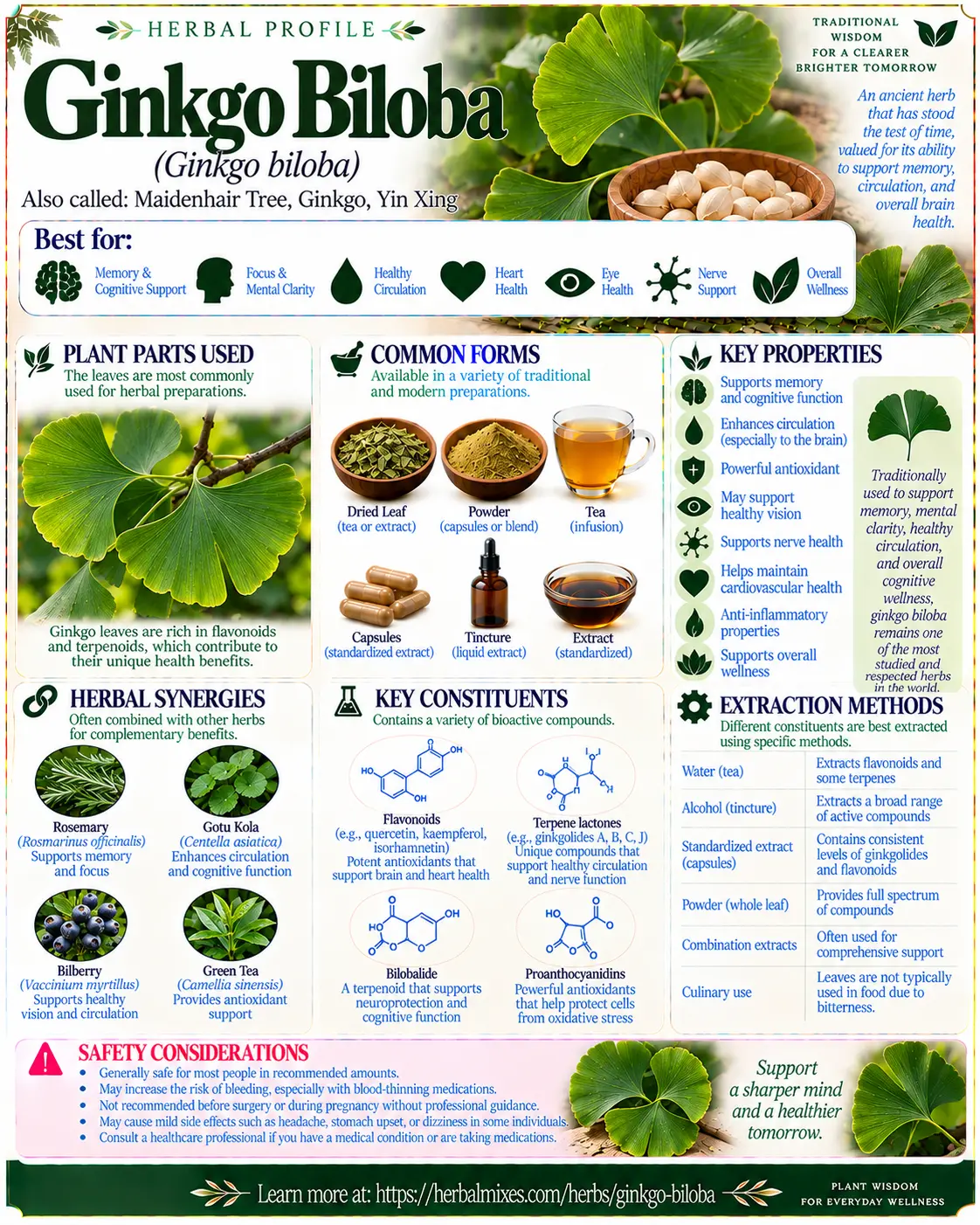
What Ginkgo Biloba Is Good For
Memory & cognitive support — Ginkgo is widely used for memory and concentration, but evidence depends heavily on the population and preparation used. NCCIH notes that ginkgo has not been shown to prevent dementia or improve cognition reliably in healthy people, although standardized extracts may provide modest benefit for some dementia symptoms.
Age-related cognitive symptoms — Standardized leaf extracts have been studied more extensively than ordinary powdered leaf. Evidence for symptom improvement in dementia is mixed, but some studies suggest modest benefit at sufficiently high standardized doses.
Healthy circulation — Ginkgo leaf is traditionally associated with circulatory support, and the EMA classifies ginkgo leaf within the therapeutic area of circulatory disorders. Its terpene lactones and flavonoids may influence vascular signaling, platelet activity, and oxidative stress.
Peripheral circulation — Ginkgo is commonly used in formulas intended to support blood flow to the extremities. Standardized extracts are more appropriate for this purpose than crude leaf because their flavone glycoside and terpene lactone content is controlled.
Vertigo and related symptoms — Some research suggests possible benefit for vertigo, but NCCIH considers the overall evidence insufficient for firm conclusions.
Ginkgo is also frequently marketed for tinnitus, but current evidence does not show reliable benefit for tinnitus.
Available Herbal Products
Ginkgo Leaf – Whole-leaf and concentrated extract capsules. Combines organic ginkgo leaf with ginkgo leaf extract and standardized flavonoid glycosides for people who prefer a broader whole-herb preparation rather than a single isolated constituent. Seller: Gaia Herbs – View Gaia Herbs Ginkgo Leaf →
Ginkgo Liquid Herbal Extract – Leaf tincture. A convenient liquid preparation for people who prefer drops rather than capsules or tablets and want a traditional hydroalcoholic extract. Seller: Herb Pharm – View Herb Pharm Ginkgo →
Ginkgo Premium Extract – Standardized capsules. Provides ginkgo leaf extract standardized to 24% ginkgo flavone glycosides and 6% terpene lactones, combined with gotu kola. Seller: Nature’s Way – View Nature’s Way Ginkgo →
Ginkgo Biloba Double Strength 120 mg – Standardized extract capsules. Provides a 50:1 leaf extract standardized to at least 24% ginkgoflavonglycosides and 6% terpene lactones, with eleuthero root. Seller: NOW Foods – View NOW Ginkgo Biloba 120 mg →
For cognitive and circulation-focused use, standardized extracts are generally preferable to ordinary leaf powder because much of the clinical research has used preparations with controlled levels of flavone glycosides and terpene lactones.
Herbal Synergies
Ginkgo biloba pairs especially well with gotu kola, bacopa, rosemary, hawthorn, and ginger depending on whether the goal is cognition, concentration, or circulation.
Ginkgo Biloba + Gotu Kola
Best for: Memory, concentration, and cognitive support
Ginkgo contributes standardized flavonoids and terpene lactones associated with vascular and neurological activity, while gotu kola is traditionally used as a cognitive and nervous-system tonic.
The combination is common in modern brain-support formulas because it combines circulation-oriented support with a more traditional nootropic herb.
Best extraction: Standardized ginkgo extract plus gotu kola tincture or extract. Ginkgo’s most researched preparations are highly processed standardized extracts rather than simple tea.
Ginkgo Biloba + Bacopa
Best for: Memory and long-term cognitive support
Ginkgo is often used for circulation and cognitive function, while bacopa contributes bacoside-containing chemistry traditionally associated with memory and learning.
Their different phytochemical profiles make them complementary rather than redundant.
Best extraction: Standardized extracts. Ginkgo is best represented by a controlled flavone/terpene extract, while bacopa is commonly standardized to bacosides.
Ginkgo Biloba + Rosemary
Best for: Mental clarity and concentration
Ginkgo contributes vascular and antioxidant support, while rosemary adds aromatic compounds traditionally associated with alertness and cognition.
Best extraction: Ginkgo standardized extract plus rosemary tincture or covered infusion. Ginkgo leaf tea does not reproduce the composition of the standardized extracts used in most studies.
Ginkgo Biloba + Hawthorn
Best for: Circulatory and cardiovascular support
Ginkgo has a stronger association with microcirculation and cerebral blood flow, while hawthorn is traditionally used as a cardiovascular tonic.
This makes the combination useful when the goal is broad circulation support rather than memory alone.
Best extraction: Standardized ginkgo extract with hawthorn tincture or standardized extract.
Ginkgo Biloba + Ginger
Best for: Peripheral circulation and warming support
Ginkgo contributes circulation-oriented flavonoids and terpene lactones, while ginger adds warming, aromatic, and digestive actions.
Best extraction: Standardized ginkgo extract plus ginger tea, tincture, or capsule.
Use particular caution with combinations that may also affect platelet activity if you take anticoagulant or antiplatelet medications.
Key Herbal Properties
Circulatory — Ginkgo is strongly associated with support for blood flow and microcirculation, particularly through standardized leaf extracts. The EMA places ginkgo leaf in the circulatory-disorders therapeutic area.
Antioxidant — Ginkgo flavonoids, including glycosides related to quercetin, kaempferol, and isorhamnetin, contribute substantial antioxidant activity.
Neuroprotective — Ginkgolides, bilobalide, and flavonoids have demonstrated neuroprotective activity in experimental models. Clinical effects are less certain and depend strongly on the condition studied.
Nootropic — Ginkgo is frequently classified as a cognitive-support herb, but this term should be used cautiously because evidence for improving cognition in healthy adults remains uncertain.
Anti-inflammatory — Ginkgo constituents affect inflammatory signaling in laboratory studies, although this property should not be interpreted as proof that ginkgo treats inflammatory disease.
Antiplatelet-related — Ginkgolides, especially ginkgolide B, can affect platelet-activating factor pathways. This may contribute to some vascular effects but also helps explain bleeding-related safety concerns.
Vascular supportive — Ginkgo extracts may influence vascular tone, endothelial function, and microcirculation, particularly through combined flavonoid and terpene activity.




Active Compounds
The most important medicinal constituents of ginkgo leaf are flavone glycosides and terpene lactones, especially ginkgolides and bilobalide. Standardized extracts commonly contain approximately 24% flavone glycosides and 6% terpene lactones.
Ginkgolide A
Found mainly in: Leaves
Ginkgolide A is a diterpene trilactone unique to ginkgo. It belongs to the group of terpene lactones responsible for part of the herb’s vascular and neurological activity.
Best extraction: Standardized hydroalcoholic or acetone-water extract. Ginkgolides are not optimally represented by ordinary home tea, and clinical preparations usually use concentrated standardized extracts.
Ginkgolide B
Found mainly in: Leaves
Ginkgolide B is one of the best-known ginkgo terpene lactones and is particularly notable for antagonizing platelet-activating factor in experimental research.
Best extraction: Standardized extract. Controlled commercial extraction is preferable because the goal is a predictable terpene lactone content.
Ginkgolide C
Found mainly in: Leaves
Ginkgolide C is another diterpene lactone included in the standardized terpene fraction of ginkgo extracts.
Best extraction: Standardized hydroalcoholic extract. It is typically measured alongside ginkgolides A and B in quality-controlled products.
Bilobalide
Found mainly in: Leaves
Bilobalide is a sesquiterpene lactone and one of ginkgo’s signature constituents. Experimental studies associate it with neurological and neuroprotective activity.
Best extraction: Standardized extract. Bilobalide is commonly quantified as part of the approximately 6% total terpene-lactone fraction in standardized ginkgo products.
Quercetin Glycosides
Found mainly in: Leaves
Quercetin occurs mainly in ginkgo as flavonoid glycosides rather than as free quercetin. These compounds contribute antioxidant and vascular-supportive activity.
Best extraction: Hydroalcoholic standardized extract. Flavonoid glycosides are relatively polar and can be extracted with water-alcohol mixtures.
Kaempferol Glycosides
Found mainly in: Leaves
Kaempferol-derived glycosides form another major part of ginkgo’s flavonoid fraction and contribute antioxidant activity.
Best extraction: Water-alcohol extraction. Standardized preparations capture them alongside quercetin and isorhamnetin derivatives.
Isorhamnetin Glycosides
Found mainly in: Leaves
Isorhamnetin glycosides are among the characteristic flavonoids measured in standardized ginkgo preparations.
Best extraction: Hydroalcoholic extract. Mixed solvents provide efficient recovery while supporting standardized flavonoid content.
Proanthocyanidins and Related Polyphenols
Found mainly in: Leaves
Ginkgo also contains proanthocyanidins, catechins, and related polyphenols that contribute to the overall antioxidant profile but are not usually the principal standardization markers.
Best extraction: Hydroalcoholic tincture or standardized extract.
FAQ
What is ginkgo biloba best used for?
Ginkgo is primarily used for cognitive and circulatory support, especially in standardized leaf-extract form.
Evidence is strongest for possible modest improvement of some dementia symptoms, but ginkgo has not been proven to prevent dementia or reliably improve memory in healthy adults.
Is standardized ginkgo extract better than plain ginkgo leaf?
For cognitive or circulation-focused use, usually yes.
Most clinical research has used concentrated standardized extracts containing about 24% flavone glycosides and 6% terpene lactones, so ordinary powdered leaf or tea should not be assumed to produce identical effects.
Does ginkgo help tinnitus?
Current evidence does not show that ginkgo reliably improves tinnitus. NCCIH specifically notes that research suggests ginkgo is not helpful for relieving tinnitus symptoms.
Can ginkgo be taken every day?
Moderate amounts of standardized ginkgo leaf extract have been used in research for periods as long as several years. However, daily use deserves more caution if you take medications—particularly drugs affecting blood clotting.
How quickly does ginkgo work?
Ginkgo is generally not an immediate-use herb. Products intended for cognition or circulation are usually taken consistently over time, and Gaia Herbs similarly notes that benefits build over time.
Safety & Precautions
Standardized ginkgo leaf extract is generally well tolerated in moderate amounts. Common adverse effects include headache, dizziness, and gastrointestinal symptoms.
Ginkgo may increase bleeding risk, particularly when combined with anticoagulant drugs such as warfarin or with other medicines that affect blood clotting. NCCIH reports an association between combined ginkgo and warfarin use and increased major bleeding risk.
People with a bleeding disorder, those taking anticoagulant or antiplatelet medicines, or those preparing for surgery should discuss ginkgo use with a healthcare professional. Nature’s Way advises discontinuing its ginkgo product one week before surgery.
People with a seizure disorder should also use caution. Several commercial products specifically advise consultation before use in people with seizure disorders, and concentrated ginkgo products may interact with anticonvulsant medicines.
Ginkgo may interact with additional medications. NCCIH specifically advises against combining ginkgo with efavirenz and recommends discussing ginkgo with a healthcare professional if you take any medicine regularly.
Ginkgo may be unsafe during pregnancy, particularly because of possible bleeding or early-labor concerns. Safety during breastfeeding has not been established.
Do not assume ginkgo seeds are interchangeable with medicinal ginkgo leaf extract. Fresh seeds are toxic when eaten, and serious adverse effects have also occurred after consumption of roasted seeds or crude ginkgo plant material.
Anyone with a medical condition or taking prescription medications should discuss regular ginkgo use with an appropriate healthcare professional.
References
- NCCIH — Ginkgo: Usefulness and Safety
- NCCIH — Herb-Drug Interactions: Ginkgo
- European Medicines Agency — Ginkgo Folium
- Kew Plants of the World Online — Ginkgo biloba L.
- PubMed Central — Chemical Markers for Quality Control of Herbal Medicines
- PubMed Central — Ginkgo biloba for Cognitive Impairment and Dementia
- PubMed Central — Ginkgo biloba: Functional Phytochemicals and Medicinal Applications
- PubMed Central — Herbal Medicine for Cardiovascular Diseases: Ginkgo
- Gaia Herbs — Ginkgo Leaf
- NOW Foods — Ginkgo Biloba Double Strength 120 mg
Disclaimer
Disclaimer: This article is for educational purposes only and is not intended to diagnose, treat, cure, or prevent any disease. Herbal products can cause side effects and interact with medications. Consult a qualified healthcare professional before using herbs therapeutically, especially if you are pregnant, breastfeeding, taking prescription medications, or managing a medical condition.