

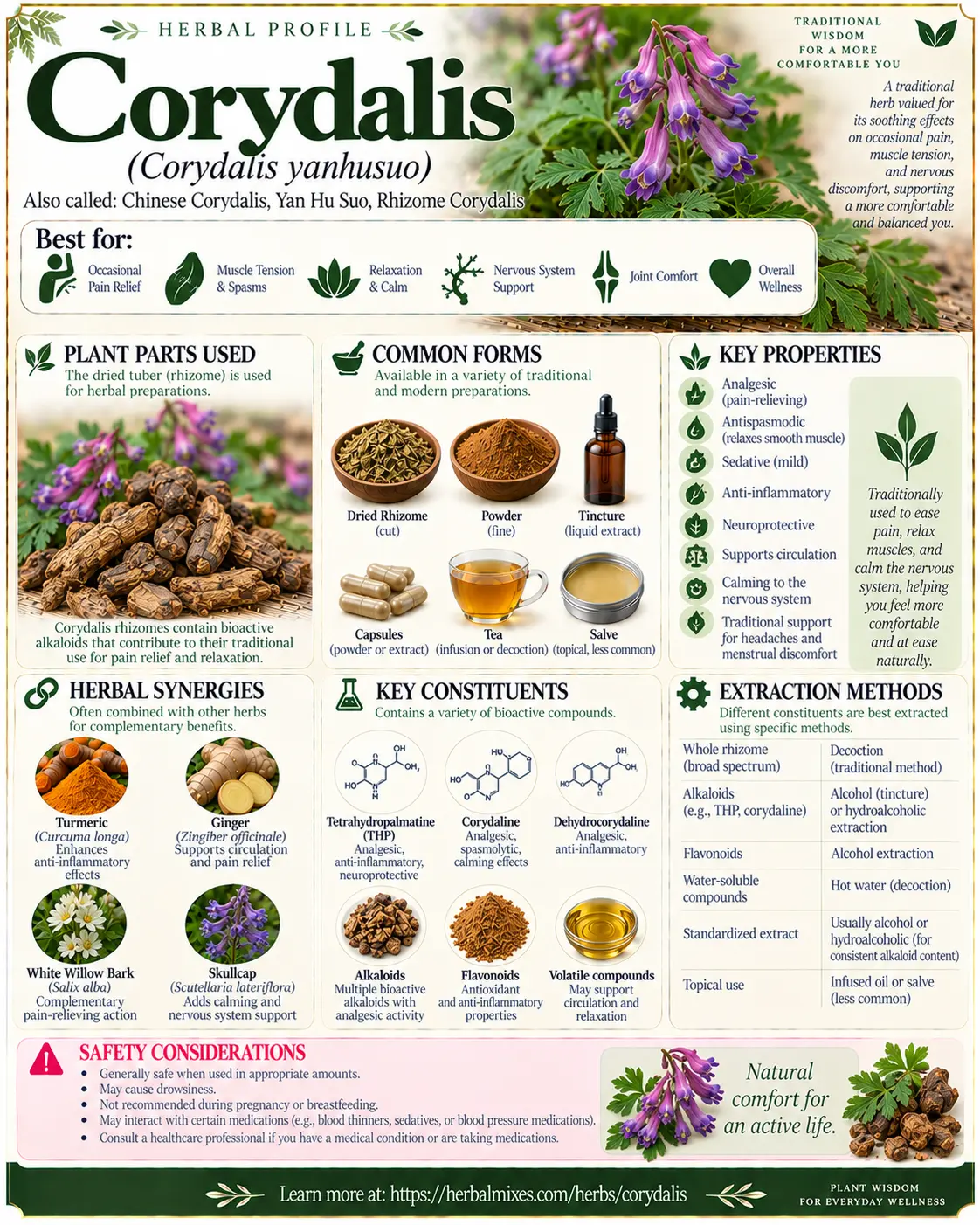
Health Conditions Corydalis Helps With
- Mild aches and tension — Corydalis’s central and defining traditional use, taken to help ease general muscle tension and mild discomfort.
- Occasional restlessness alongside discomfort — Some traditional use includes corydalis for its mild calming quality alongside its pain-relief reputation.
Available Herbal Products
Products Featuring Corydalis
- Standardized capsules — The most common and safest form, given the importance of consistent, controlled dosing with this herb.
- Tincture — A concentrated liquid extract, best used according to labeled guidance rather than estimated amounts.
Herbal Synergies
Cramp Bark — Shares an analgesic traditional profile, sometimes paired with corydalis for muscle tension.
Skullcap — Complements corydalis’s mild calming quality in traditional tension-relief blends.
Key Herbal Properties
Analgesic — Corydalis’s defining and singular traditional property; used for mild pain and tension relief.

Active Compounds
Alkaloids (including tetrahydropalmatine) — The primary active compound group in corydalis, traditionally credited with its analgesic and mildly calming reputation, and also the reason for its more significant safety cautions compared to gentler herbs (see Safety & Precautions).
Recipes Using Corydalis
- Evening comfort tea — Corydalis root combined with a milder calming herb like chamomile for an evening tea aimed at easing tension.
- Standardized capsule routine — Corydalis is more often used in standardized capsule form than as a home tea, given the importance of consistent dosing with this particular herb.
Safety & Precautions
Corydalis is more potent than many gentler traditional herbs, and its alkaloid content — particularly tetrahydropalmatine — has real sedating, pain-relieving activity, which means it deserves more careful attention to dosing than milder herbs. Drowsiness is a common effect, so corydalis should not be combined with driving, operating machinery, or other activities requiring full alertness until you know how it affects you.
Because of its sedative-leaning action, corydalis may add to the effects of other sedative medications, sleep aids, or alcohol, and combining them should be avoided or discussed with a healthcare provider first. Its alkaloids are processed by the liver, so anyone with liver concerns should use particular caution and check with a provider before use. Corydalis’s compounds may also interact with medications that affect dopamine activity, including certain medications for Parkinson’s disease or some antipsychotic medications, so anyone taking these should talk to a healthcare provider before considering corydalis. It should be avoided during pregnancy and breastfeeding, given its potent alkaloid profile and limited safety data in this context.
There isn’t well-established traditional guidance for using corydalis with pets, so it should not be given to an animal without veterinary advice.
Q&A
Does corydalis taste bitter?
Yes, corydalis root has a distinctly bitter, somewhat sharp taste, which is part of why standardized capsules are the more common and practical way to take it rather than tea. If you do try it as tea, expect a genuinely strong bitter flavor.
Because dosing matters more with corydalis than with many gentler herbs, capsules also offer more consistency than trying to judge the strength of a homemade tea.
Can corydalis be used every day?
Corydalis is generally used for defined periods related to specific discomfort, such as a stretch of muscle tension, rather than as an indefinite daily supplement, given its more potent nature compared to gentler analgesic herbs. Ongoing daily use over an extended period isn’t well studied and is best discussed with a healthcare provider.
Starting with a smaller amount and paying close attention to how you respond, including any drowsiness, is an important precaution with this particular herb.
Does corydalis make you drowsy?
Yes, drowsiness is a fairly common effect of corydalis given its alkaloid content, which has real sedating activity alongside its pain-relieving reputation. This is more pronounced than with many milder calming herbs, so it’s worth being cautious about driving or other alertness-dependent activities until you know how it affects you.
If you’re using corydalis in the evening specifically for its calming quality, this drowsiness may actually be part of why it’s chosen, but daytime use should be approached carefully.
Does corydalis interact with medications?
Yes, and more so than many gentler herbs. Corydalis may add to the effects of sedative medications and alcohol, and its compounds can interact with medications that affect dopamine activity, including some Parkinson’s disease and antipsychotic medications. It’s also processed by the liver, which is relevant for anyone with liver concerns.
Given these more significant interaction considerations, it’s especially worth checking with a healthcare provider before starting corydalis if you take any regular medication.
Is corydalis safe for beginners to herbal medicine?
Corydalis is generally considered a more potent herb than many of the gentler options on this site, given its real sedating and pain-relieving alkaloid activity, so it’s not necessarily the best starting point for someone completely new to herbal use. Starting with well-established, gentler herbs and working with a knowledgeable practitioner if you’re interested in something like corydalis is a reasonable approach.
If you do try corydalis, starting with a standardized, lower-dose product and paying close attention to how you feel is an important precaution.
References
- Plants of the World Online: Corydalis yanhusuo
- PubMed: Scientific Literature on Corydalis yanhusuo
- National Library of Medicine: Chemical Constituents from Corydalis yanhusuo
- Wikipedia: Corydalis yanhusuo
- ScienceDirect Topics: Corydalis yanhusuo Research
- PubMed: Tetrahydropalmatine Bioactivity and Safety