

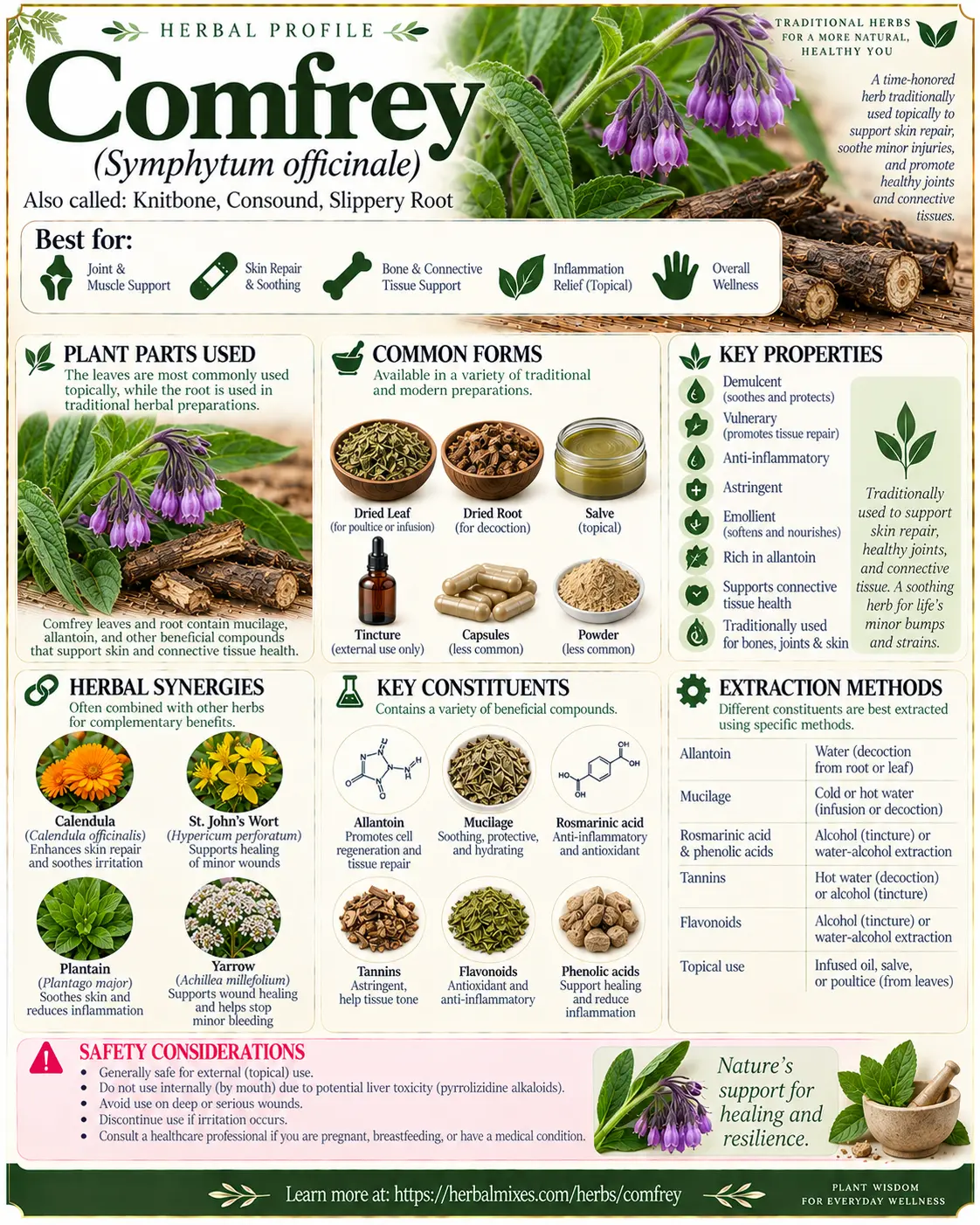
What Comfrey Is Good For
Tissue Regeneration & Vulnerary Care — Comfrey is globally renowned as the ultimate vulnerary, earning its historical moniker “Knitbone” for its extraordinary ability to accelerate the repair of skin, muscle, and connective tissue.
Bone, Joint & Tendon Recovery — Traditionally applied externally to support the healing of hairline fractures, sprains, strains, and deep-seated joint trauma.
Wound & Abrasion Healing — Helps promote rapid cellular proliferation and clean closure of minor superficial cuts, scrapes, and bruises.
Skin Soothing & Demulcent Care — Rich in allantoin, it deeply softens, hydrates, and calms irritated skin, eczema flare-ups, and minor burns.
Swelling & Bruise Relief — Helps rapidly disperse localized bruising, swelling, and fluid accumulation following physical impacts.
Available Herbal Products
Organic Comfrey Root & Leaf Cut – Dried botanical material. Purchased primarily for crafting traditional external poultices and infused healing oils under professional herbal guidance. Seller: Mountain Rose Herbs – View Mountain Rose Herbs Comfrey →
Comfrey First-Aid Healing Salve – Professional topical ointment. Formulated with infused comfrey leaf and root combined with calendula and plantain to provide targeted skin and tissue repair. Seller: Wise Woman Herbals – View Wise Woman Herbals Salves →
Allantoin-Rich Comfrey Extract Ointment – Standardized topical cream. Designed to deliver concentrated allantoin directly to bruises, sprains, and strained muscles. Seller: Boericke & Tafel – View Herbal Ointments →
Organic Comfrey Root Powder – Finely ground root. Used traditionally for compounding external poultices for sprains, fractures, and deep bruising. Seller: Starwest Botanicals – View Starwest Botanicals Comfrey →
Herbal Synergies
Comfrey pairs especially well with Plantain Leaf, Calendula Flowers, and St. John’s Wort, depending on the goal of the formula.
Comfrey Root + Plantain Leaf – Best for: Rapid skin repair, drawing out deep tissue heat, and healing stubborn abrasions Comfrey delivers high concentrations of allantoin to stimulate rapid cell division and tissue knitting, while plantain leaf offers soothing mucilage and drawing properties. Together, they form the ultimate external first-aid duo. Best extraction: Fresh plant poultice or infused oil salve. Combining these herbs maximizes cellular regeneration and soothing moisture.
Comfrey Root + Calendula Flowers – Best for: Comprehensive skin healing, soothing burns, and easing surface irritation Comfrey promotes deep tissue proliferation and skin barrier restoration, whereas calendula supplies triterpenoid saponins to fight inflammation and encourage clean wound closure. Best extraction: Infused oil salve. Macerating comfrey and calendula together in olive oil creates a deeply restorative ointment.
Comfrey Root + St. John’s Wort Flower – Best for: Healing deep sprains, nerve-rich joint injuries, bruising, and trauma recovery Comfrey knits connective tissue and bone trauma, while St. John’s wort oil delivers hypericin to ease nerve-related pain and muscular shock. Best extraction: Topical liniment or dual-infused massage oil. Applied externally to painful joints and strains.
Key Herbal Properties
Vulnerary — Dramatically accelerates the healing of wounds, fractures, and torn tissue by stimulating rapid cell proliferation.
Allantoin Source — A powerful organic compound that triggers cell division and tissue growth.
Demulcent — Softens, protects, and moistens inflamed skin and mucous membranes.
Astringent — Tones local tissue and blood vessels, reducing swelling and bleeding.
Counterirritant (Mild) — Draws blood flow to injured areas to speed metabolic clearance and repair.



Active Compounds
Allantoin (Cell-Proliferating Compound) Found mainly in: Root and leaves (highest concentration in root) The primary bioactive compound responsible for comfrey’s legendary tissue-regenerative properties, stimulating rapid growth of new skin, bone, and connective cells. Best extraction: Water decoction, cold infusion, or lipid oil maceration. Allantoin dissolves efficiently in warm water and carrier oils.
Mucilage Polysaccharides Found mainly in: Fleshy root tissues High-molecular-weight carbohydrates that provide soothing, protective moisture to damaged skin. Best extraction: Cold or warm aqueous infusion. Soluble in water.
Pyrrolizidine Alkaloids (PAs — including Symphytine and Echimidine) Found mainly in: Roots and leaves Potentially hepatotoxic compounds that can cause liver strain if absorbed systemically in high amounts. Crucial Safety Note: Due to PA risks, modern clinical herbalism restricts comfrey strictly to external, unbroken-skin use and advises against internal oral consumption. Best extraction: Topical oil infusion or poultice (external use only).
FAQ
Why is internal use of comfrey discouraged in modern herbalism? Comfrey contains pyrrolizidine alkaloids (PAs) that can cause severe liver damage when ingested internally over time; modern herbalists restrict comfrey strictly to external topical applications.
What is comfrey best used for? Comfrey is primarily used externally in salves, oils, and poultices to heal sprains, strains, bruises, minor fractures, and skin abrasions.
How does comfrey help heal bones and sprains? Its high allantoin content stimulates rapid cell division and tissue proliferation, helping connective tissue and bone micro-fractures knit back together more efficiently.
Can comfrey be applied to open, bleeding cuts? No, comfrey should never be applied to deep, dirty, or actively bleeding open wounds, as its cell-proliferating action can cause skin to close over too quickly, trapping bacteria underneath and forming an abscess; use it on clean, healing abrasions or closed sprains.
How did comfrey get the name “Knitbone”? Historically, herbalists applied thick comfrey root poultices around broken limbs under casts to help bone fractures heal with remarkable speed.
Safety & Precautions
Strictly External Use Only: Never ingest comfrey tea, tinctures, or raw plant material internally, as pyrrolizidine alkaloids can cause severe, irreversible liver damage (hepatic veno-occlusive disease).
Unbroken Skin Only: Do not apply comfrey salves or poultices to deep, uncleaned open wounds or punctures, as rapid surface closure can trap bacteria and cause infection.
Short-Term Topical Application: Avoid continuous, indefinite daily application of heavy comfrey preparations over massive surface areas of the body.
Pregnancy & Breastfeeding: Avoid all internal use and exercise caution with extensive external application during pregnancy and lactation.
Consult a qualified healthcare professional before using comfrey therapeutically, especially if you manage underlying medical conditions or take prescription drugs.
References
National Center for Complementary and Integrative Health (NCCIH)
PubMed Central – Symphytum officinale (Comfrey) Allantoin and Topical Musculoskeletal Safety
European Medicines Agency (EMA) Monograph on Symphytum officinale radix / folium (External Use Only)
World Health Organization (WHO) Monographs on Selected Medicinal Plants
Mountain Rose Herbs Comfrey Root Monograph
Herb Pharm Topical Botanical Safety Guidelines
Disclaimer
Disclaimer: This article is for educational purposes only and is not intended to diagnose, treat, cure, or prevent any disease. Herbal products can cause side effects and interact with medications. Consult a qualified healthcare professional before using herbs therapeutically, especially if you are pregnant, breastfeeding, taking prescription medications, or managing a medical condition.