

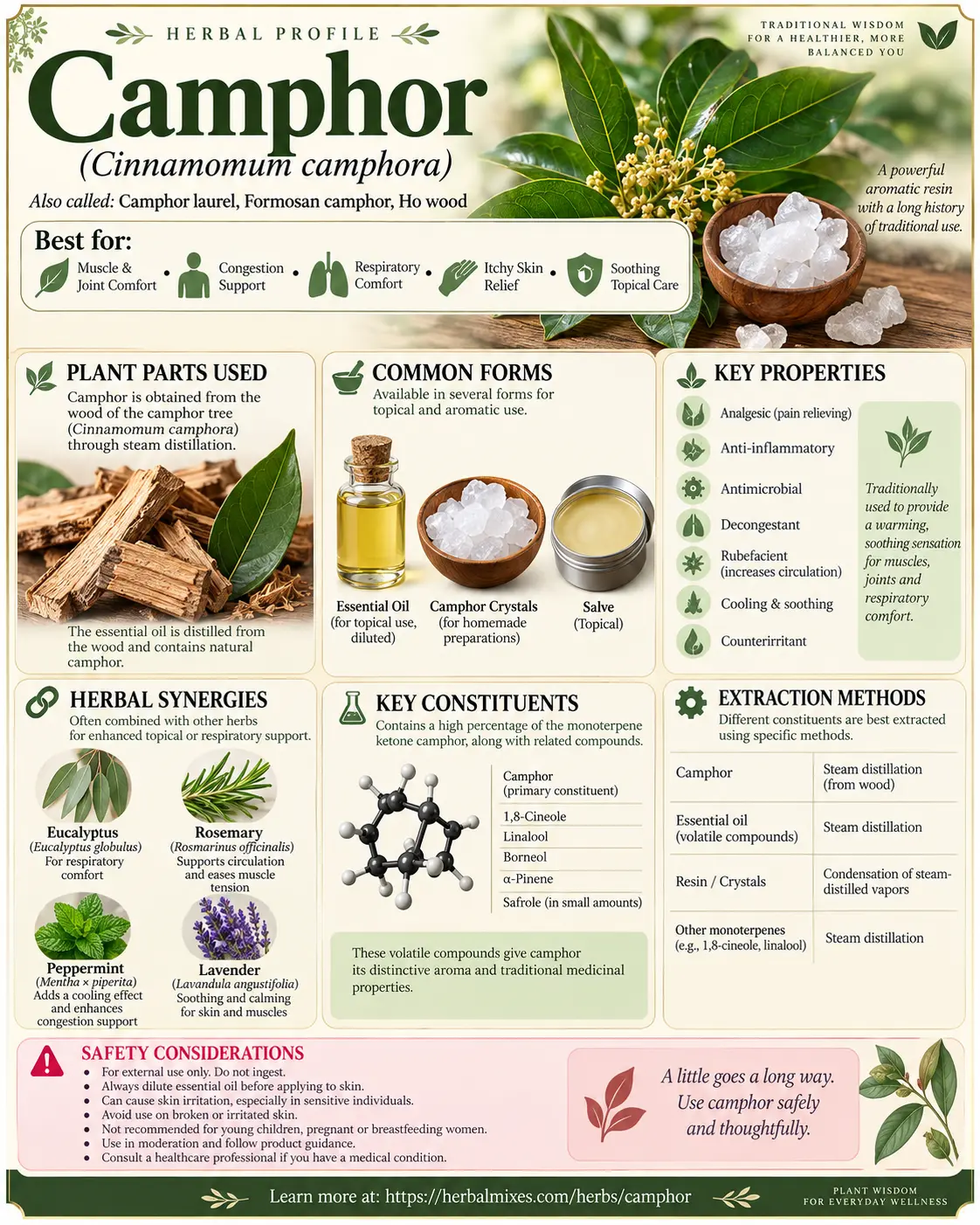
What Camphor Is Good For
Topical Pain Relief & Sore Muscles — Camphor acts as a potent counterirritant and local analgesic, creating a cooling-to-warming sensation that distracts sensory nerves from deep muscle aches and joint stiffness.
Respiratory Congestion & Cough Relief — Inhaled via steam or applied in chest rubs, its pungent vapors help open nasal passages and ease acute chest congestion.
Cough Suppression — Widely utilized in over-the-counter medicated chest ointments to help soothe minor throat irritation and suppress spasmodic coughing.
Itch & Skin Irritation Relief — Provides mild anesthetic properties that help soothe surface skin itching, insect bites, and minor cutaneous irritations.
Antiseptic Defense — Exhibits strong antimicrobial and antifungal properties that help protect minor surface skin abrasions.
Available Herbal Products
Buying Guides for Available Camphor Products
Medicated Vapor Chest Rub – Topical ointment. Formulated with natural camphor, menthol, and eucalyptus oil to provide rapid respiratory relief and ease coughs. Seller: Vicks VapoRub – View Vicks VapoRub Chest Rub →
Natural Camphor Essential Oil – Concentrated aromatic oil. Sourced from steam-distilled wood and bark. An effective choice for blending into custom muscle liniments and warming massage oils (always dilute). Seller: Mountain Rose Herbs – View Mountain Rose Herbs Camphor Oil →
Pain-Relieving Herbal Liniment – Topical spray or liquid. Combines natural camphor with menthol and wintergreen to deliver fast-acting relief for sore joints and strained muscles. Seller: Tiger Balm – View Tiger Balm Liniments →
Pure Camphor Blocks / Tablets – Traditional aromatic resin pieces. Used primarily for traditional ritual purposes, ambient clearing, or dissolving into carrier oils for topical liniments. Seller: Starwest Botanicals – View Starwest Botanicals Camphor →
Herbal Synergies
Camphor pairs especially well with Menthol, Eucalyptus Oil, and Wintergreen Oil, depending on the goal of the formula.
Camphor + Menthol Crystals – Best for: Immediate cooling pain relief, opening nasal passages, and easing muscular tension Camphor acts as a warming counterirritant, while menthol triggers cold receptors in the skin. Together, they create an alternating thermal sensation that provides fast, effective relief for sore muscles and congestion. Best extraction: Topical ointment or liniment blend. Both volatile compounds dissolve readily into carrier oils, balms, and alcohol solvents.
Camphor + Eucalyptus Essential Oil – Best for: Upper respiratory clearance, easing chest tightness, and cold symptom relief Camphor delivers penetrating vapor to soothe coughs and open airways, whereas eucalyptus supplies cineole to loosen bronchial mucus and promote effortless breathing. Best extraction: Steam inhalation or chest rub. Blending these volatile oils creates the quintessential respiratory relief formula.
Camphor + Wintergreen Essential Oil – Best for: Deep joint discomfort, athletic recovery, and soothing stiff muscles Camphor stimulates surface circulation and nerve distraction, while wintergreen delivers natural methyl salicylate to ease deep inflammatory tension in joints. Best extraction: Topical massage oil or liniment. Must be properly diluted in a carrier oil for safe application.
Key Herbal Properties
Counterirritant — Irritates sensory nerve endings in the skin to produce mild local inflammation that relieves deeper muscular or joint pain.
Analgesic (Topical) — Numbs local sensory nerve endings to reduce the perception of minor pain and itching.
Decongestant — Volatile vapors open nasal passages and clear upper respiratory congestion.
Antitussive — Suppresses cough reflex centers when inhaled or applied to the chest.
Antimicrobial — Inhibits the growth of bacteria and fungi on skin surfaces.



Active Compounds
Camphor (Terpene Ketone / C10H16O) Found mainly in: Wood, bark, and leaves of the camphor laurel tree The primary bioactive crystalline terpene responsible for camphor’s distinctive penetrating aroma, cooling-warming sensation, and counterirritant properties. Best extraction: Steam distillation of chipped wood and bark. The volatile white crystalline camphor separates easily during distillation and condenses into pure blocks or essential oil.
Eucalyptol and Safrole Found mainly in: Wood essential oil Aromatic compounds that contribute to the plant’s respiratory-opening and solvent properties. Best extraction: Steam distillation. Captured efficiently in volatile oil fractions.
Terpenoid Fractions Found mainly in: Bark and leaves Support the broad-spectrum antimicrobial and counterirritant action of the tree. Best extraction: Alcohol dissolution or steam distillation. Soluble in high-proof alcohol and lipid solvents.
FAQ
What is camphor best used for? Camphor is primarily used topically in balms and rubs to relieve sore muscles, ease joint stiffness, and open up nasal passages during colds.
Can camphor be ingested internally? No, internal ingestion of pure camphor or camphor essential oil is highly toxic and can cause severe poisoning, seizures, and organ failure; it is strictly intended for external or aromatic use.
How does camphor relieve pain? As a counterirritant, camphor stimulates nerve endings in the skin, overriding pain signals coming from deeper muscles and joints and providing a soothing warm-cold sensation.
Can camphor be used on broken skin? No, camphor should never be applied to broken, damaged, or wounded skin, as it can be rapidly absorbed into the bloodstream and cause systemic toxicity.
Is natural camphor different from synthetic camphor? Yes, natural camphor is steam-distilled from the wood of Cinnamomum camphora, while synthetic camphor is chemically manufactured from turpentine oil; both share similar physical properties, but herbalists prefer natural extracts.
Safety & Precautions
Strictly External Use Only: Never ingest camphor internally. Ingestion of even small amounts can cause severe toxicity, nausea, vomiting, central nervous system stimulation, and seizures.
Broken Skin & Mucous Membranes: Never apply camphor to open wounds, cuts, abraded skin, or near the nostrils of infants and young children, as it can cause respiratory collapse.
Pediatric Restrictions: Keep all camphor-containing rubs and oils entirely out of reach of young children, as accidental ingestion or inhalation can be life-threatening.
Pregnancy & Breastfeeding: Avoid use during pregnancy and lactation due to lack of safety data and the risk of transdermal absorption.
Epilepsy & Seizure Disorders: Individuals with epilepsy or seizure histories should avoid using strong camphor preparations, as high exposures can lower seizure thresholds.
Consult a qualified healthcare professional before using camphor therapeutically, especially if you manage underlying medical conditions or take prescription drugs.
References
National Center for Complementary and Integrative Health (NCCIH)
PubMed Central – Cinnamomum camphora Essential Oil and Camphor Pharmacology
National Library of Medicine – Camphor Toxicity and Pharmacokinetics
World Health Organization (WHO) Monographs on Selected Medicinal Plants
Mountain Rose Herbs Camphor Oil Monograph
Disclaimer
Disclaimer: This article is for educational purposes only and is not intended to diagnose, treat, cure, or prevent any disease. Herbal products can cause side effects and interact with medications. Consult a qualified healthcare professional before using herbs therapeutically, especially if you are pregnant, breastfeeding, taking prescription medications, or managing a medical condition.