

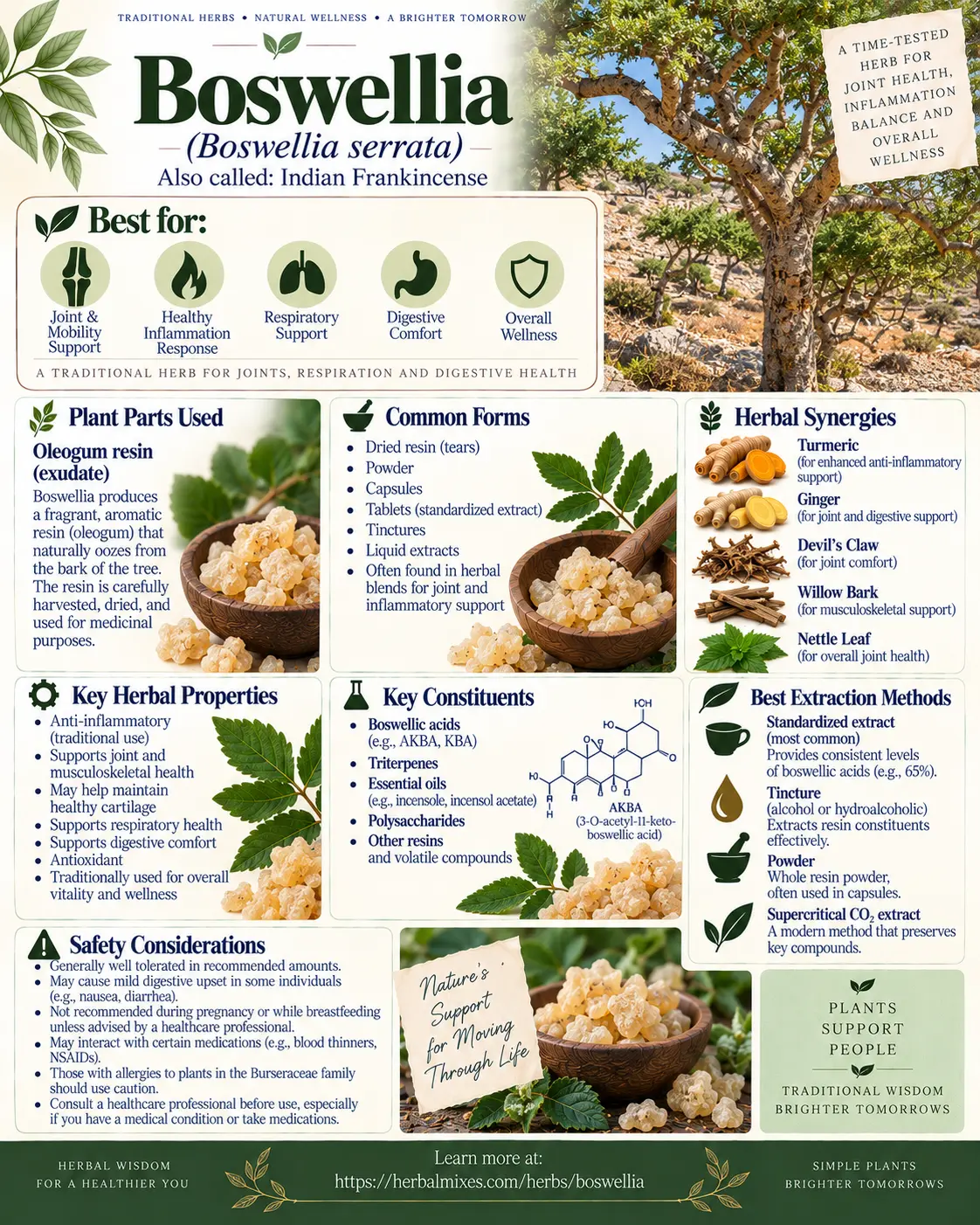
What Boswellia Is Good For
Inflammatory & Joint Comfort — Boswellia is widely renowned for its potent ability to support normal inflammatory balance, helping maintain comfortable joint movement and flexibility.
Cartilage Protection — Active boswellic acids help inhibit enzymes that break down joint cartilage, supporting long-term structural integrity and cushioning.
Respiratory Comfort — Traditionally utilized to support clear upper airways and maintain comfortable breathing, especially during seasonal respiratory challenges.
Gastrointestinal Health — Helps maintain a balanced inflammatory response along the digestive tract lining, supporting overall gut comfort.
Skin Elasticity & Appearance — Applied topically in cosmetic and herbal salves to support skin hydration, elasticity, and youthful radiance.
Available Herbal Products
Standardized Boswellia Extract Capsules – Concentrated capsules. Formulated with a guaranteed concentration of active beta-boswellic acids (such as AKBA) for reliable joint and mobility support. Seller: Gaia Herbs – View Gaia Herbs Boswellia →
Boswellia & Turmeric Complex – Advanced joint support capsules. Combines standardized boswellia resin extract with turmeric root to deliver comprehensive synergistic support for joint flexibility. Seller: Nature’s Way – View Nature’s Way Joint Formulas →
Boswellia Liquid Extract – Hydroalcoholic tincture. A concentrated liquid format that captures the aromatic oleo-resins for fast absorption and convenient daily joint dosing. Seller: Herb Pharm – View Herb Pharm Boswellia Extract →
Organic Frankincense (Boswellia) Resin Tears – Raw oleo-gum resin. An authentic, traditional choice for compounding custom herbal salves, incense, or oil macerations. Seller: Mountain Rose Herbs – View Mountain Rose Herbs Frankincense Resin →
Herbal Synergies
Boswellia pairs especially well with Turmeric Root, Ginger, and Willow Bark, depending on the goal of the formula.
Boswellia Resin + Turmeric Root – Best for: Comprehensive joint mobility, athletic recovery, and systemic inflammatory balance Boswellia supplies active boswellic acids that inhibit 5-lipoxygenase (5-LOX), while turmeric delivers curcuminoids that modulate cyclooxygenase (COX) pathways. Together, they create the ultimate dual-pathway inflammatory support team. Best extraction: Standardized extract capsules. Both resinous gum and dense root combine seamlessly into concentrated capsule supplements designed for joint comfort.
Boswellia Resin + Ginger Root – Best for: Warming circulation, soothing stiff joints, and easing physical discomfort Boswellia targets joint cushioning and cartilage maintenance, whereas ginger offers rapid circulatory stimulation and warming carminative actions that ease acute muscular tightness. Best extraction: Capsules or hydroalcoholic tincture. These formats capture both the resin acids and ginger’s pungent oleoresins efficiently.
Boswellia Resin + White Willow Bark – Best for: Supporting structural comfort, easing back tension, and soothing sore joints Boswellia promotes healthy tissue flexibility, while white willow bark provides natural salicin compounds to support overall structural comfort. Best extraction: Standardized extract or decoction blend. Combines resin extracts with water-soluble bark constituents for robust support.
Key Herbal Properties
Anti-inflammatory (5-LOX Inhibitor) — Selectively inhibits the 5-lipoxygenase enzyme, helping modulate leukotrienes and maintain normal tissue comfort.
Anti-arthritic — Supports joint mobility, flexibility, and the protection of articular cartilage from breakdown.
Vulnerary — Supports the normal recovery and comfort of connective tissues and skin.
Expectorant — Helps clear respiratory mucous membranes and supports easy breathing.
Astringent — Tones and tightens mucosal tissues throughout the body.





Active Compounds
Boswellic Acids (including AKBA — Acetyl-11-keto-beta-boswellic acid) Found mainly in: Oleo-gum resin The primary bioactive triterpene acids responsible for boswellia’s potent anti-inflammatory, 5-LOX-inhibiting, and joint-protecting properties. Best extraction: Standardized extract or high-proof alcohol tincture. Boswellic acids are fat-soluble and dissolve efficiently in alcohol or lipid suspensions rather than plain water.
Volatile Oils (including Monoterpenes and Diterpenes) Found mainly in: Aromatic resin Contribute to boswellia’s pleasant fragrance, respiratory support, and calming topical properties. Best extraction: Steam distillation or alcohol extraction. These aromatic compounds are captured effectively in essential oils and tinctures.
Mucilage and Complex Polysaccharides Found mainly in: Raw gum resin Provide soothing, demulcent properties that support mucosal tissues in the gut and respiratory tract. Best extraction: Warm water extraction or aqueous suspension. Polysaccharides dissolve readily in water.
FAQ
What is boswellia best used for? Boswellia is primarily used to support normal inflammatory balance, promote joint mobility and flexibility, and protect cartilage health.
How does boswellia differ from turmeric? While both support joint comfort, turmeric primarily targets the COX pathway of inflammation, whereas boswellia targets the 5-LOX pathway. Using them together provides comprehensive dual-pathway support.
Can boswellia be taken every day? Yes, boswellia is traditionally taken daily as a continuous supplement to maintain joint comfort, mobility, and structural health over time.
How long does it take for boswellia to work? Because it supports tissue comfort and cartilage maintenance cumulatively, most people notice optimal joint benefits after 2 to 4 weeks of consistent daily supplementation.
Can boswellia resin be chewed like gum? Yes, in traditional Middle Eastern and Indian cultures, raw frankincense resin tears are occasionally chewed to freshen breath, aid digestion, and support oral hygiene.
Safety & Precautions
Gastrointestinal Tolerance: High therapeutic doses may occasionally cause mild stomach upset, nausea, acid reflux, or loose stools in sensitive individuals.
Pregnancy & Breastfeeding: Due to insufficient safety data regarding its physiological activity during pregnancy and nursing, professional medical guidance is strongly recommended.
Medication Interactions: Exercise caution if you take blood-thinning medications (anticoagulants) or non-steroidal anti-inflammatory drugs (NSAIDs), as boswellia may exert additive effects.
Skin Sensitivity: Undiluted topical essential oils derived from boswellia should be patch-tested or diluted in a carrier oil before widespread application.
Consult a qualified healthcare professional before using boswellia therapeutically, especially if you manage underlying medical conditions or take prescription drugs.
References
National Center for Complementary and Integrative Health (NCCIH)
PubMed Central – Boswellia serrata Extract in Joint Health and Osteoarthritis: A Systematic Review
National Library of Medicine – Boswellic Acids and 5-LOX Inhibition Mechanisms
European Medicines Agency (EMA) Herbal Documentation
Gaia Herbs Boswellia Monograph
Mountain Rose Herbs Frankincense Resin Monograph
Disclaimer
Disclaimer: This article is for educational purposes only and is not intended to diagnose, treat, cure, or prevent any disease. Herbal products can cause side effects and interact with medications. Consult a qualified healthcare professional before using herbs therapeutically, especially if you are pregnant, breastfeeding, taking prescription medications, or managing a medical condition.