

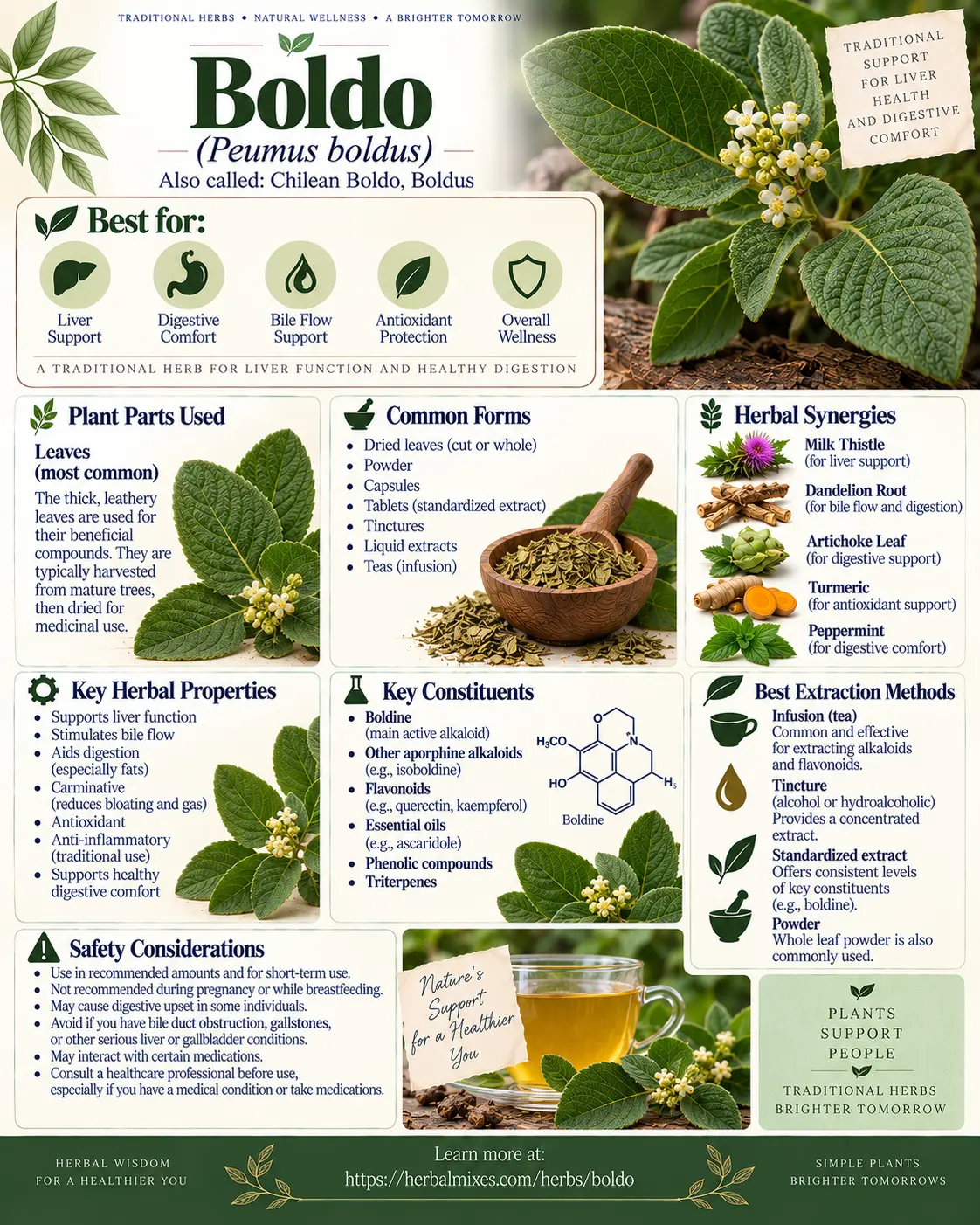
What Boldo Is Good For
Liver & Gallbladder Support — Boldo is a premier South American choleretic and cholagogue traditionally used to stimulate liver function and increase the release of bile.
Digestive Stimulation & Heavy Meals — Its concentrated bitter principles and volatile oils prime the gastrointestinal tract, easing post-meal heaviness, gas, and sluggish digestion.
Gallbladder Tonic — Commonly utilized to support normal biliary motility and maintain comfortable gallbladder function already within healthy parameters.
Mild Parasitic & Microbial Support — Historically valued in traditional herbal protocols to help maintain a balanced microbial environment in the digestive tract.
Gentle Diuretic Action — Encourages normal fluid elimination and renal cleansing.
Available Herbal Products
Organic Boldo Leaf Cut – Dried loose leaves. An authentic, traditional choice for brewing an intensely aromatic and bitter herbal tea to support digestion after heavy meals. Seller: Mountain Rose Herbs – View Mountain Rose Herbs Boldo Leaf →
Boldo Leaf Liquid Extract – Hydroalcoholic tincture. A convenient, fast-absorbing liquid format that allows for precise drop-by-drop dosing of boldo’s active volatile oils and alkaloids. Seller: Herb Pharm – View Herb Pharm Boldo Extract →
South American Bitter Tonic Formula – Professional herbal blend combining boldo leaf with artichoke and dandelion. Designed to provide comprehensive liver and gallbladder support. Seller: Wise Woman Herbals – View Wise Woman Herbals Formulas →
Boldo Leaf Powder – Fine dried leaf powder. A versatile option for compounding custom herbal digestive capsules or bitter tonics under professional guidance. Seller: Starwest Botanicals – View Starwest Botanicals Boldo Leaf →
Herbal Synergies
Boldo pairs especially well with Artichoke Leaf, Milk Thistle Seed, and Peppermint Leaf, depending on the goal of the formula.
Boldo Leaf + Artichoke Leaf – Best for: Comprehensive liver protection, intense bile flow, and heavy meal digestion Boldo provides powerful choleretic action and volatile oils that stimulate gallbladder contraction, while artichoke leaf supplies rich caffeoylquinic acids to optimize liver function and lipid metabolism. Together, they form a premier hepatic support duo. Best extraction: Decoction or hydroalcoholic tincture. Simmering boldo leaves briefly while steeping artichoke extracts their active alkaloids and bitter principles.
Boldo Leaf + Milk Thistle Seed – Best for: Liver cell repair, detoxification, and long-term biliary wellness Boldo stimulates active bile flow and digestive secretions, whereas milk thistle delivers silymarin to protect liver cell membranes and promote tissue regeneration. Best extraction: Capsule blend or tincture combination. Combining these extracts ensures efficient delivery of both leaf alkaloids and seed flavonolignans.
Boldo Leaf + Peppermint Leaf – Best for: Improving flavor palatability and easing post-meal gas Boldo possesses a remarkably strong, camphoraceous, and bitter taste profile; pairing it with cooling peppermint leaf helps balance the flavor while adding carminative antispasmodic comfort. Best extraction: Covered hot infusion (tea). Steeping these leaves together captures both boldo’s active volatile oils and mint’s soothing compounds.
Key Herbal Properties
Choleretic — Stimulates liver cells to actively increase the production and output of fluid bile.
Cholagogue — Promotes the contraction of the gallbladder, releasing stored bile into the small intestine.
Bitter Tonic — Engages bitter taste receptors in the mouth and gut, initiating digestive enzyme and gastric acid secretion.
Antimicrobial — Supports a balanced microbial flora in the digestive tract.
Antispasmodic — Relaxes smooth muscle tissue, easing occasional cramping in the digestive tract.





Active Compounds
Boldine (Aporphine Alkaloid) Found mainly in: Leaves The primary bioactive alkaloid responsible for boldo’s liver-protecting, choleretic, and mild smooth muscle-relaxing properties. Best extraction: Standardized hydroalcoholic extract or alcohol tincture. Boldine dissolves efficiently in alcohol-water solutions.
Volatile Oils (including Ascaridole and Cineole) Found mainly in: Leaves Aromatic compounds that contribute to boldo’s strong camphoraceous scent, carminative action, and antimicrobial support. Best extraction: Hydroalcoholic tincture or steam distillation. These volatile compounds are captured effectively in high-proof alcohol.
Flavonoids and Tannins Found mainly in: Leaves Antioxidant compounds that support cellular protection and provide mild astringency. Best extraction: Warm water infusion or alcohol-water extract. Soluble in hydroalcoholic solvents.
FAQ
What is boldo best used for? Boldo is primarily used as a powerful liver and gallbladder tonic to stimulate bile flow, ease sluggish digestion, and support the breakdown of heavy meals.
How does boldo taste? Boldo tea has an exceptionally strong, pungent, bitter, and camphor-like flavor profile driven by its high concentration of volatile oils and boldine.
Can boldo be used every day long-term? No, due to the presence of active alkaloids and volatile components like ascaridole, boldo is traditionally intended for short-term, intermittent use (typically under 4 weeks) rather than continuous daily consumption.
Can boldo be used if you have gallstones? Individuals with known bile duct obstructions, acute gallbladder inflammation, or active gallstones should consult a healthcare professional before using strong cholagogues like boldo.
Is boldo safe to use during pregnancy? No, internal use of boldo is strictly contraindicated during pregnancy and breastfeeding due to its strong uterine-stimulating and neurotoxic volatile oil risks in high doses.
Safety & Precautions
Pregnancy & Breastfeeding: Strictly contraindicated during pregnancy and lactation due to potential uterine stimulation and high concentrations of active volatile oils (such as ascaridole).
Duration of Use: Avoid continuous long-term internal use; boldo is designed for short-term, intermittent herbal digestive support (typically restricted to periods under 4 weeks).
Gallstones & Biliary Obstruction: Avoid use in cases of complete bile duct obstruction. Consult a healthcare professional before use if you have gallstones or active gallbladder disease.
Liver or Kidney Disease: Individuals with severe liver or kidney impairment should avoid high-dose boldo use unless directly supervised by a qualified physician.
Consult a qualified healthcare professional before using boldo therapeutically, especially if you manage underlying medical conditions or take prescription drugs.
References
National Center for Complementary and Integrative Health (NCCIH)
PubMed Central – Peumus boldus (Boldo) Leaf Extract and Boldine Pharmacology
European Medicines Agency (EMA) Monograph on Peumus boldus M., folium
World Health Organization (WHO) Monographs on Selected Medicinal Plants
Mountain Rose Herbs Boldo Leaf Monograph
Disclaimer
Disclaimer: This article is for educational purposes only and is not intended to diagnose, treat, cure, or prevent any disease. Herbal products can cause side effects and interact with medications. Consult a qualified healthcare professional before using herbs therapeutically, especially if you are pregnant, breastfeeding, taking prescription medications, or managing a medical condition.